
[Paper Review] Observation of four top quark production in proton-proton collisions at $\sqrt{s}$ = 13 TeV
This paper reports the first observation of four top quark production in proton-proton collisions at $\sqrt{s} = 13$ TeV using 138 fb$^{-1}$ of integrated luminosity from the CMS experiment at the LHC. By employing advanced lepton and b-jet identification, along with a refined multivariate analysis using machine learning, the analysis achieves a significance of 5.6 standard deviations, measuring a cross section of $17.7^{+3.7}_{-3.5}\text{ stat}^{+2.3}_{-1.9}\text{ syst}$ fb, consistent with the Standard Model prediction.
The observation of the production of four top quarks in proton-proton collisions is reported, based on a data sample collected by the CMS experiment at a center-of-mass energy of 13 TeV in 2016-2018 at the CERN LHC and corresponding to an integrated luminosity of 138 fb$^{-1}$. Events with two same-sign, three, or four charged leptons (electrons and muons) and additional jets are analyzed. Compared to previous results in these channels, updated identification techniques for charged leptons and jets originating from the hadronization of b quarks, as well as a revised multivariate analysis strategy to distinguish the signal process from the main backgrounds, lead to an improved expected signal significance of 4.9 standard deviations above the background-only hypothesis. Four top quark production is observed with a significance of 5.6 standard deviations, and its cross section is measured to be 17.7 $^{+3.7}_{-3.5}$ (stat) $^{+2.3}_{-1.9}$ (syst) fb, in agreement with the available standard model predictions.
Motivation & Objective
- To observe the rare four top quark production process ($\ttbar\ttbar$) in proton-proton collisions at $\sqrt{s} = 13$ TeV.
- To improve sensitivity to $\ttbar\ttbar$ production by enhancing lepton and b-jet identification techniques.
- To reduce background contributions and improve signal discrimination using a revised multivariate analysis strategy based on machine learning.
- To measure the $\ttbar\ttbar$ production cross section with high precision, testing Standard Model predictions and probing new physics.
- To provide a complementary measurement of the top quark Yukawa coupling and constraints on physics beyond the Standard Model.
Proposed method
- The analysis uses 138 fb$^{-1}$ of proton-proton collision data collected by the CMS experiment at $\sqrt{s} = 13$ TeV between 2016 and 2018.
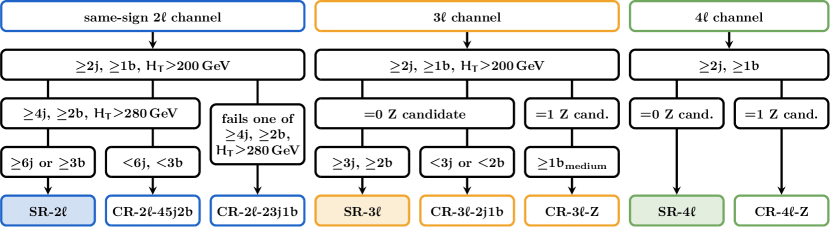
- Events are selected with two same-sign, three, or four charged leptons (electrons and muons) and additional jets to enhance signal sensitivity.
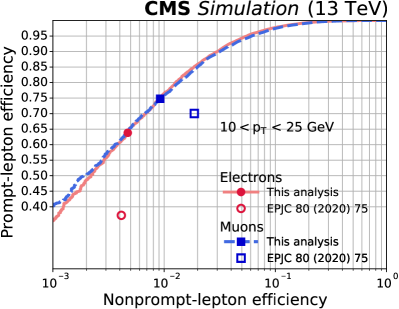
- Updated identification algorithms for charged leptons and b-jets are applied to improve signal efficiency and reduce misidentification.
- A multivariate analysis strategy based on machine learning techniques is implemented to distinguish the $\ttbar\ttbar$ signal from dominant backgrounds such as $\ttbar\PW$ and $\ttbar\PZ$.
- The signal cross section is extracted via a profile likelihood fit to kinematic distributions optimized for signal-to-background discrimination.
- Backgrounds are modeled with free normalization parameters in the fit, allowing for data-driven estimation of $\ttbar\PW$ and $\ttbar\PZ$ contributions.
Experimental results
Research questions
- RQ1What is the statistical significance of observing four top quark production in $\Pp\Pp$ collisions at $\sqrt{s} = 13$ TeV?
- RQ2How do improved lepton and b-jet identification techniques affect the sensitivity to the $\ttbar\ttbar$ signal?
- RQ3To what extent does a revised multivariate analysis strategy enhance signal-background separation?
- RQ4What is the measured $\ttbar\ttbar$ production cross section, and how does it compare to Standard Model predictions?
- RQ5Can this measurement provide constraints on new physics scenarios, such as extended Higgs sectors or supersymmetry?
Key findings
- The $\ttbar\ttbar$ production process is observed with a significance of 5.6 standard deviations, exceeding the 5σ threshold for observation.
- The measured cross section is $17.7^{+3.7}_{-3.5}\text{ stat}^{+2.3}_{-1.9}\text{ syst}$ fb, consistent with the Standard Model prediction of $13.4^{+1.0}_{-1.8}$ fb.
- The improved analysis strategy, including advanced lepton and b-jet identification, increases the expected signal significance to 4.9 standard deviations, enabling the observation.
- The signal-to-background discrimination is significantly enhanced through the use of machine learning-based multivariate techniques in the analysis.
- The result provides a precise measurement of the top quark Yukawa coupling and serves as a sensitive probe for new physics beyond the Standard Model.
- The observation is in agreement with the Standard Model and supports the consistency of current theoretical predictions at next-to-leading order in QCD and electroweak theory.
Better researchstarts right now
From reading papers to final review, dramatically reduce your research time.
No credit card · Free plan available
This review was created by AI and reviewed by human editors.