
[Paper Review] Observing neutrinos from failed Supernovae at LNGS
This paper proposes using the water veto regions of dark matter and neutrinoless double beta decay experiments at Laboratori Nazionali del Gran Sasso (LNGS) as a free, distributed network of small Water Cherenkov detectors to observe neutrinos from failed core-collapse supernovae. It demonstrates that this network can measure the time of black hole formation with a precision of ~4 ms, providing a critical real-time trigger for gravitational wave detectors like VIRGO and the Einstein Telescope, even in the absence of electromagnetic signals.
We discuss the possibility to observe neutrinos emitted from a failed core collapse Supernova in the various experiments at Laboratori Nazionali del Gran Sasso. We show that the veto regions of dark matter and neutrinoless double beta decay experiments can be used as a network of small detectors to measure Supernova neutrinos. In addition we show that this network can measure very precisely the moment of black hole formation, which can be then used in the nearby VIRGO detector and future Einstein Telescope to look for the gravitational wave counterpart to the neutrino signal.
Motivation & Objective
- To explore the feasibility of repurposing existing veto regions in neutrino and dark matter experiments at LNGS as a network for detecting supernova neutrinos.
- To determine whether this network can provide precise timing of black hole formation in failed supernovae, a key event for gravitational wave detection.
- To assess the potential of this approach as a model-independent, real-time trigger for gravitational wave observatories like VIRGO and the Einstein Telescope.
- To project the sensitivity of current and future LNGS detectors for detecting neutrino signals from failed supernovae up to the Magellanic Clouds.
Proposed method
- Utilizing the water veto regions of three LNGS experiments—COSINUS, LEGEND-200, and XENONnT—as a network of small Water Cherenkov detectors for neutrino detection.
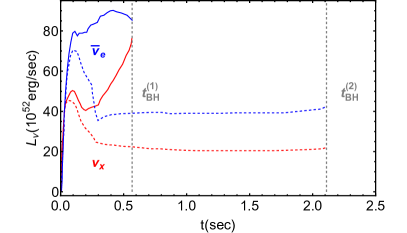
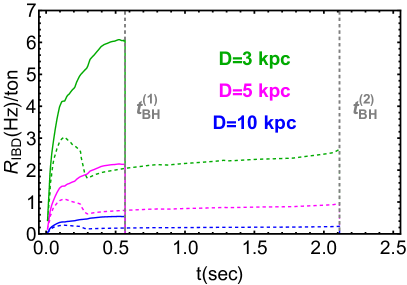
- Modeling neutrino emission from failed supernovae using two distinct theoretical models (Model 1 and Model 2) with different black hole formation times (0.568 s and 2.113 s post-bounce).
- Calculating event rates using the neutrino flux formula: $ \frac{d\Phi_{\alpha}^{0}}{dE_{\nu_{\alpha}}dt} = \frac{1}{4\pi d^{2}} \frac{L_{\nu_{\alpha}}(t)}{\langle E_{\nu_{\alpha}}(t)\rangle} \phi_{\alpha}(E_{\nu_{\alpha}},t) $, with a normalized energy spectrum parameterized by $ \phi_{\alpha}(E_{\nu_{\alpha}},t) = \langle E_{\nu_{\alpha}}(t)\rangle \frac{1+\xi_{\alpha}}{\Gamma(1+\xi_{\alpha})} \left( \frac{E_{\nu_{\alpha}}}{\langle E_{\nu_{\alpha}}(t)\rangle} \right)^{\xi_{\alpha}} e^{-\frac{E_{\nu_{\alpha}}}{\langle E_{\nu_{\alpha}}(t)\rangle}} $.
- Estimating the time uncertainty of black hole formation detection via the temporal resolution of the detector network and the neutrino flight time to gravitational wave detectors.
- Assessing the temporal uncertainty $ \delta T^{\text{GW}}_{\text{BH}} = \delta T^{\text{LNGS}}_{\text{BH}} + \delta t_{\text{fly}} $, where $ \delta t_{\text{fly}} \leq 1 $ ms due to the short distance between LNGS and VIRGO.
- Projecting future sensitivity using upcoming detectors at LNGS, assuming improved statistics and reduced timing uncertainty.
Experimental results
Research questions
- RQ1Can the water veto regions of existing LNGS experiments be effectively used as a network of small neutrino detectors for failed supernova signals?
- RQ2What is the achievable timing precision for detecting black hole formation in a failed supernova using this detector network?
- RQ3How does the temporal uncertainty from LNGS compare to that of large-scale detectors like Super-Kamiokande in triggering gravitational wave searches?
- RQ4Can this method provide a real-time, model-independent trigger for gravitational wave detectors without prior knowledge of the source direction?
- RQ5What is the potential for improving sensitivity by including additional detection channels beyond inverse beta decay in the veto regions?
Key findings
- The LNGS water veto network can detect neutrinos from failed supernovae up to the Magellanic Clouds, with a sensitivity limited only by the IBD detection channel and veto region size.
- The network can determine the time of black hole formation with a temporal uncertainty of 4 ms for the slowest BH formation model (Model 2), due to a 3 ms uncertainty in the detector network and ≤1 ms flight time.
- This timing precision is significantly better than that of Super-Kamiokande, which would yield a total uncertainty of 28.3 ms due to longer flight time to VIRGO, even with a smaller intrinsic timing uncertainty.
- The method provides a real-time, model-independent trigger for gravitational wave detectors, crucial in the absence of electromagnetic counterparts.
- The analysis is conservative, as it considers only IBD and veto regions; sensitivity could improve by including inner detector regions and other detection channels like elastic scattering or liquid scintillator.
- The approach is timely, as COSINUS and LEGEND-200 are still finalizing their veto region configurations, allowing for immediate implementation of this detection strategy.
Better researchstarts right now
From reading papers to final review, dramatically reduce your research time.
No credit card · Free plan available
This review was created by AI and reviewed by human editors.