
[Paper Review] On the correlation between dark matter, intracluster light and globular cluster distribution in SMACS0723
This study presents a free-form gravitational lensing model of SMACS0723 using JWST data to investigate correlations between dark matter, intracluster light (ICL), and globular cluster distributions. It finds that while ICL and globular clusters have similar, steep radial profiles, the total mass (dominated by dark matter) is significantly shallower, differing by 1 dex in log scale, consistent with cold dark matter simulations and indicating a decoupling between visible and dark matter components beyond the BCG's influence.
We present a free-form model of SMACS0723, the first cluster observed with JWST. This model makes no strong assumptions about the distribution of mass (mostly dark matter) in the cluster and we use it to study the possible correlation between dark matter with the intracluster light and distribution of globular clusters. To explore the uncertainty in mass modelling, we derive three lens models based on spectroscopically confirmed systems and new candidate systems with redshifts predicted by the lens model derived from the spectroscopic systems. We find that beyond the radius of influence of the BCG, the total mass does not trace the ICL, implying the need for a dark component (dark matter). Two loop-like structures observed in the intracluster light do not have an obvious correspondence with the total mass (mostly dark matter) distribution. The radial profiles of the ICL and the distribution of globular clusters are similar to each other, but steeper than the profile of the lens model. More specifically, we find that the total mass is shallower by 1 dex in log scale than both ICL and globular cluster profiles. This is in excellent agreement with N-body simulations of cold dark matter.
Motivation & Objective
- To investigate the spatial correlation between dark matter, intracluster light (ICL), and globular cluster distributions in SMACS0723 using JWST data.
- To test whether the observed ICL structures, such as loop-like features and cavities, align with the total mass distribution (mostly dark matter).
- To assess the consistency of observed radial profiles of ICL and globular clusters with predictions from cold dark matter (CDM) simulations.
- To explore the implications of profile discrepancies for the origin of ICL and globular clusters, particularly whether they originate from stripped galactic cores.
- To improve lens modeling resolution by incorporating spectroscopic redshifts and new lensed galaxy candidates from JWST data.
Proposed method
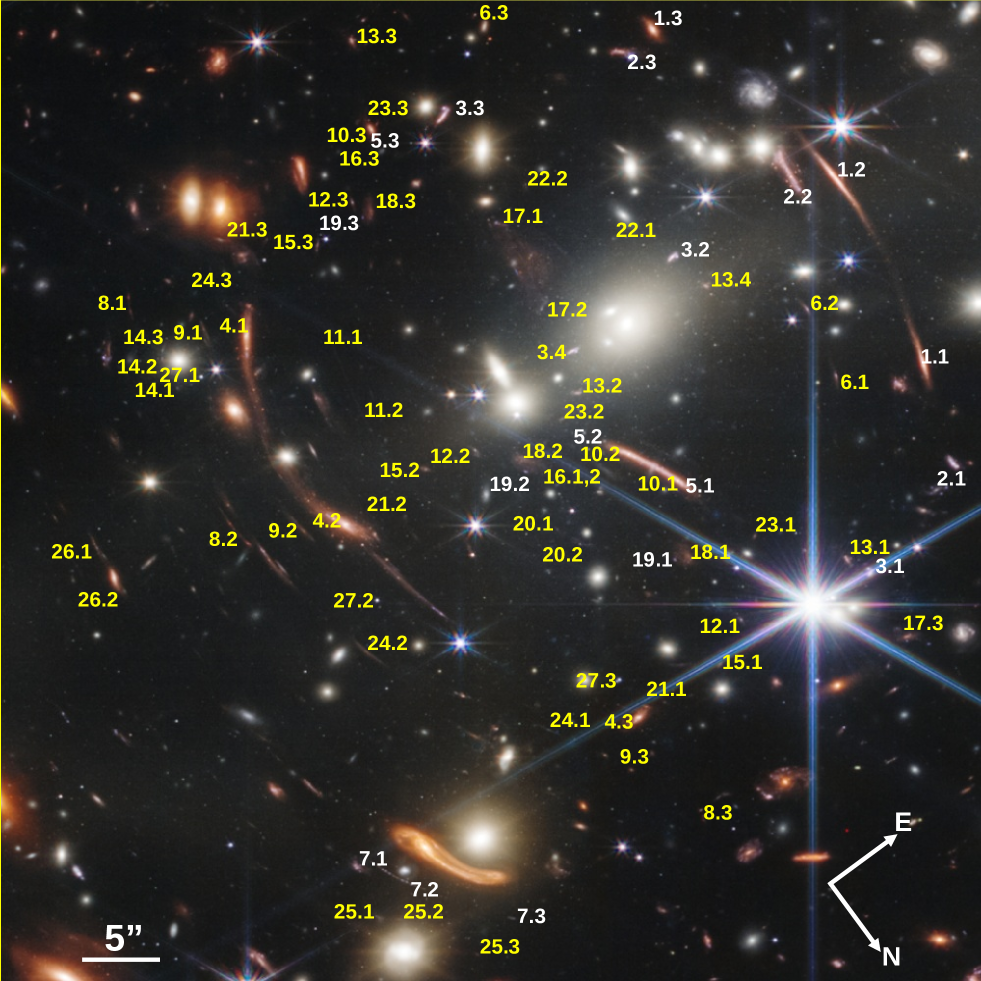
- A free-form lens model is constructed for SMACS0723 without strong assumptions about mass distribution, using multiple lensing constraints from JWST and HST data.
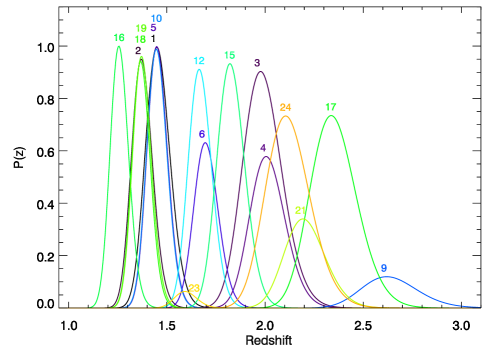
- Three distinct lens models are derived: one from spectroscopically confirmed systems and two from predicted redshifts of new candidate systems.
- Radial mass, ICL, and globular cluster number density profiles are extracted and compared across the three models to assess robustness.
- Profiles are fitted with power laws to quantify slope differences: e.g., R⁻¹.³ for ICL and globular clusters, R⁻⁰.³ for total mass.
- The model incorporates constraints from 4–5 lensed galaxies in the west cavity region, though data density remains low in this area.
- Simulations and theoretical comparisons are used to interpret profile differences in the context of tidal stripping and CDM halo formation.
Experimental results
Research questions
- RQ1Does the total mass distribution (dominated by dark matter) trace the intracluster light (ICL) beyond the central BCG?
- RQ2Are the loop-like ICL structures and associated cavities spatially correlated with the total mass distribution?
- RQ3How do the radial profiles of ICL and globular clusters compare to the total mass profile in SMACS0723?
- RQ4Is the observed profile steepness of ICL and globular clusters consistent with predictions from cold dark matter (CDM) simulations?
- RQ5Can the ICL and globular cluster distributions be explained by the tidal stripping of satellite galaxies, with globular clusters representing surviving galactic cores?
Key findings
- Beyond the BCG's radius of influence, the total mass profile is significantly shallower than both the ICL and globular cluster profiles, with a difference of 1 dex in log scale.
- The ICL and globular cluster radial profiles are similar in shape and steeper than the total mass profile, scaling approximately as R⁻¹.³, while the mass profile scales as R⁻⁰.³.
- The loop-like ICL structures and associated cavities do not have a clear correspondence with the total mass (dark matter) distribution, suggesting different formation mechanisms.
- The observed profile discrepancy is in excellent agreement with N-body simulations of cold dark matter, supporting the CDM paradigm.
- The similarity between ICL and globular cluster profiles suggests a possible physical link, possibly indicating that ICL is composed of the outer envelopes of stripped galactic cores, with globular clusters being the surviving cores.
- The low number of lensing constraints in the west cavity region (≈4 galaxies) limits resolution and highlights the need for future data with more spectroscopic redshifts to refine mass modeling.
Better researchstarts right now
From reading papers to final review, dramatically reduce your research time.
No credit card · Free plan available
This review was created by AI and reviewed by human editors.