
[Paper Review] On the design space between molecular mechanics and machine learning force fields
This paper explores the design space between molecular mechanics (MM) and machine learning force fields (MLFFs), arguing that current MLFFs are accurate but too slow for widespread use. It proposes a next-generation MLFF architecture combining simple, differentiable operations with E(3)-equivariant inductive biases to achieve high speed and accuracy, enabling efficient, physically meaningful simulations of biomolecular systems.
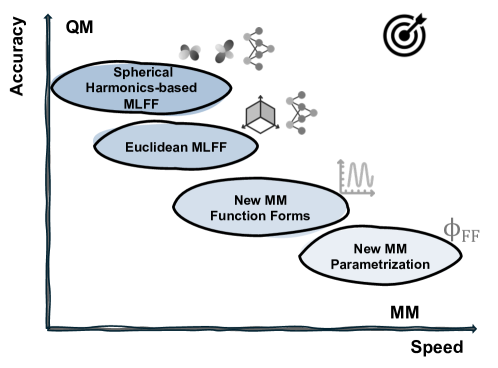
A force field as accurate as quantum mechanics (QM) and as fast as molecular mechanics (MM), with which one can simulate a biomolecular system efficiently enough and meaningfully enough to get quantitative insights, is among the most ardent dreams of biophysicists -- a dream, nevertheless, not to be fulfilled any time soon. Machine learning force fields (MLFFs) represent a meaningful endeavor towards this direction, where differentiable neural functions are parametrized to fit ab initio energies, and furthermore forces through automatic differentiation. We argue that, as of now, the utility of the MLFF models is no longer bottlenecked by accuracy but primarily by their speed (as well as stability and generalizability), as many recent variants, on limited chemical spaces, have long surpassed the chemical accuracy of $1$ kcal/mol -- the empirical threshold beyond which realistic chemical predictions are possible -- though still magnitudes slower than MM. Hoping to kindle explorations and designs of faster, albeit perhaps slightly less accurate MLFFs, in this review, we focus our attention on the design space (the speed-accuracy tradeoff) between MM and ML force fields. After a brief review of the building blocks of force fields of either kind, we discuss the desired properties and challenges now faced by the force field development community, survey the efforts to make MM force fields more accurate and ML force fields faster, envision what the next generation of MLFF might look like.
Motivation & Objective
- To address the current bottleneck in ML force field adoption—computational speed—despite their high accuracy.
- To bridge the gap between traditional molecular mechanics (MM) and modern machine learning force fields (MLFFs) by exploring the design space between them.
- To identify key challenges in MLFF development, including speed, stability, generalizability, and data efficiency.
- To envision a new generation of MLFFs that are both fast and accurate, capable of simulating complex biomolecular systems with quantitative predictive power.
- To advocate for community-wide efforts in creating high-quality, diverse datasets to enable broad chemical space coverage in MLFF training.
Proposed method
- Surveying existing MM and MLFF architectures to identify functional forms and design principles that balance accuracy and efficiency.
- Proposing a new MLFF architecture based on simple, differentiable operations (e.g., dot products) that can universally approximate E(3)-invariant functions.
- Incorporating physical inductive biases—such as rotational and translational invariance—into the neural architecture to ensure smoothness and stability.
- Leveraging automatic differentiation for force computation and implementing models within general tensor-accelerating frameworks (e.g., PyTorch, JAX).
- Emphasizing the use of scalable, physics-informed training strategies, including curriculum learning and adaptive batching, to improve data efficiency.
- Advocating for foundation models trained on large-scale, high-quality datasets to enable few-shot or zero-shot generalization across chemical space.
Experimental results
Research questions
- RQ1What are the key design tradeoffs between speed and accuracy in modern force fields, and how can they be optimized?
- RQ2How can machine learning force fields be made significantly faster while retaining chemical accuracy below 1 kcal/mol?
- RQ3What architectural and inductive bias choices enable universal approximation of E(3)-invariant energy functions with minimal computational cost?
- RQ4Can community-driven, high-quality datasets enable generalization of MLFFs across diverse chemical spaces without extensive retraining?
- RQ5To what extent can direct generative modeling of Boltzmann distributions eliminate the need for explicit force fields in molecular simulation?
Key findings
- Current MLFFs have surpassed the 1 kcal/mol chemical accuracy threshold on limited chemical spaces but remain orders of magnitude slower than molecular mechanics force fields.
- The primary bottleneck in MLFF adoption is computational speed, not accuracy, especially for large-scale biomolecular simulations.
- A next-generation MLFF architecture based on simple, differentiable operations (e.g., dot products) can achieve universal approximation of E(3)-invariant functions while maintaining high speed.
- Incorporating E(3)-equivariant inductive biases into the model architecture ensures physical consistency, smoothness, and stability without sacrificing expressivity.
- Community-wide efforts to generate high-quality, diverse datasets are essential for enabling few-shot or zero-shot generalization across broad chemical spaces.
- Emerging generative models, such as Boltzmann generators and diffusion models, may eventually render explicit force fields obsolete by directly sampling from the Boltzmann distribution in a single step.
Better researchstarts right now
From reading papers to final review, dramatically reduce your research time.
No credit card · Free plan available
This review was created by AI and reviewed by human editors.