
[Paper Review] On The Effects of The Variations In Network Characteristics In Cyber Physical Systems
This paper proposes a Gazebo plugin, OurPlugin 2017, to simulate network-induced control latency in cyber-physical systems (CPS), enabling realistic evaluation of Quality of Control (QoC) metrics in remote robotic control. The plugin introduces configurable delays in control and status messages, demonstrating that increased latency degrades trajectory tracking accuracy and causes instability around 10 ms, validating its utility for CPS research.
The popular robotic simulator, Gazebo, lacks the feature of simulating the effects of control latency that would make it a fully-fledged cyber-physical system (CPS) simulator. The CPS that we address to measure is a robotic arm (UR5) controlled remotely with velocity commands. The main goal is to measure Quality of Control (QoC) related KPIs during various network conditions in a simulated environment. We propose a Gazebo plugin to make the above measurement feasible by making Gazebo capable to delay internal control and status messages and also to interface with external network simulators to derive even more advanced network effects. Our preliminary evaluation shows that there is certainly an effect on the behavior of the robotic arm with the introduced network latency in line with our expectations, but a more detailed further study is needed.
Motivation & Objective
- Address the lack of network latency simulation in Gazebo, a widely used robotic simulator, to enable realistic CPS evaluation.
- Enable measurement of Quality of Control (QoC) KPIs—such as PID error and trajectory deviation—under varying network conditions.
- Extend Gazebo’s capabilities to interface with external network simulators for advanced network effect modeling.
- Provide a modular, reusable plugin for the research community to study network impact on robotic control in CPS.
- Lay the foundation for future integration with radio network simulators and protocol-level network behavior analysis.
Proposed method
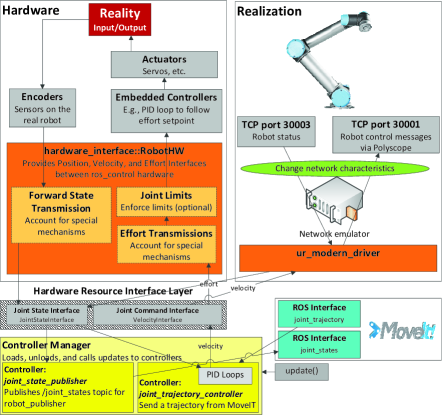
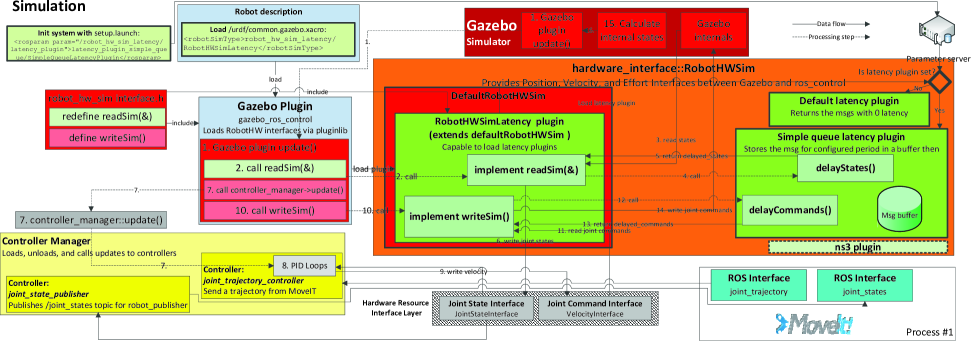
- Develop a Gazebo plugin that injects configurable delays into internal control and status message flows between the controller and robot actuator.
- Integrate the plugin with ROS and Gazebo to simulate remote control of a UR5 robotic arm using velocity commands.
- Use MoveIt for trajectory planning and ur_modern_driver to interface with the robot’s TCP/IP ports (50001 for commands, 50003 for status).
- Implement bidirectional latency injection—on both command transmission and status feedback—to reflect real-world network asymmetry.
- Visualize trajectories and control signals using rviz and ROS tools to compare planned vs. executed motion under different latency conditions.
- Measure QoC via cumulated deviation of velocity commands and trajectory tracking errors across multiple latency levels (2ms, 5ms, 7ms, 10ms).
Experimental results
Research questions
- RQ1How does introduced network latency affect the trajectory tracking accuracy of a remotely controlled UR5 robotic arm in simulation?
- RQ2What is the impact of varying latency levels (2ms to 10ms) on the stability and performance of velocity-based control loops in a CPS?
- RQ3To what extent does the simulation behavior of the plugin align with expected physical dynamics and control theory under non-ideal network conditions?
- RQ4How do non-deterministic planning and simulation initialization affect the reproducibility and comparability of QoC metrics across latency scenarios?
- RQ5Can the plugin be effectively extended to interface with external radio network simulators to model real-world wireless channel effects?
Key findings
- Increasing network latency from 0ms to 10ms causes a measurable and increasing deviation between planned and executed trajectories, with the 10ms scenario showing a deviation magnitude that exceeds the scale of the diagram after one second.
- The 2ms latency scenario produced the closest match to the reference (0ms) scenario in terms of velocity command deviation, confirming the expected monotonic degradation with latency.
- At around 10ms latency, the system exhibited signs of instability, likely due to timing mismatches with Gazebo’s internal simulation clock and message update frequencies.
- The 5ms latency scenario initially outperformed the 7ms scenario in the first 3 seconds, but by 6 seconds, accumulated error caused the 5ms case to diverge more than the 7ms case, indicating non-linear error accumulation.
- Visual inspection in rviz confirmed that straight-line Cartesian trajectories resulted in complex joint-space movements, and latency-induced deviations were clearly visible in colored trajectory overlays.
- The non-deterministic nature of trajectory planning and simulation execution introduced variability, making direct comparison across runs challenging without careful synchronization and control of initialization parameters.
Better researchstarts right now
From reading papers to final review, dramatically reduce your research time.
No credit card · Free plan available
This review was created by AI and reviewed by human editors.