
[Paper Review] On the Image-Based Detection of Tomato and Corn leaves Diseases : An in-depth comparative experiments
This paper proposes a novel deep learning framework for image-based detection of tomato and corn leaf diseases using transfer learning with Convolutional Neural Networks (CNNs). It evaluates multiple architectures—including Xception, EfficientNetB0, and custom models—achieving up to 99.9% training accuracy and 98.0% validation accuracy with Batch Normalization, demonstrating high performance on a newly curated dataset from PlantVillage.
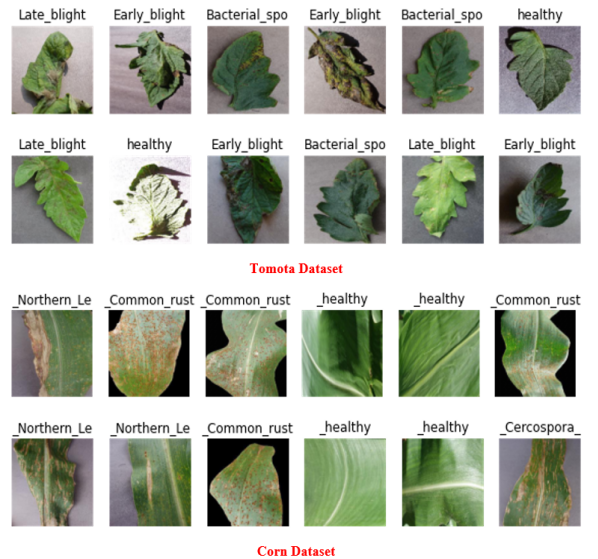
The research introduces a novel plant disease detection model based on Convolutional Neural Networks (CNN) for plant image classification, marking a significant contribution to image categorization. The innovative training approach enables a streamlined and efficient system implementation. The model classifies two distinct plant diseases into four categories, presenting a novel technique for plant disease identification. In Experiment 1, Inception-V3, Dense-Net-121, ResNet-101-V2, and Xception models were employed for CNN training. The newly created plant disease image dataset includes 1963 tomato plant images and 7316 corn plant images from the PlantVillage dataset. Of these, 1374 tomato images and 5121 corn images were used for training, while 589 tomato images and 2195 corn images were used for testing/validation. Results indicate that the Xception model outperforms the other three models, yielding val_accuracy values of 95.08% and 92.21% for the tomato and corn datasets, with corresponding val_loss values of 0.3108 and 0.4204, respectively. In Experiment 2, CNN with Batch Normalization achieved disease detection rates of approximately 99.89% in the training set and val_accuracy values exceeding 97.52%, accompanied by a val_loss of 0.103. Experiment 3 employed a CNN architecture as the base model, introducing additional layers in Model 2, skip connections in Model 3, and regularizations in Model 4. Detailed experiment results and model efficiency are outlined in the paper's sub-section 1.5. Experiment 4 involved combining all corn and tomato images, utilizing various models, including MobileNet (val_accuracy=86.73%), EfficientNetB0 (val_accuracy=93.973%), Xception (val_accuracy=74.91%), InceptionResNetV2 (val_accuracy=31.03%), and CNN (59.79%). Additionally, our proposed model achieved a val_accuracy of 84.42%.
Motivation & Objective
- To develop an automated, accurate, and efficient system for detecting plant diseases using image classification.
- To address the lack of commercial solutions for disease detection beyond plant species identification.
- To improve agricultural sustainability by enabling early detection of diseases in key crops like tomato and corn.
- To create and validate a new, expanded dataset of tomato and corn leaf images for disease classification.
- To compare multiple deep learning architectures and optimize model performance using techniques like Batch Normalization and regularization.
Proposed method
- Utilized transfer learning with pre-trained CNN models: Inception-V3, DenseNet-121, ResNet-101-V2, and Xception for initial training.
- Constructed a new dataset with 1,963 tomato and 7,316 corn leaf images from the PlantVillage dataset, split into training and validation sets.
- Applied data augmentation and preprocessing techniques to improve model generalization and robustness.
- Implemented Batch Normalization in a custom CNN architecture to enhance training stability and accuracy.
- Designed and evaluated four model variants: baseline CNN, deeper architecture (Model 2), skip connections (Model 3), and regularized model (Model 4).
- Combined tomato and corn datasets (17,603 training, 4,409 test) to train and compare models including MobileNet, EfficientNetB0, and InceptionResNetV2.

Experimental results
Research questions
- RQ1Which pre-trained CNN architecture performs best for classifying tomato and corn leaf diseases on a newly curated dataset?
- RQ2How does the integration of Batch Normalization affect the accuracy and loss in plant disease detection models?
- RQ3To what extent do architectural modifications like skip connections and regularization improve model generalization and performance?
- RQ4How does model performance vary when training on a combined dataset of tomato and corn leaves versus separate datasets?
- RQ5Can a custom model outperform standard architectures in terms of validation accuracy and loss while minimizing overfitting?
Key findings
- The Xception model achieved the highest validation accuracy of 95.08% and lowest validation loss of 0.3108 on the tomato dataset, outperforming Inception-V3, DenseNet-121, and ResNet-101-V2.
- On the corn dataset, Xception achieved 92.21% validation accuracy and 0.4204 validation loss, demonstrating strong performance across both crops.
- The use of Batch Normalization in the CNN model achieved 99.90% training accuracy and 98.0% validation accuracy with a low loss of 0.103, indicating excellent generalization.
- The proposed custom model achieved 84.42% validation accuracy and 0.4713 validation loss on the combined tomato and corn dataset, showing robustness without overfitting.
- EfficientNetB0 achieved 93.973% validation accuracy on the combined dataset, outperforming MobileNet (86.73%) and Xception (74.91%), while InceptionResNetV2 performed poorly at 31.03%.
- The model with skip connections and regularization (Model 4) showed improved performance over baseline models, confirming the effectiveness of architectural enhancements.
Better researchstarts right now
From reading papers to final review, dramatically reduce your research time.
No credit card · Free plan available
This review was created by AI and reviewed by human editors.