
[Paper Review] On the interpretation of $Λ$ spin polarization measurements
This paper proposes a corrected method for interpreting $Λ$ hyperon spin polarization measurements in relativistic heavy-ion collisions by properly accounting for Lorentz boosts between the center-of-mass frame and the $Λ$ rest frame. It shows that projecting polarization along the direction of total angular momentum—transformed to the $Λ$ rest frame before averaging—yields a 10% correction for high-transverse-momentum $Λ$'s, improving accuracy for relativistic hyperons.
The physics interpretation of the recent measurements of the spin polarization of $Λ$ hyperons produced in relativistic heavy-ion collisions is discussed. We suggest that the polarization measured in the $Λ$ rest frame should be projected along the direction of the total angular momentum that is first transformed to the same frame, and only then averaged over $Λ$'s with different momenta in the center-of-mass frame. While this procedure does not affect the current measurements done in a broad transverse-momentum range, it may become important (represent a correction of about 10\%) for the most energetic hyperons under study (with transverse momenta reaching 4-5 GeV/c). The proposed treatment is generally more appropriate for relativistic $Λ$'s. Throughout the paper, we deliver explicit expressions for various boosts, rotations, and transformations of angular distributions, which may help to compare model predictions with the experimental results.
Motivation & Objective
- To address inconsistencies in the interpretation of $Λ$ spin polarization measurements due to improper frame transformations.
- To resolve the mismatch between the $Λ$ rest frame and center-of-mass (COM) frame directions, especially for relativistic $Λ$'s.
- To provide a frame-invariant method for relating $Λ$ spin polarization to the system's total angular momentum.
- To deliver explicit transformation formulas for angular distributions and polarization vectors across frames, enabling better model-experiment comparison.
Proposed method
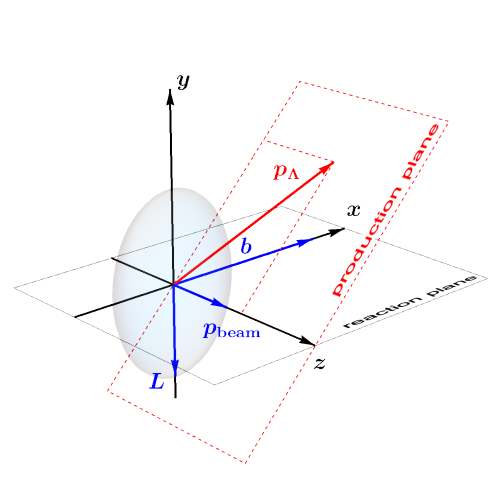
- Applies Lorentz transformations to map the total angular momentum vector from the COM frame to the $Λ$ rest frame before polarization projection.
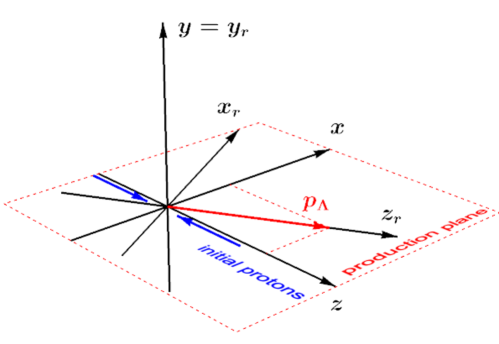
- Uses explicit boost and rotation transformations to relate spatial directions in the COM frame to those in the $Λ$ rest frame.
- Derives frame-invariant polarization components via four-vector formalism, ensuring consistency across reference frames.
- Constructs the projected momentum distribution of decay protons along an arbitrary direction in the $Λ$ rest frame using angular distribution integrals with Dirac delta functions.
- Derives the Jacobian correction for the delta function in angular integrals to handle non-trivial directional mappings.
- Validates the transformation by numerically confirming consistency with the inverse of the weak decay angular distribution.
Experimental results
Research questions
- RQ1How does the direction of the total angular momentum in the COM frame relate to the direction in the $Λ$ rest frame after Lorentz transformation?
- RQ2What is the impact of neglecting frame-dependent direction transformations on the measured $Λ$ spin polarization?
- RQ3How can polarization be consistently projected along the total angular momentum direction when the $Λ$ is relativistic?
- RQ4What corrections arise from proper frame transformation for high-transverse-momentum $Λ$'s?
- RQ5Can a frame-invariant formalism be constructed to relate experimental polarization measurements to global angular momentum in heavy-ion collisions?
Key findings
- The standard interpretation of $Λ$ spin polarization neglects the non-trivial boost-induced rotation between the COM frame and the $Λ$ rest frame.
- Projecting polarization along the total angular momentum direction after transforming it to the $Λ$ rest frame yields a more accurate and physically consistent result.
- For $Λ$'s with transverse momenta of 4–5 GeV/c, the correction to polarization magnitude is approximately 10%, making it significant for high-$p_T$ measurements.
- The proposed method ensures frame-invariance of polarization direction by using a four-vector formalism for the direction vector.
- Explicit analytical expressions are derived for the transformation of angular distributions and polarization components across frames, enabling direct comparison with model predictions.
- Numerical checks confirm the consistency of the derived transformation with the inverse of the weak decay angular distribution.
Better researchstarts right now
From reading papers to final review, dramatically reduce your research time.
No credit card · Free plan available
This review was created by AI and reviewed by human editors.