
[Paper Review] On the measurement of the dispersion relation by a radar and the implication on the current retrieval
This study uses simulated X-band radar images to quantify errors in retrieving ocean shear current profiles from radar-measured dispersion relations. It finds that a 45 m high vertical-polarization radar minimizes error (RMS ≤ 0.05 m/s), and 5–10 minute observation windows balance temporal resolution and accuracy, though reconstruction uncertainty varies significantly across realizations due to imaging artifacts and wavenumber-dependent biases.
The work analyses the error in current retrievals from images of marine radars. The study is based on simulations of waves interacting with a shear current. The measured dispersion is related to the underlying wavenumber-dependent effective current. The highest tested radar antenna (H=45 m) with vertical polarization performed the best. For that case the root mean square error was at most 0.05 m/s above the one for the simulated wave field without imaging mechanism. The observation time of 20 minutes was compared to shorter windows. Depending on the needed accuracy, the time may be reduced to five minutes, associated with an loss of accuracy below 12%. The study shows the error of the current reconstruction depends on the shape of the profile and varies considerably from realization to realization
Motivation & Objective
- To quantify errors in current profile retrieval from marine X-band radar images due to dispersion relation measurement and inversion.
- To assess the impact of radar configuration (antenna height, polarization) and observation window length on retrieval accuracy.
- To evaluate how imaging mechanisms amplify deviations and variability in current reconstructions across different wavenumber regimes.
- To investigate the sensitivity of current inversion to Doppler estimate selection and spectral leakage in realistic wave-current interactions.
- To provide guidelines for future radar campaigns by identifying optimal settings for minimizing retrieval error in upper-ocean shear current estimation.
Proposed method
- Simulated wave fields with directional JONSWAP spectra and shear currents (e.g., U(z) = exp(0.5z) + 0.05) were generated using linear wave theory and the Rayleigh equation for wave-current interaction.
- Radar images were synthesized by modeling the Doppler shift induced by wave motion over a shear current, assuming Eulerian measurement rather than Lagrangian.
- The dispersion relation was extracted from radar images and compared to the theoretical relation to infer the effective wavenumber-dependent current.
- A current inversion method from Smeltzer et al. (2019) was applied to reconstruct shear profiles from measured dispersion, with error quantified against the true simulated current profiles.
- Error analysis included RMS deviation, confidence intervals, and sensitivity to noise and window size, with 1000 realizations used to assess statistical spread.
- The study isolated errors from both radar measurement (dispersion estimation) and current reconstruction (inversion), using known ground-truth profiles for validation.
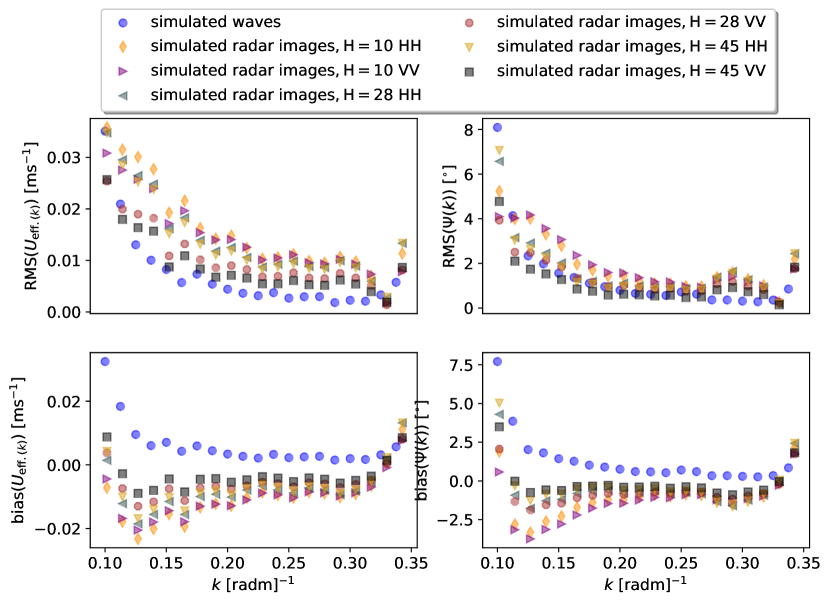
Experimental results
Research questions
- RQ1How does radar antenna height and polarization affect the accuracy of measured dispersion relations and subsequent current retrieval?
- RQ2What is the optimal observation window length for balancing temporal resolution and retrieval accuracy in shear current estimation?
- RQ3How do imaging mechanisms and spectral leakage influence the spread and bias in reconstructed current profiles across different wavenumbers?
- RQ4To what extent does the shape of the current profile affect the error in radar-based current inversion?
- RQ5How does random noise in radar measurements impact the reliability and bias of current retrieval results?
Key findings
- The highest radar antenna (H = 45 m) with vertical polarization achieved the lowest root mean square error (RMS ≤ 0.05 m/s) in current retrieval, approaching the error level of the simulated wave field without imaging effects.
- Observation windows of 5–10 minutes offer a practical trade-off between temporal resolution and accuracy, with a potential accuracy loss of less than 12% compared to 20-minute windows.
- The error in current reconstruction varies significantly between realizations due to amplification of deviations by the imaging mechanism, especially for profiles with weaker shear.
- Confidence intervals for current estimates extend up to 3 cm/s at 10 m depth, with larger spread for horizontal polarization and lower-shear profiles.
- The inversion error is strongly dependent on the input current profile, doubling for some example profiles when using the same inversion method.
- Random noise in radar measurements increases error with depth but does not introduce a systematic bias, as confirmed by 1000 realization simulations.
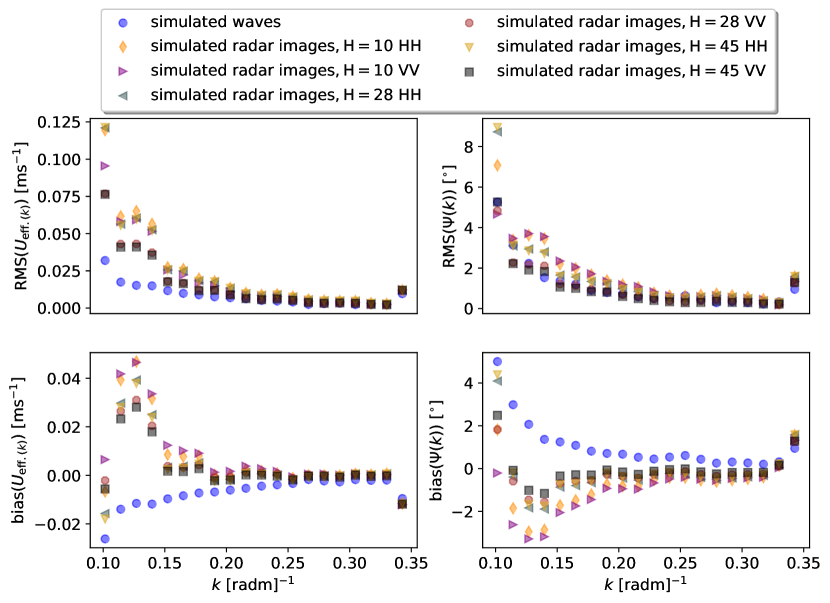
Better researchstarts right now
From reading papers to final review, dramatically reduce your research time.
No credit card · Free plan available
This review was created by AI and reviewed by human editors.