
[Paper Review] On the Radio Stripe Deployment for Indoor RF Wireless Power Transfer
This paper proposes optimal deployment strategies for radio stripe networks in indoor RF wireless power transfer systems to maximize the minimum received power at energy-harvesting hotspots. Using geometric programming, it designs straight-line and polygon-shaped radio stripes that outperform centralized fully-digital arrays by reducing path loss and enabling better near-field beam focusing, especially with longer stripe lengths and lower frequencies.
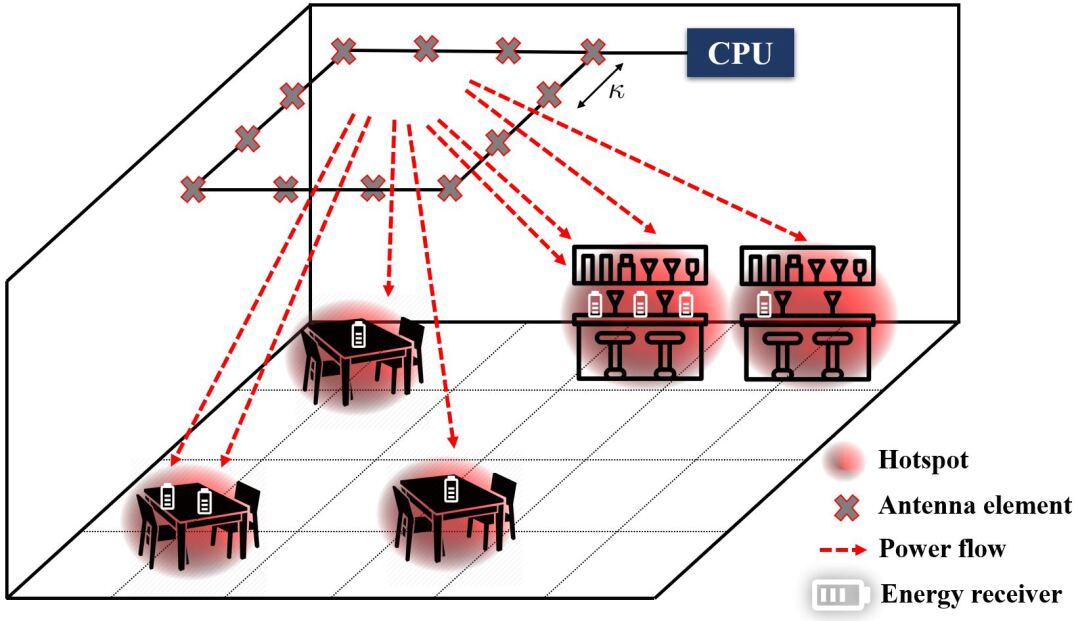
One of the primary goals of future wireless systems is to foster sustainability, for which, radio frequency (RF) wireless power transfer (WPT) is considered a key technology enabler. The key challenge of RF-WPT systems is the extremely low end-to-end efficiency, mainly due to the losses introduced by the wireless channel. Distributed antenna systems are undoubtedly appealing as they can significantly shorten the charging distances, thus, reducing channel losses. Interestingly, radio stripe systems provide a cost-efficient and scalable way to deploy a distributed multi-antenna system, and thus have received a lot of attention recently. Herein, we consider an RF-WPT system with a transmit radio stripe network to charge multiple indoor energy hotspots, i.e., spatial regions where the energy harvesting devices are expected to be located, including near-field locations. We formulate the optimal radio stripe deployment problem aimed to maximize the minimum power received by the users and explore two specific predefined shapes, namely the straight line and polygon-shaped configurations. Then, we provide efficient solutions relying on geometric programming to optimize the location of the radio stripe elements. The results demonstrate that the proposed radio stripe deployments outperform a central fully-digital square array with the same number of elements and utilizing larger radio stripe lengths can enhance the performance, while increasing the system frequency may degrade it.
Motivation & Objective
- To address the low end-to-end efficiency of RF wireless power transfer (WPT) in indoor environments due to high path loss.
- To explore distributed antenna deployment via radio stripes as a cost-effective alternative to co-located arrays for reducing charging distances and improving energy delivery.
- To formulate and solve an optimization problem that maximizes the minimum power received at predefined indoor energy hotspots.
- To compare performance against a central fully-digital square array benchmark under identical hardware constraints.
- To evaluate the impact of radio stripe shape (line vs. polygon), length, and operating frequency on system performance.
Proposed method
- Formulates the radio stripe deployment problem as a geometric programming (GP) optimization to maximize the minimum received power at user locations.
- Models the transmitter as a distributed array of antenna elements placed along a cable (radio stripe), with uniform spacing and phase control.
- Considers two predefined shapes: straight-line and polygon-shaped configurations, optimizing element positions for beamforming gain.
- Employs maximum ratio transmission (MRT) and semidefinite programming (SDP)-based precoding to compute beamforming weights.
- Uses a near-field channel model to account for spherical wavefronts, enabling spatial power focusing beyond far-field beamforming.
- Sets system parameters including frequency, total power, number of elements, and hotspot locations to evaluate performance across configurations.
Experimental results
Research questions
- RQ1How does the performance of a radio stripe deployment compare to a centralized fully-digital array in terms of minimum received power for indoor RF-WPT?
- RQ2What is the optimal placement of radio stripe elements (in line or polygon shape) to maximize the minimum energy harvested at indoor hotspots?
- RQ3How does increasing the radio stripe length affect system performance, and does it consistently improve energy delivery?
- RQ4What is the impact of operating frequency on system efficiency, given that higher frequency increases path loss despite more elements?
- RQ5How do different shapes (line vs. polygon) influence beamforming directivity and near-field focusing capability?
Key findings
- The proposed radio stripe deployments outperform the central fully-digital square array in terms of minimum received power, especially in near-field conditions.
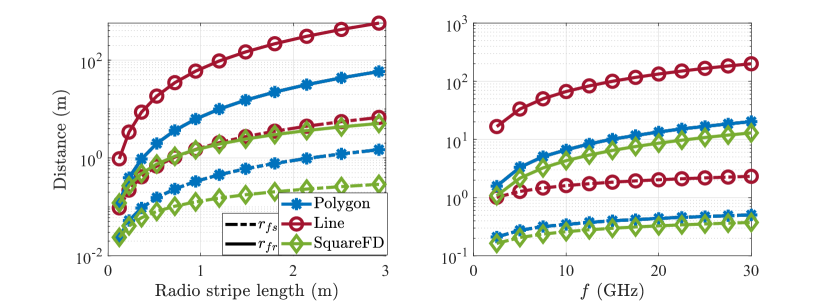
- Increasing the radio stripe length enhances performance by distributing more elements over a larger area, improving beamforming degrees of freedom and reducing average distance to users.
- Higher operating frequencies degrade system performance due to increased path loss, despite the higher number of antenna elements per unit length.
- The polygon-shaped radio stripe achieves better performance than the line-shaped configuration, particularly with MRT-based precoding, due to more uniform proximity to hotspots.
- The performance gap between radio stripes and centralized arrays increases in larger areas, as the latter suffers from higher path loss due to co-located elements.
- With SDP-based precoding, the polygon-shaped deployment performs best, while the line-shaped deployment degrades significantly, approaching the performance of the center-FD benchmark.
Better researchstarts right now
From reading papers to final review, dramatically reduce your research time.
No credit card · Free plan available
This review was created by AI and reviewed by human editors.