
[Paper Review] On the Significance of the Thick Disks of Disk Galaxies
This study uses high-resolution NewHorizon and NewHorizon2 cosmological simulations to investigate the origin and mass fraction of thick disks in massive disk galaxies. It finds that thick disks contribute 48±13% to the disk's stellar mass and 34±15% to its r-band luminosity, with kinematic and profile-based methods yielding consistent results, challenging prior assumptions about their minor role and highlighting the importance of multi-component kinematic and chemical analysis for accurate identification.
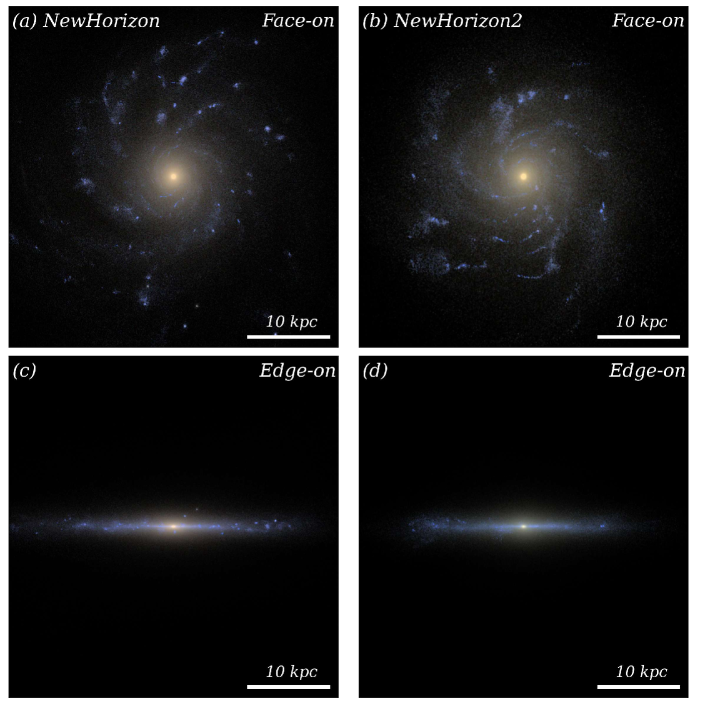
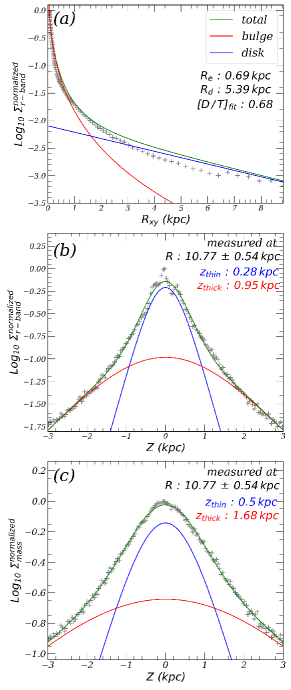
Thick disks are a prevalent feature observed in numerous disk galaxies including our own Milky Way. Their significance has been reported to vary widely, ranging from a few to 100% of the disk mass, depending on the galaxy and the measurement method. We use the NewHorizon simulation which has high spatial and stellar mass resolutions to investigate the issue of thick disk mass fraction. We also use the NewHorizon2 simulation that was run on the same initial conditions but additionally traced nine chemical elements. Based on a sample of 27 massive disk galaxies with M* > 10^10 M_{\odot} in NewHorizon, the contribution of the thick disk was found to be 34 \pm 15% in r-band luminosity or 48 \pm 13% in mass to the overall galactic disk, which seems in agreement with observational data. The vertical profiles of 0, 22, and 5 galaxies are best fitted by 1, 2, or 3 sech2 components, respectively. The NewHorizon2 data show that the selection of thick disk stars based on a single [α/Fe] cut is severely contaminated by stars of different kinematic properties while missing a bulk of kinematically thick disk stars. Vertical luminosity profile fits recover the key properties of thick disks reasonably well. The majority of stars are born near the galactic mid-plane with high circularity and get heated with time via fluctuation in the force field. Depending on the star formation and merger histories, galaxies may naturally develop thick disks with significantly different properties.
Motivation & Objective
- To determine the true mass and luminosity fractions of thick disks in massive disk galaxies using high-resolution cosmological simulations.
- To resolve discrepancies between observational estimates of thick disk fractions derived from vertical profile fitting versus chemical abundance (e.g., [α/Fe]) cuts.
- To assess the reliability of kinematic and chemical criteria in identifying thick disk stars and to evaluate the role of secular heating and merger events in thick disk formation.
- To compare kinematic decomposition via Gaussian Mixture Models with structural profile fitting to validate thick disk identification methods.
Proposed method
- Simulations were run using the NewHorizon and NewHorizon2 codes, with high spatial and stellar mass resolution, including full chemical evolution tracking for nine elements.
- Kinematic decomposition was performed using Gaussian Mixture Models (GMM) on energy and angular momentum to identify distinct stellar populations without relying on single-value cuts.
- Vertical luminosity profiles were fitted with one, two, or three sech² components to characterize the structural properties of thick disks.
- Chemical abundance cuts (e.g., [α/Fe]) were tested for their ability to isolate kinematically thick disk stars, with results compared against GMM and profile-based classifications.
- The simulations tracked star formation history, orbital heating via force fluctuations, and merger histories to link thick disk properties to formation mechanisms.
- Ensemble averaging of orbital diffusion in 3+1D phase and chemical space was proposed as a future path to model collective effects of accretion events.
Experimental results
Research questions
- RQ1What is the true mass fraction of thick disks in massive disk galaxies, and how does it compare to observational estimates from vertical profile fitting and chemical abundance cuts?
- RQ2To what extent is the [α/Fe] bimodality a reliable tracer of thick disk stars, and how does it compare to kinematic-based identification?
- RQ3How do secular heating and merger events shape the formation of thick disks, and can they produce multiple thick disk components?
- RQ4Can kinematic decomposition via Gaussian Mixture Models (GMM) provide a more accurate and robust identification of thick disk stars than single-threshold chemical cuts?
- RQ5What is the relationship between the number of thick disk components (1, 2, or 3 sech² profiles) and the merger or star formation history of a galaxy?
Key findings
- The thick disk contributes 48±13% to the total stellar mass and 34±15% to the r-band luminosity of massive disk galaxies in the NewHorizon simulation.
- Vertical luminosity profiles were best fitted by one, two, or three sech² components in 20, 5, and 2 galaxies, respectively, indicating structural diversity.
- A single [α/Fe] cut severely contaminates thick disk identification, missing a significant fraction of kinematically thick stars and including stars with different kinematic properties.
- Kinematic decomposition using GMM shows good correspondence with profile-based decomposition, confirming the reliability of both methods when applied consistently.
- Stars are primarily born near the mid-plane with high circularity and are gradually heated over time by fluctuations in the gravitational potential, leading to thick disk formation.
- Galaxies with different star formation and merger histories naturally develop thick disks with significantly varying properties, suggesting a complex, multi-phase origin.
Better researchstarts right now
From reading papers to final review, dramatically reduce your research time.
No credit card · Free plan available
This review was created by AI and reviewed by human editors.