
[Paper Review] Optimal ANN-SNN Conversion for High-accuracy and Ultra-low-latency Spiking Neural Networks
This paper introduces a quantization clip-floor-shift activation to train ANNs so that ANN-SNN conversion yields zero estimated conversion error at ultra-low latency (as low as 4 time-steps) and achieves state-of-the-art accuracy on CIFAR-10/100 and ImageNet.
Spiking Neural Networks (SNNs) have gained great attraction due to their distinctive properties of low power consumption and fast inference on neuromorphic hardware. As the most effective method to get deep SNNs, ANN-SNN conversion has achieved comparable performance as ANNs on large-scale datasets. Despite this, it requires long time-steps to match the firing rates of SNNs to the activation of ANNs. As a result, the converted SNN suffers severe performance degradation problems with short time-steps, which hamper the practical application of SNNs. In this paper, we theoretically analyze ANN-SNN conversion error and derive the estimated activation function of SNNs. Then we propose the quantization clip-floor-shift activation function to replace the ReLU activation function in source ANNs, which can better approximate the activation function of SNNs. We prove that the expected conversion error between SNNs and ANNs is zero, enabling us to achieve high-accuracy and ultra-low-latency SNNs. We evaluate our method on CIFAR-10/100 and ImageNet datasets, and show that it outperforms the state-of-the-art ANN-SNN and directly trained SNNs in both accuracy and time-steps. To the best of our knowledge, this is the first time to explore high-performance ANN-SNN conversion with ultra-low latency (4 time-steps). Code is available at https://github.com/putshua/SNN\_conversion\_QCFS
Motivation & Objective
- Understand and model the three main sources of ANN-SNN conversion error (clipping, quantization, unevenness).
- Propose an activation function replacement (quantization clip-floor-shift) to align ANN activations with SNN firing behavior.
- Prove that expected conversion error can be zero under ultra-low latency and demonstrate state-of-the-art results on standard benchmarks.
- Provide guidance on selecting quantization steps L to balance ultra-low latency and peak accuracy.
Proposed method
- Derive the ANN-SNN conversion framework from Integrate-and-Fire (IF) SNNs and ReLU-based ANNs.
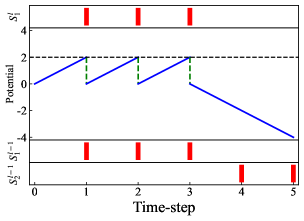
- Decompose conversion error into clipping error, quantization error, and unevenness error.
- Introduce quantization clip-floor activation (and shift variant) to train ANNs so that converted SNNs match activations at time-step T; prove zero expected error under certain conditions.
- Theorem 1: with T = L and θ = λ, zero estimated conversion error when using quantization clip-floor activation.
- Theorem 2: with shift φ = 1/2, zero expected conversion error for arbitrary T and L.
- Train ANNs with straight-through estimator for the floor operator to realize the proposed activation.
Experimental results
Research questions
- RQ1Can ANN-SNN conversion achieve zero conversion error with ultra-low time-steps?
- RQ2How should ANN activations be modified to better approximate SNN firing rates at low latency?
- RQ3What is the effect of the quantization step L and shift φ on conversion accuracy across datasets and architectures?
Key findings
- Achieves state-of-the-art accuracy with ultra-low latency on CIFAR-10/100 and ImageNet across multiple architectures.
- With T = L and φ = 0, zero estimated conversion error per layer; practical results show near-zero or zero gap at low time-steps.
- ANNs trained with quantization clip-floor-shift activation retain performance close to ReLU-based ANNs for L ≥ 4.
- For CIFAR-10, they report 4-time-step results surpassing several prior ANN-SNN methods.
- On ImageNet, the method yields leading results with reduced time-steps (e.g., substantial gains at T = 16–32).
- Quantization step L=4 or 8 balances ultra-low latency and peak accuracy effectively.
Better researchstarts right now
From reading papers to final review, dramatically reduce your research time.
No credit card · Free plan available
This review was created by AI and reviewed by human editors.