
[Paper Review] Origin of correlated isolated flat bands in copper-substituted lead phosphate apatite
The paper uses DFT with Hubbard U to show that Cu substitution in lead phosphate apatite creates an isolated, flat Cu-dominated band at the Fermi level, driven by Cu-induced structural distortion and Pb lone-pair–driven chiral charge density waves, suggesting a minimal two-band model for low-energy physics and potential superconductivity.
A recent report of room temperature superconductivity at ambient pressure in Cu-substituted apatite (`LK99') has invigorated interest in the understanding of what materials and mechanisms can allow for high-temperature superconductivity. Here I perform density functional theory calculations on Cu-substituted lead phosphate apatite, identifying correlated isolated flat bands at the Fermi level, a common signature of high transition temperatures in already established families of superconductors. I elucidate the origins of these isolated bands as arising from a structural distortion induced by the Cu ions and a chiral charge density wave from the Pb lone pairs. These results suggest that a minimal two-band model can encompass much of the low-energy physics in this system. Finally, I discuss the implications of my results on possible superconductivity in Cu-doped apatite.
Motivation & Objective
- Understand the structural and electronic origin of correlated flat bands in Cu-doped lead phosphate apatite.
- Identify how Cu substitution alters local coordination and polyhedral tilts.
- Assess implications for low-energy models and potential superconductivity in Cu-doped apatite.
Proposed method
- Perform density functional theory calculations with VASP.
- Apply GGA+U (Cu-d states) with U values 2–6 eV; main results use U=4 eV.
- Include spin-orbit coupling; analyze electronic structure and projected DOS.
- Relax structures to capture Cu-induced distortions and compute symmetry-adapted phonon modes with AMPLIMODES.
- Compare Cu substitution on Pb(1) versus Pb(2) sites and test non-relaxed structures to assess robustness.
Experimental results
Research questions
- RQ1What structural distortions does Cu substitution induce in Pb10(PO4)6(OH)2 apatite?
- RQ2How does Cu substitution affect the Cu-d derived bands and their isolation at the Fermi level?
- RQ3Can a minimal two-band model (d_yz/d_xz) describe the low-energy physics of Cu-doped apatite?
- RQ4What are the potential competing interactions (magnetic, charge, phonons) relevant to superconductivity in this system?
Key findings
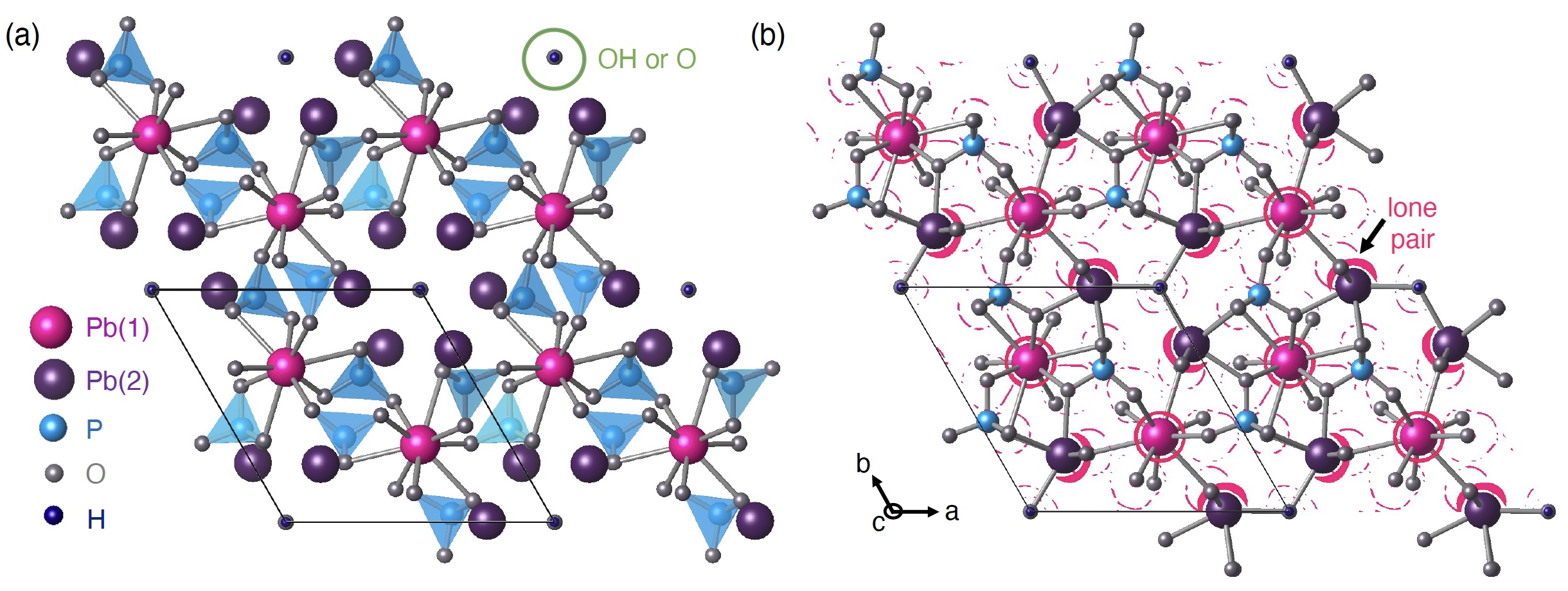
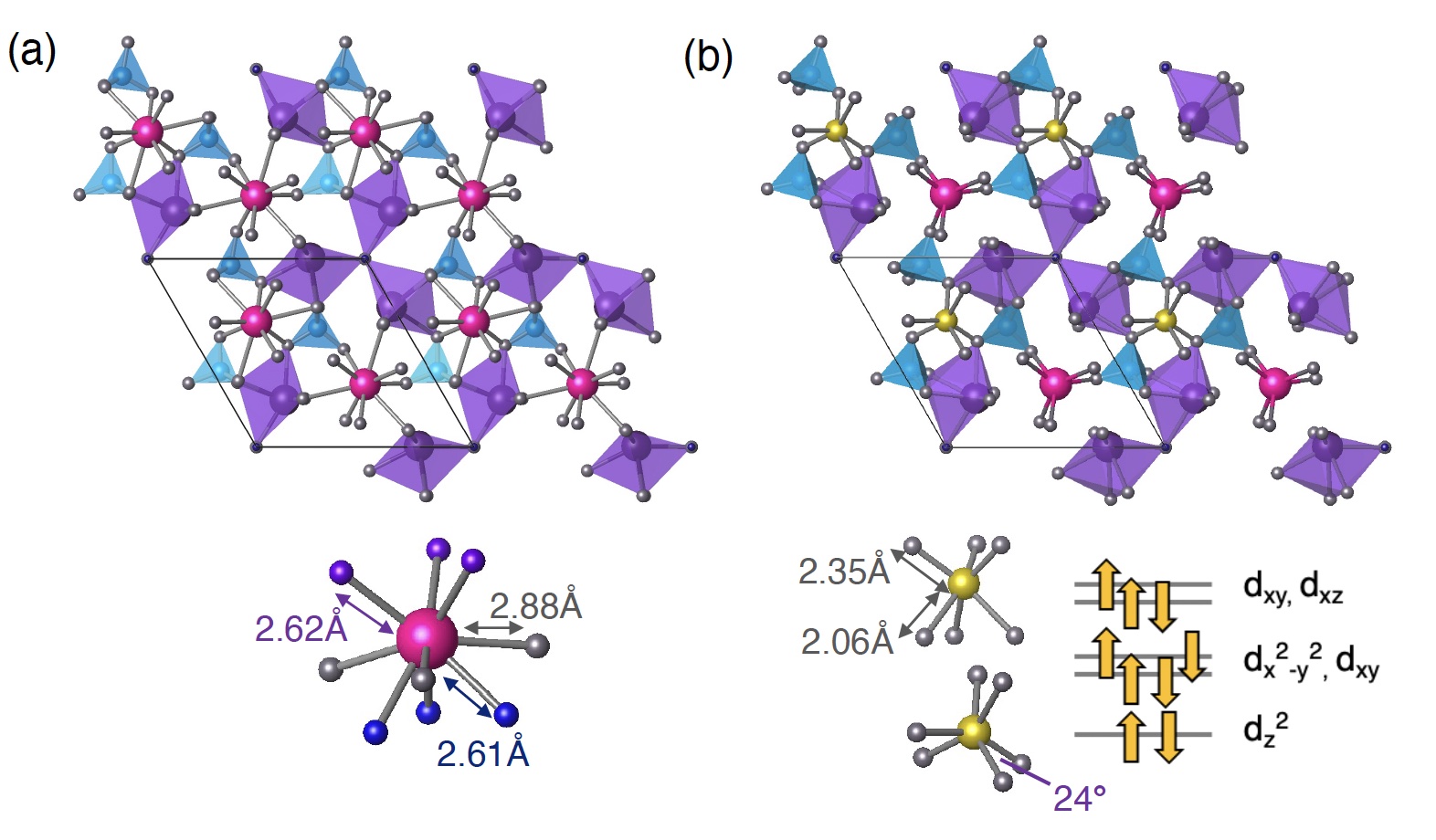
- Cu substitution on the Pb(1) site yields an isolated pair of flat Cu-d bands crossing the Fermi level with bandwidth ~130 meV.
- These flat bands are separated from the rest of the valence manifold by ~160 meV, indicating strong correlation potential.
- Cu-induced distortion changes Cu coordination from ninefold to sixfold, forming a Jahn-Teller distorted trigonal prism that contributes to the flat-band formation.
- Pb(2) lone pairs create a chiral charge density wave that drives a structural distortion propagating via PO4 polyhedra; this lone-pair activity is linked to the electronic structure.
- A two-band model focusing on Cu-d_yz/d_xz states can capture the low-energy physics, with spin polarization and modest U dependence preserving the flat-band feature.
- Out-of-plane Cu-Cu exchange is FM by ~2 meV per Cu, while in-plane coupling is AFM by ~7 μeV per Cu, under the assumption of Cu occupying the Pb(1) site.
Better researchstarts right now
From reading papers to final review, dramatically reduce your research time.
No credit card · Free plan available
This review was created by AI and reviewed by human editors.