
[Paper Review] Palatini $f(R)$ gravity tests in the weak field limit: Solar System, seismology and galaxies
This paper tests Palatini $f(R)$ gravity as a dark matter alternative in galaxies using the SPARC dataset and a novel normalized additional velocity (NAV) method. It finds that Palatini $f(R)$, along with Eddington-inspired Born-Infeld gravity, fails to fit rotation curve data, yielding a model efficiency $E_{\text{M}} < -2.0$, indicating strong incompatibility with observations across all tested values of the free parameter $\alpha$. The results hold regardless of whether $\alpha$ is constant or varies per galaxy.
Palatini $f(R)$ gravity is probably the simplest extension of general relativity (GR) and the simplest realization of a metric-affine theory. It has the same number of degrees of freedom as GR and, in vacuum, it is straightforwardly mapped into GR with a cosmological constant. The mapping between GR and Palatini $f(R)$ inside matter is possible but at the expense of reinterpreting the meaning of the matter fields. The physical meaning and consequences of such mapping will depend on the physical context. Here we consider three such cases within the weak field limit: Solar System dynamics, planetary internal dynamics (seismology), and galaxies. After revising our previous results on the Solar System and Earth's seismology, we consider here the possibility of $f(R)$ Palatini as a dark matter candidate. For any $f(R)$ that admits a polynomial approximation in the weak field limit, we show here, using SPARC data and a recent method that we proposed, that the theory cannot be used to replace dark matter in galaxies. We also show that the same result applies to the Eddington-inspired Born-Infeld gravity. Differently from the metric $f(R)$ case, the rotation curve data are sufficient for this conclusion. This result does not exclude a combination of modified gravity and dark matter.
Motivation & Objective
- To test whether Palatini $f(R)$ gravity can replace dark matter in galaxies without invoking additional matter fields.
- To assess the viability of Palatini $f(R)$ gravity in weak-field regimes using Solar System, seismology, and galactic rotation curve data.
- To evaluate whether the theory can reproduce observed rotation curves in 122 SPARC galaxies using a recently proposed normalized additional velocity (NAV) method.
- To extend the analysis to Eddington-inspired Born-Infeld (EiBI) gravity, given its similar weak-field behavior.
- To determine if the theory remains consistent across different physical contexts, including planetary interiors and galactic dynamics.
Proposed method
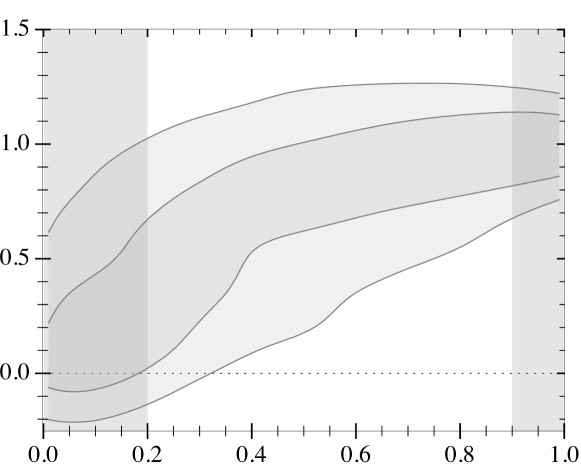
- The study employs the normalized additional velocity (NAV) method to quantify the discrepancy between predicted and observed rotation curves in 122 SPARC galaxies.
- It uses a weak-field approximation of Palatini $f(R)$ gravity, leading to a modified Poisson equation: $\nabla^2\phi = \frac{\kappa}{2}(\rho + \alpha \nabla^2\rho)$, where $\alpha$ is a free parameter.
- The model efficiency $E_{\text{M}}$ is computed as a metric to assess how well the predicted velocity profile aligns with observational data.
- The analysis assumes a thin disk approximation for galactic structure and applies the method to both constant and galaxy-dependent $\alpha$ values.
- The same method is applied to Eddington-inspired Born-Infeld (EiBI) gravity, which shares the same weak-field limit as Palatini $f(R)$.
- The study compares model predictions against observational data from the SPARC dataset, focusing on rotation curves and their deviations.
Experimental results
Research questions
- RQ1Can Palatini $f(R)$ gravity reproduce observed galaxy rotation curves without dark matter, using the SPARC dataset?
- RQ2What constraints does the NAV method impose on the free parameter $\alpha$ in Palatini $f(R)$ gravity across galaxies?
- RQ3Does the theory remain viable when tested against seismology data from Earth and Solar System dynamics?
- RQ4Is the failure of Palatini $f(R)$ to fit rotation curves due to the theory's inherent structure or the choice of $\alpha$?
- RQ5Does the same conclusion hold for Eddington-inspired Born-Infeld gravity, given its similar weak-field behavior?
Key findings
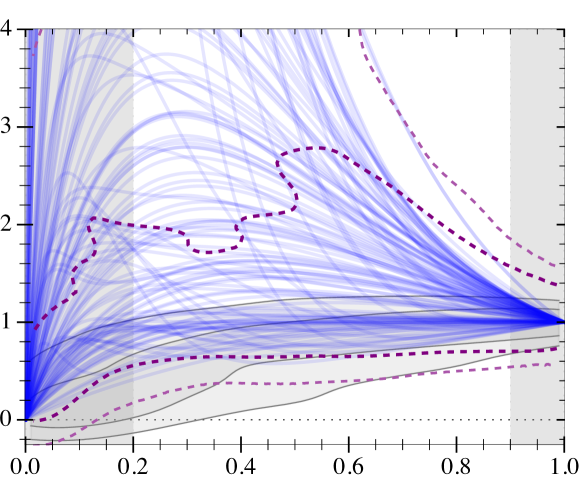
- Palatini $f(R)$ gravity cannot replace dark matter in galaxies, as the model efficiency $E_{\text{M}}$ is found to be less than -2.0, indicating strong incompatibility with observational data.
- The result holds for any value of the free parameter $\alpha$, whether constant across galaxies or allowed to vary per galaxy.
- The NAV method reveals that most model predictions lie far outside the observational data region, indicating a large systematic discrepancy.
- The failure is robust and does not depend on the specific value of $\alpha$, suggesting a fundamental incompatibility with galactic rotation curves.
- The same conclusion applies to Eddington-inspired Born-Infeld gravity due to its identical weak-field limit, confirming the result extends beyond Palatini $f(R)$.
- The study rules out Palatini $f(R)$ as a viable alternative to dark matter in rotationally supported galaxies, even when allowing for $\alpha$ to vary.
Better researchstarts right now
From reading papers to final review, dramatically reduce your research time.
No credit card · Free plan available
This review was created by AI and reviewed by human editors.