
[Paper Review] Particle track reconstruction with noisy intermediate-scale quantum computers
This paper demonstrates a proof of concept for using variational quantum eigensolver (VQE) on noisy intermediate-scale quantum (NISQ) computers to solve particle track reconstruction as a quadratic unconstrained binary optimization (QUBO) problem. By dividing the full QUBO into smaller sub-QUBOs compatible with current hardware, the study shows that VQE with CVaR cost function and L-VQE enhancements achieves up to 70% ground state component fidelity on 32-qubit sub-QUBOs in ideal conditions, with performance approaching full QUBO results for sub-QUBO sizes of 128–512 triplets.
The reconstruction of trajectories of charged particles is a key computational challenge for current and future collider experiments. Considering the rapid progress in quantum computing, it is crucial to explore its potential for this and other problems in high-energy physics. The problem can be formulated as a quadratic unconstrained binary optimization (QUBO) and solved using the variational quantum eigensolver (VQE) algorithm. In this work the effects of dividing the QUBO into smaller sub-QUBOs that fit on the hardware available currently or in the near term are assessed. Then, the performance of the VQE on small sub-QUBOs is studied in an ideal simulation, using a noise model mimicking a quantum device and on IBM quantum computers. This work serves as a proof of principle that the VQE could be used for particle tracking and investigates modifications of the VQE to make it more suitable for combinatorial optimization.
Motivation & Objective
- To explore the feasibility of using NISQ-era quantum computers for particle track reconstruction in high-energy physics.
- To address the challenge of limited qubit count by decomposing large QUBO problems into smaller, hardware-compatible sub-QUBOs.
- To evaluate the performance of VQE on sub-QUBOs under ideal, noisy, and real quantum hardware conditions.
- To investigate modifications to VQE—specifically CVaR cost function and L-VQE—for improved performance on combinatorial optimization problems in particle physics.
- To benchmark efficiency and purity of reconstructed tracks against full QUBO solutions using realistic track density scenarios.
Proposed method
- Formulates particle track reconstruction as a QUBO problem with coefficients $ a_i $ for triplet quality and $ b_{ij} $ for triplet compatibility.
- Applies geometric slicing to divide the full QUBO into overlapping sub-QUBOs of size 16 to 512 triplets, ensuring spatial coherence.
- Maps the QUBO to a quantum Hamiltonian via $ T_i \to (1 - Z_i)/2 $, enabling VQE to find the ground state corresponding to the optimal solution.
- Employs the variational quantum eigensolver (VQE) with parameterized quantum circuits, using COBYLA optimizer and 1024 measurements per iteration.
- Implements two VQE enhancements: the CVaR cost function with $ \alpha = 0.1 $ and $ \alpha = 1 $, and L-VQE with up to two additional entangling layers.
- Evaluates performance across three settings: ideal simulation, noise model (ibmq_kolkata), and real IBM quantum hardware using Qiskit.

Experimental results
Research questions
- RQ1Can VQE on NISQ devices reconstruct particle tracks with sufficient efficiency and purity when the full QUBO is decomposed into sub-QUBOs?
- RQ2How does sub-QUBO size affect the performance of VQE in terms of ground state fidelity, efficiency, and purity?
- RQ3What is the impact of noise—simulated or real—on VQE performance for particle track reconstruction?
- RQ4Do CVaR cost function and L-VQE with additional layers improve convergence and solution quality for combinatorial optimization in this context?
- RQ5To what extent can sub-QUBO decomposition preserve the performance of full QUBO solutions on current and near-term quantum hardware?
Key findings
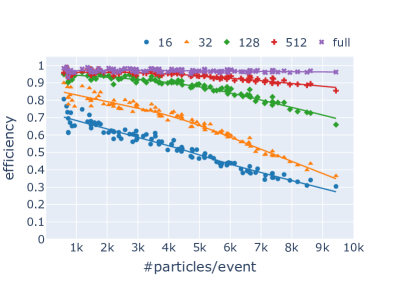
- For sub-QUBO sizes of 128 and 512 triplets, efficiency exceeds 0.9 and purity remains comparable to the full QUBO solution for up to 5,000 particles per event.
- With 32-qubit sub-QUBOs, the ideal VQE simulation achieves up to 70% of instances reaching at least 1% ground state component, indicating strong solution fidelity.
- The CVaR cost function with $ \alpha = 0.1 $ significantly improves performance in both ideal and noisy simulations, outperforming standard VQE ($ \alpha = 1 $).
- Adding one additional layer in L-VQE improves performance on noisy simulations up to 20 qubits, though benefits diminish at larger sizes.
- Results from real IBM quantum hardware (ibmq_kolkata) are consistent with classical noise simulations, validating the reliability of the noise model.
- Efficiency drops sharply for 16-qubit sub-QUBOs beyond low track densities, while purity remains above 0.8 across most conditions, indicating robustness to false positives.
Better researchstarts right now
From reading papers to final review, dramatically reduce your research time.
No credit card · Free plan available
This review was created by AI and reviewed by human editors.