
[Paper Review] Pb$_{10-x}$Cu$_x$(PO$_4$)$_6$O: a Mott or charge transfer insulator in need of further doping for (super)conductivity
The paper analyzes LK-99, derives two- and five-band tight-binding models from ab initio data, and shows DMFT results indicating a Mott or charge-transfer insulator that requires electron or hole doping for metallicity and potential superconductivity.
We briefly review the status quo of research on the putative superconductor Pb$_9$Cu(PO$_4$)$_6$O also known as LK-99. Further, we provide {\em ab initio} derived tight-binding parameters for a two- and five-band model, and solve these in dynamical-mean-field theory. The ratio interaction-to-bandwidth makes LK-99 a Mott or charge transfer insulator. Electron or hole doping (which is different from substituting Pb by Cu and thus differs from LK-99) is required to make it metallic and potentially superconducting.
Motivation & Objective
- Assess the electronic nature of Pb10-xCux(PO4)6O (LK-99) and clarify whether it is a Mott or charge-transfer insulator.
- Derive low-energy tight-binding models (two-band and five-band) from ab initio data.
- Investigate the role of electronic correlations via DMFT and determine the insulating state.
- Estimate realistic interaction parameters to discuss doping needed for metallicity or superconductivity.
Proposed method
- Perform DFT structural relaxations and band calculations to obtain a relaxed structure.
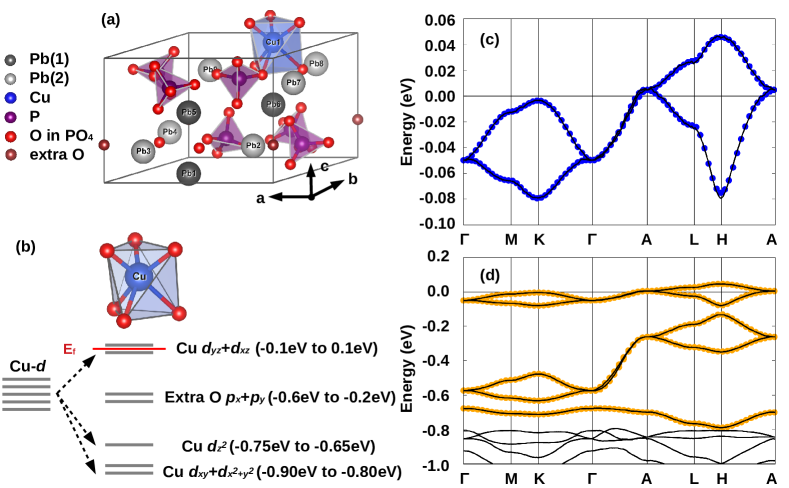
- Project DFT bands onto Wannier functions to obtain two-band and five-band tight-binding models.
- Add a local Kanamori interaction on Cu sites and solve with DMFT at 298 K using a continuous-time QMC solver.
- Compare DMFT spectra with DFT+U results to assess insulating behavior (Mott vs. charge-transfer).
- Use cRPA-inspired reasoning to discuss plausible U, J, and U' values for the models.
Experimental results
Research questions
- RQ1Is Pb10-xCux(PO4)6O a Mott or a charge-transfer insulator under realistic interaction strengths?
- RQ2What are the low-energy electronic models (two-band and five-band) that best describe LK-99?
- RQ3Does electronic correlation in DMFT open a gap, and how does the gap depend on U', J, and model choice?
- RQ4What doping (electron or hole) is required to drive metallicity or superconductivity in this material?
- RQ5How do DFT+U results compare with DMFT in capturing the insulating state and orbital polarization?
Key findings
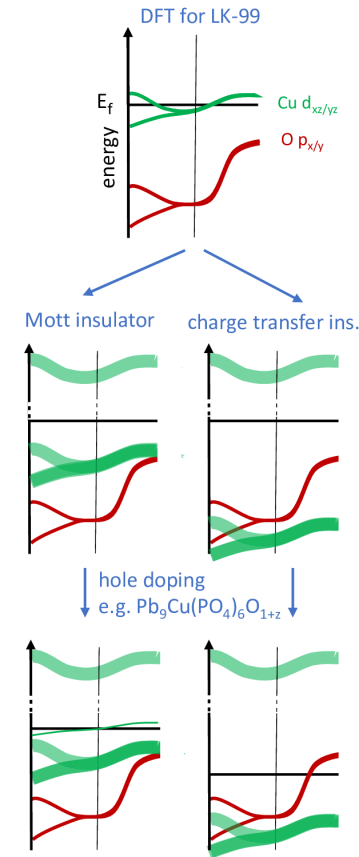
- DMFT shows a clear gap at the Fermi energy with Cu d-band (d_xz/d_yz) split into lower and upper Hubbard bands.
- Five-band model indicates a charge-transfer insulator at U' = 3 eV and a Mott-like character at U' = 2 eV; the system is near a crossover between charge-transfer and Mott insulating behavior.
- Two-band model yields larger gaps due to less screening; orbitals remain degenerate without symmetry breaking in DMFT.
- DFT+U can yield an insulating state under symmetry-broken structures, highlighting the role of lattice distortions in stabilizing insulating behavior.
- Overall, LK-99 is predicted to be an insulator (Mott or charge-transfer) at moderate U; metallicity and possible superconductivity would require electron or hole doping beyond Cu Pb substitution.
Better researchstarts right now
From paper design to paper writing, dramatically reduce your research time.
No credit card · Free plan available
This review was created by AI and reviewed by human editors.