
[Paper Review] Peduncle Gripping and Cutting Force for Strawberry Harvesting Robotic End-effector Design
This study experimentally determines critical mechanical parameters for robotic strawberry harvesting end-effectors, establishing a safe gripping force of 10 N on the peduncle and a required cutting force of 15 N at a 30° blade orientation with a 16.6° wedge angle. These values enable reliable gripping and cutting of 50g strawberries at 50 m/s² acceleration without damage.
Robotic harvesting of strawberries has gained much interest in the recent past. Although there are many innovations, they haven't yet reached a level that is comparable to an expert human picker. The end effector unit plays a major role in defining the efficiency of such a robotic harvesting system. Even though there are reports on various end effectors for strawberry harvesting, but there they lack a picture of certain parameters that the researchers can rely upon to develop new end effectors. These parameters include the limit of gripping force that can be applied on the peduncle for effective gripping, the force required to cut the strawberry peduncle, etc. These estimations would be helpful in the design cycle of the end effectors that target to grip and cut the strawberry peduncle during the harvesting action. This paper studies the estimation and analysis of these parameters experimentally. It has been estimated that the peduncle gripping force can be limited to 10 N. This enables an end effector to grip a strawberry of mass up to 50 grams with a manipulation acceleration of 50 m/s$^2$ without squeezing the peduncle. The study on peduncle cutting force reveals that a force of 15 N is sufficient to cut a strawberry peduncle using a blade with a wedge angle of 16.6 degrees at a 30-degree orientation.
Motivation & Objective
- To determine the maximum safe gripping force that can be applied to a strawberry peduncle without causing structural damage or crushing.
- To quantify the minimum cutting force required to sever a strawberry peduncle using a blade with a defined wedge angle and orientation.
- To support the design of robust, fruit-safe end-effectors by providing empirical data on force limits for gripping and cutting actions.
- To evaluate the influence of blade orientation and peduncle diameter on cutting force requirements for two strawberry varieties (Katrina and Zara).
Proposed method
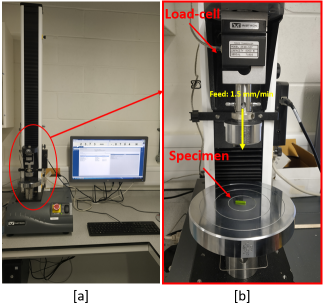
- Conducted experimental force measurements on strawberry peduncles from two varieties (Katrina and Zara) under controlled conditions.
- Applied incremental gripping forces up to 10 N to assess structural integrity and prevent crushing during robotic manipulation.
- Performed cutting trials using a blade with a 16.6° wedge angle at multiple orientations (0°, 10°, 20°, 30°) to measure peak cutting forces.
- Recorded and analyzed force profiles during cutting to identify peak forces (F_P1, F_P2) and detect blade contact with peduncle supports.
- Calculated mean cutting forces (F_PM) across specimens at different diameters and orientations, applying a factor of safety of 2 to derive design-relevant values.
- Used statistical analysis to compare cutting force trends across different blade orientations and strawberry varieties.
![Figure 1: Strawberry harvesting end effectors: [a]. Parallel jaw mechanism for simultaneous attachment and detachment [ 9 ] , [b].Suction head for attachment and blade action for detachment [ 2 ] , [c]. Suction head and two jaw fingers for attachment and bending action of end effector for detachment](https://ar5iv.labs.arxiv.org/html/2207.12552/assets/x1.jpg)
Experimental results
Research questions
- RQ1What is the maximum gripping force that can be safely applied to a strawberry peduncle without causing structural damage or crushing?
- RQ2What is the minimum cutting force required to sever a strawberry peduncle using a blade with a 16.6° wedge angle at various orientations?
- RQ3How does blade orientation (0°, 10°, 20°, 30°) affect the required cutting force for strawberry peduncles?
- RQ4How do peduncle diameter and strawberry variety (Katrina vs. Zara) influence the measured gripping and cutting forces?
- RQ5Can a 15 N cutting force with a 30° blade orientation reliably cut peduncles across different varieties, considering a factor of safety?
Key findings
- A gripping force of 10 N is safe and sufficient for securely holding a 50g strawberry during robotic manipulation at an acceleration of up to 50 m/s² without crushing the peduncle.
- The peak cutting force required for peduncle severance is lowest at a 30° blade orientation, with mean values of 4.13 N (Zara) and 5.00 N (Katrina) at this angle.
- A cutting force of 15 N, derived with a factor of safety of 2, is sufficient to reliably cut strawberry peduncles at 30° orientation across both varieties.
- Cutting forces increase at steeper blade angles, with the highest mean force (7.17 N) recorded at 10° orientation for the Katrina variety.
- The force profile during cutting shows two distinct peaks followed by a drop and a sharp rise when the blade contacts peduncle supports, confirming the onset of complete severance.
- The study's findings are limited to two strawberry varieties (Katrina and Zara), and results for other varieties remain untested, though trends are assumed to be similar within close tolerances.
Better researchstarts right now
From reading papers to final review, dramatically reduce your research time.
No credit card · Free plan available
This review was created by AI and reviewed by human editors.