
[Paper Review] Phenomenology of Holography via Quantum Coherence on Causal Horizons
This paper proposes a phenomenological model linking quantum coherence on causal horizons to holographic space-time fluctuations, predicting measurable Planckian strain in interferometers. It unifies black hole and flat space-time holography via coherent quantum information, offering testable signatures in cosmological data and next-generation 3D interferometers with optimized frequency spectra.
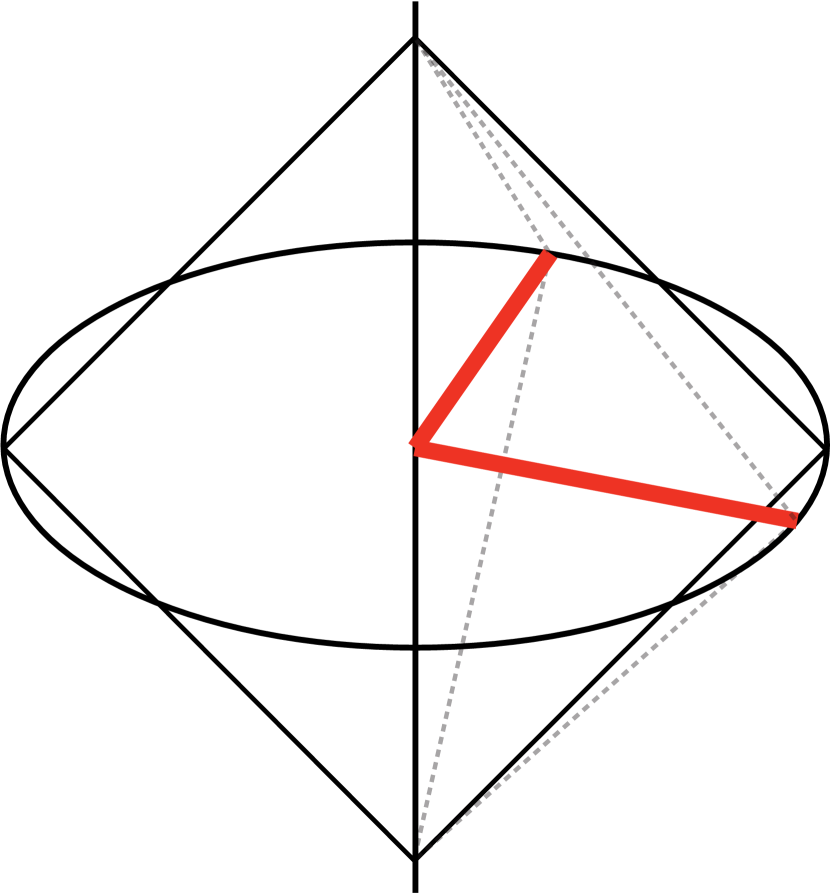
There is much recent development towards interferometric measurements of holographic quantum uncertainties in an emergent background space-time. Despite increasing promise for the target detection regime of Planckian strain power spectral density, the foundational insights of the motivating theories have not been connected to a phenomenological model of observables measured in a realistic experiment. This work proposes a candidate model, based on the central hypothesis that all horizons are universal boundaries of coherent quantum information -- where the decoherence of space-time happens for the observer. The prediction is inspired by 't Hooft's algebra for black hole information that gives coherent states on horizons, whose spatial correlations were shown by Verlinde and Zurek to also appear on holographic fluctuations of causal boundaries in flat space-time (conformal Killing horizons). Time-domain correlations are projected from Planckian jitters whose coherence scales match causal diamonds, motivated by Banks' framework for the emergence of space-time and locality. The universality of this coherence on causal horizons compels a multimodal research program probing concordant signatures: An analysis of cosmological data to probe primordial correlations, motivated by Hogan's interpretation of well-known CMB anomalies as coherent fluctuations on the inflationary horizon, and upcoming 3D interferometers to probe causal diamonds in flat space-time. Candidate interferometer geometries are presented, with a modeled frequency spectrum for each design.
Motivation & Objective
- To bridge foundational holographic quantum gravity with measurable interferometric observables in realistic experiments.
- To establish causal horizons as universal boundaries of coherent quantum information, where space-time decoherence occurs.
- To develop a multimodal research program testing holographic signatures in cosmological data and next-generation 3D interferometers.
- To model time- and frequency-domain signals for candidate interferometer geometries with attainable sensitivity.
Proposed method
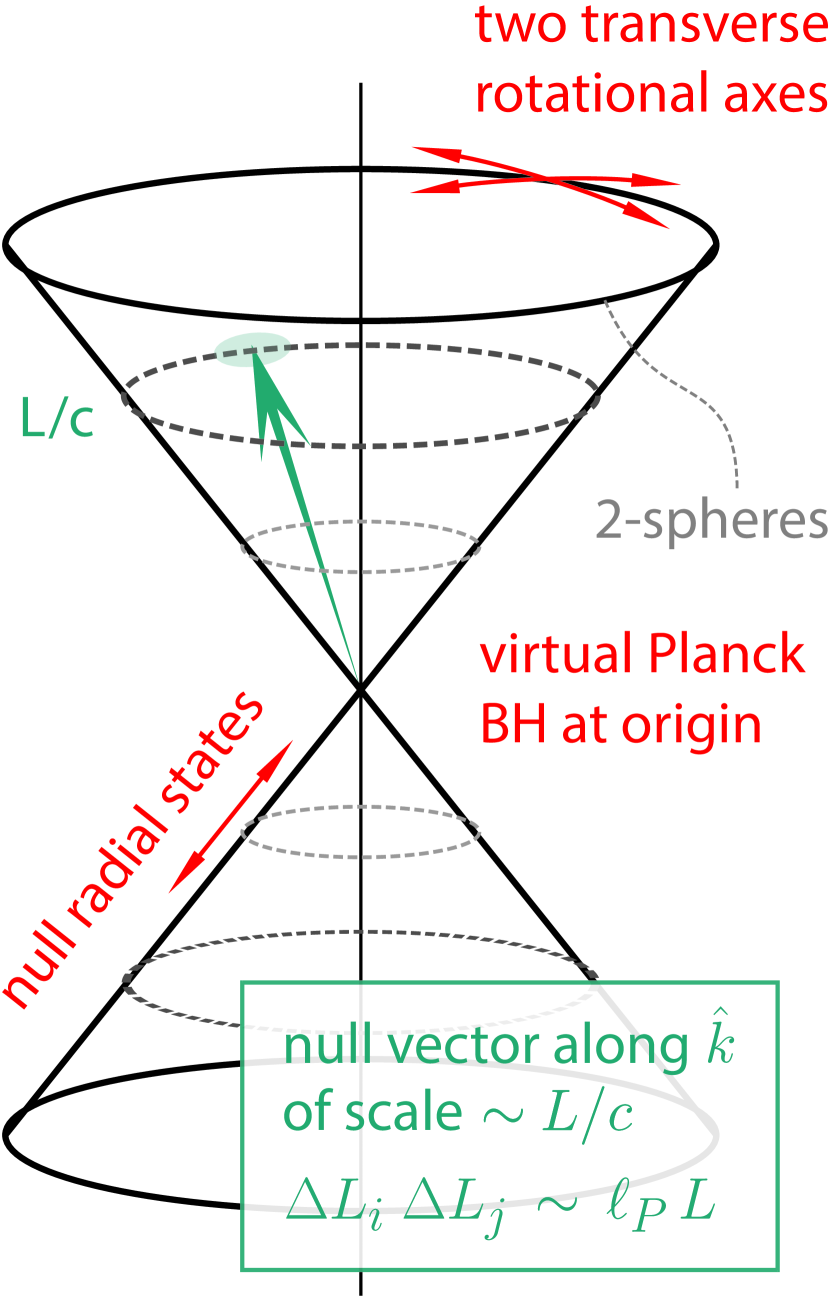
- Proposes that all causal horizons—black hole and conformal Killing horizons—host coherent quantum states from ’t Hooft’s algebra, extended via Verlinde and Zurek’s work on holographic fluctuations.
- Models Planckian jitters with coherence scales matching causal diamonds, projecting time-domain correlations from a random walk of nested Planck-scale fluctuations.
- Applies Banks’ framework for emergent space-time and locality, where space-time degrees of freedom exhibit large-scale infrared correlations due to causal boundary constraints.
- Derives a strain power spectral density (PSD) scaling as ~tP over bandwidth ~1/τ, consistent with holographic uncertainty in causal diamonds.
- Optimizes 3D interferometer geometries for maximal coupling to holographic noise, modeling their frequency spectra for near-term experimental feasibility.
- Reconciles theoretical predictions with observed CMB anomalies by mapping the angular correlation spectrum to holographic fluctuations after removing inflationary history.
Experimental results
Research questions
- RQ1Can quantum coherence on causal horizons produce measurable, universal signatures of holographic space-time fluctuations in interferometers?
- RQ2Do cosmological CMB anomalies—such as zero correlation at 90° and negative correlations near antipodes—arise from nonlocal quantum states across the inflationary horizon?
- RQ3What interferometer geometries and frequency spectra maximize sensitivity to Planckian strain in the regime of holographic uncertainty?
- RQ4How do causal diamond coherence scales and Planckian jitters combine to produce macroscopic, nonlocal quantum fluctuations in flat space-time?
- RQ5Can a unified phenomenological model of holography be constructed that applies to both black hole horizons and flat space-time causal boundaries?
Key findings
- The strain power spectral density for holographic fluctuations scales as ~tP over a bandwidth ~1/τ, matching the Planckian random walk scaling of space-time uncertainty in causal diamonds.
- Causal horizons act as universal boundaries of coherent quantum information, where decoherence of space-time occurs for the observer, unifying black hole and flat space-time holography.
- Candidate 3D interferometer geometries are proposed with modeled frequency spectra, optimized for sensitivity to holographic noise in near-future experiments.
- The angular correlation spectrum of the CMB anomalies matches the predicted spectrum for holographic fluctuations in flat space-time when inflationary history is removed.
- Multiple theoretical approaches—holographic degrees of freedom, entanglement entropy, squeezed graviton states, and coherent shockwaves—converge on the same phenomenological regime accessible to state-of-the-art interferometers.
- The model provides a unified framework linking quantum gravity foundations, cosmological observations, and laboratory-scale quantum-enhanced interferometry.
Better researchstarts right now
From reading papers to final review, dramatically reduce your research time.
No credit card · Free plan available
This review was created by AI and reviewed by human editors.