
[Paper Review] Practical Guidance for Bayesian Inference in Astronomy
Provides a cross-disciplinary translation of Bayesian notation and practical guidance for performing Bayesian inference in astronomy, with parallax as running example and emphasis on priors, likelihoods, posteriors, and posterior predictive checks.
In the last two decades, Bayesian inference has become commonplace in astronomy. At the same time, the choice of algorithms, terminology, notation, and interpretation of Bayesian inference varies from one sub-field of astronomy to the next, which can lead to confusion to both those learning and those familiar with Bayesian statistics. Moreover, the choice varies between the astronomy and statistics literature, too. In this paper, our goal is two-fold: (1) provide a reference that consolidates and clarifies terminology and notation across disciplines, and (2) outline practical guidance for Bayesian inference in astronomy. Highlighting both the astronomy and statistics literature, we cover topics such as notation, specification of the likelihood and prior distributions, inference using the posterior distribution, and posterior predictive checking. It is not our intention to introduce the entire field of Bayesian data analysis -- rather, we present a series of useful practices for astronomers who already have an understanding of the Bayesian "nuts and bolts" and wish to increase their expertise and extend their knowledge. Moreover, as the field of astrostatistics and astroinformatics continues to grow, we hope this paper will serve as both a helpful reference and as a jumping off point for deeper dives into the statistics and astrostatistics literature.
Motivation & Objective
- Clarify terminology and notation differences between astronomy and statistics to promote reproducibility and understanding.
- Offer practical guidance on specifying priors, likelihoods, and posterior distributions in astronomical problems.
- Illustrate the Bayesian workflow with parallax-based distance estimation as a running example.
- Highlight posterior predictive checking as a diagnostic tool for model adequacy and computation checks.
Proposed method
- Present Bayes’ theorem and standard notation for data y and parameters theta, emphasizing p(theta|y) and p(y|theta).
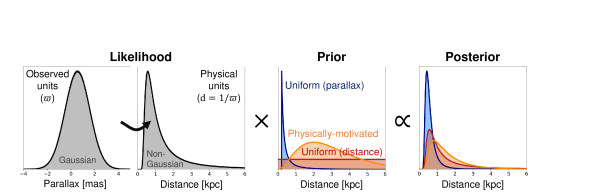
- Define the likelihood as p(y|d) or p(y|varpi) for parallax, and discuss related sampling distributions and model choices (e.g., Gaussian vs discrete).
- Discuss prior distributions (informative vs non-informative), including examples of truncated uniform and physically motivated priors for distance/parallax.
- Derive posterior forms for single-star and cluster-distance problems and describe how to compute or approximate posteriors when closed forms are unavailable.
- Explain posterior predictive checks as a diagnostic tool to compare real data with data simulated from the posterior predictive distribution.
Experimental results
Research questions
- RQ1How should Bayesian notation and concepts be translated between astronomy and statistics for clarity and reproducibility?
- RQ2What are best practices for specifying priors and likelihoods in astronomical Bayesian models, and how do these choices affect posterior inference?
- RQ3How can posterior distributions be used and validated for distance estimation from parallax data, including for star clusters?
- RQ4What role do posterior predictive checks play in assessing model adequacy and computational methods in astrostatistics?
Key findings
- A clear translation of Bayesian notation helps researchers interpret results across disciplines.
- Priors have a substantial impact on posteriors, especially with limited data or when parameterizations change the prior’s implications (e.g., distance vs parallax).
- Physically motivated priors (e.g., d^2 e^{-d/L}) better reflect space densities than naïve uniform priors in distance.
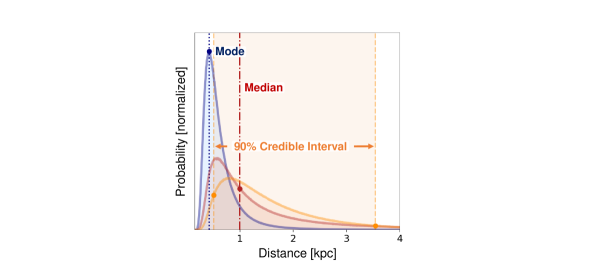
- Posterior distributions can be multi-modal or skewed, requiring visualization and appropriate summaries beyond simple means or 1-sigma intervals.
- Posterior predictive checks are useful for model assessment and for diagnosing sampling or model misspecification.
- The running parallax example demonstrates how to combine multiple measurements and how to propagate uncertainties to derived quantities.
Better researchstarts right now
From reading papers to final review, dramatically reduce your research time.
No credit card · Free plan available
This review was created by AI and reviewed by human editors.