
[Paper Review] Pre-training of Lightweight Vision Transformers on Small Datasets with Minimally Scaled Images
This paper demonstrates that lightweight Vision Transformers (ViTs) can outperform ResNets on small datasets like CIFAR-10 and CIFAR-100 using Masked Auto-Encoder (MAE) pre-training with minimal image scaling. By applying MAE with learnable positional embeddings and a 75% masking ratio, the authors achieve state-of-the-art accuracy—96.41% on CIFAR-10 and 96.01% on CIFAR-100—using models with under 3.7 million parameters and minimal computational cost.
Can a lightweight Vision Transformer (ViT) match or exceed the performance of Convolutional Neural Networks (CNNs) like ResNet on small datasets with small image resolutions? This report demonstrates that a pure ViT can indeed achieve superior performance through pre-training, using a masked auto-encoder technique with minimal image scaling. Our experiments on the CIFAR-10 and CIFAR-100 datasets involved ViT models with fewer than 3.65 million parameters and a multiply-accumulate (MAC) count below 0.27G, qualifying them as 'lightweight' models. Unlike previous approaches, our method attains state-of-the-art performance among similar lightweight transformer-based architectures without significantly scaling up images from CIFAR-10 and CIFAR-100. This achievement underscores the efficiency of our model, not only in handling small datasets but also in effectively processing images close to their original scale.
Motivation & Objective
- Investigate whether lightweight Vision Transformers (ViTs) can match or exceed CNNs like ResNet on small datasets with minimal image scaling.
- Address the performance gap between ViTs and CNNs in low-data regimes by leveraging self-supervised pre-training.
- Demonstrate that ViTs can achieve state-of-the-art performance without architectural modifications like convolutional inductive biases or image upscaling.
- Evaluate the effectiveness of Masked Auto-Encoder (MAE) pre-training on small-scale images (32×32) with minimal augmentation.
- Establish a benchmark for efficient, small-parameter ViT models that are competitive with larger or more complex architectures on small datasets.
Proposed method
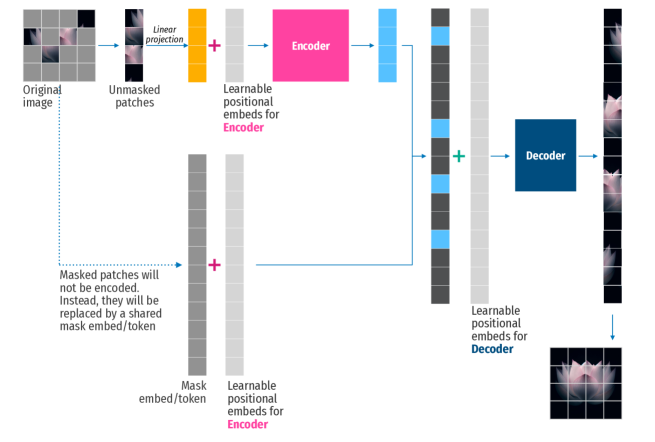
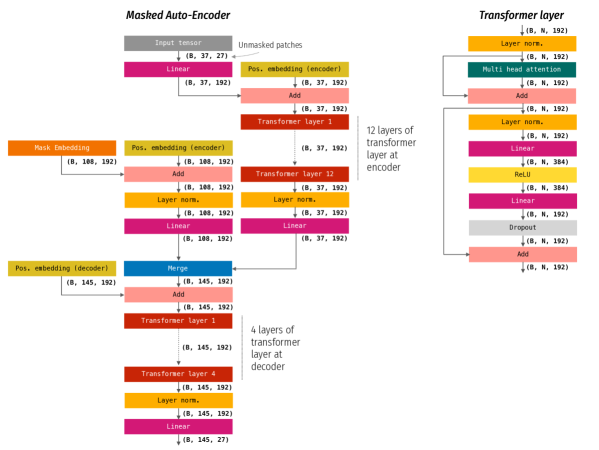
- Adopt a Masked Auto-Encoder (MAE) framework with a 75% patch masking ratio, where only 25% of patches are fed into the encoder.
- Use learnable positional embeddings in both the encoder and decoder instead of sinusoidal embeddings, improving spatial awareness and adaptability.
- Design a separate decoder with learnable positional embeddings and a flexible architecture independent from the encoder to enhance reconstruction quality.
- Compute a combined loss function that includes both masked patch reconstruction (using MSE) and a discounted loss on unmasked patches to stabilize training.
- Fine-tune the pre-trained ViT models on downstream classification tasks using standard cross-entropy loss and standard optimization protocols.
- Train models with minimal image scaling—only increasing resolution from 32×32 to 36×36—to preserve original data fidelity and reduce computational overhead.
Experimental results
Research questions
- RQ1Can a lightweight Vision Transformer achieve superior performance to ResNet on small datasets like CIFAR-10 and CIFAR-100 without image upscaling?
- RQ2Does MAE pre-training with minimal data augmentation and small image resolutions enable ViTs to overcome their lack of inductive bias in low-data regimes?
- RQ3How does the use of learnable positional embeddings in both encoder and decoder affect reconstruction and downstream classification performance?
- RQ4Can ViTs pre-trained on one dataset generalize effectively to another when fine-tuned, or is in-domain pre-training essential?
- RQ5What is the impact of a combined loss function (masked + unmasked patch loss) on training stability and model generalization?
Key findings
- The proposed MAE-pretrained ViT models, Mae-ViT-C10 and Mae-ViT-C100, achieved 96.41% and 96.01% top-1 accuracy on CIFAR-10 and CIFAR-100 respectively, surpassing state-of-the-art lightweight ViT models.
- The ViT-Lite-7/4 model, which has similar parameter count (3.72M) and MACs (0.26G) to the MAE models, achieved only 93.57% and 73.94% accuracy, demonstrating the superiority of the MAE pre-training strategy.
- The models outperform other ViT variants such as CVT-7/4 (94.01% on CIFAR-100) and CCT-7/3×2 (95.04% on CIFAR-10), even without additional convolutional inductive biases.
- Pre-training on one dataset and fine-tuning on another led to faster convergence but slightly lower final performance, indicating that in-domain pre-training is more effective.
- Reconstruction quality improved progressively over training, with visible refinement in image details by epoch 3020, confirming effective feature learning.
- The use of a discounted loss on unmasked patches improved training stability and contributed to better generalization, especially in early training phases.
Better researchstarts right now
From reading papers to final review, dramatically reduce your research time.
No credit card · Free plan available
This review was created by AI and reviewed by human editors.