
[Paper Review] Primordial Black Holes from Supercooled Phase Transitions
This paper proposes that primordial black holes (PBHs) can form during strongly supercooled first-order phase transitions in the early universe, where delayed bubble nucleation in causal patches leads to large density contrasts due to prolonged vacuum domination. The key result is that PBHs form abundantly when the phase transition duration exceeds 12% of a Hubble time (β/H ≲ 8), with abundance independent of supercooling duration, consistent with the de Sitter no-hair conjecture.
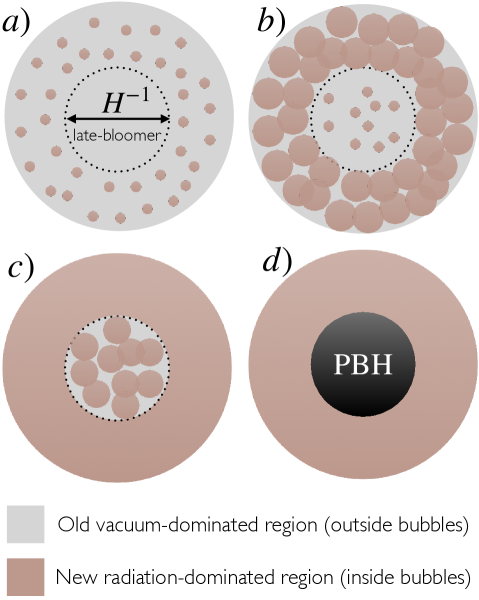
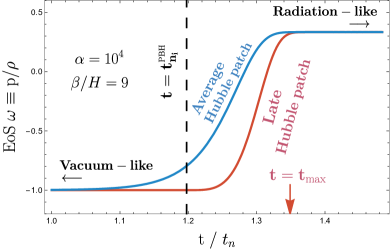
Cosmological first-order phase transitions (1stOPTs) are said to be strongly supercooled when the nucleation temperature is much smaller than the critical temperature. These are often encountered in theories that admit a nearly scale-invariant potential, for which the bounce action decreases only logarithmically with temperature. During supercooled 1stOPTs the equation of state of the universe undergoes a rapid and drastic change, transitioning from vacuum-domination to radiation-domination. The statistical variations in bubble nucleation histories imply that distinct causal patches percolate at slightly different times. Patches which percolate the latest undergo the longest vacuum-domination stage and as a consequence develop large over-densities triggering their collapse into primordial black holes (PBHs). We derive an analytical approximation for the probability of a patch to collapse into a PBH as a function of the 1stOPT duration, $β^{-1}$, and deduce the expected PBH abundance. We find that 1stOPTs which take more than $12\%$ of a Hubble time to complete ($β/H \lesssim 8$) produce observable PBHs. Their abundance is independent of the duration of the supercooling phase, in agreement with the de Sitter no hair conjecture.
Motivation & Objective
- To investigate the formation of primordial black holes (PBHs) via delayed nucleation in supercooled first-order phase transitions (1stOPTs).
- To quantify the probability of PBH formation as a function of phase transition duration, β⁻¹.
- To determine the threshold for observable PBH production in cosmological and astrophysical constraints.
- To derive an analytical approximation for PBH collapse probability that matches numerical simulations.
Proposed method
- Models the universe as a mixture of vacuum energy (ρ_V) and radiation (ρ_R), with equation of state ω = -1 during supercooling.
- Uses an exponential bubble nucleation rate per unit volume, Γ_V(t) = Γ₀e^{βt}, with β derived from the bounce action near nucleation temperature.
- Applies the causal volume approximation under exponential expansion to compute survival probability of late-nucleating patches.
- Derives the collapse probability P_coll as a function of β/H_n, δ_c, and Hubble rate, using the survival probability of patches with no prior nucleation.
- Fits a semi-analytical formula P_coll ≈ exp[−a(β/H_n)^b(1+δ_c)^{cβ/H_n}] to numerical results, with fitted parameters a≈0.5646, b≈1.266, c≈0.6639.
- Validated against numerical calculations and compared to the analytical approximation from causal volume and tunneling rate.
Experimental results
Research questions
- RQ1What is the probability that a causal patch with delayed bubble nucleation collapses into a primordial black hole during a supercooled first-order phase transition?
- RQ2How does the duration of the phase transition (β⁻¹) affect the abundance of PBHs formed via this mechanism?
- RQ3At what threshold does the PBH abundance become observationally significant, and what is the dependence on supercooling duration?
- RQ4How does the collapse probability depend on the density contrast threshold δ_c and the Hubble rate during the transition?
- RQ5To what extent does the de Sitter no-hair conjecture hold in this PBH formation mechanism?
Key findings
- PBHs are produced abundantly when the phase transition duration exceeds 12% of a Hubble time, corresponding to β/H ≲ 8.
- The PBH abundance is independent of the length of the supercooling phase, consistent with the de Sitter no-hair conjecture.
- The collapse probability is well-approximated by a semi-analytical formula P_coll ≈ exp[−a(β/H_n)^b(1+δ_c)^{cβ/H_n}] with fitted parameters a≈0.5646, b≈1.266, c≈0.6639.
- Numerical results show better agreement with the fitted formula than with the analytical approximation derived from causal volume and exponential rate.
- The mechanism predicts observable PBHs with masses set by the sound horizon at the time of transition, with constraints from CMB, microlensing, and gravitational waves.
- The model explains PBH formation in theories with nearly scale-invariant potentials, where the bounce action decreases slowly with temperature, enabling long supercooling phases.
Better researchstarts right now
From reading papers to final review, dramatically reduce your research time.
No credit card · Free plan available
This review was created by AI and reviewed by human editors.