
[Paper Review] Probing the high temperature symmetry breaking with gravitational waves from domain walls
The paper analyzes high-temperature Z2 symmetry breaking leading to domain wall formation and annihilation, producing gravitational waves; it links the GW signal to the symmetry-breaking energy scale and discusses potential explanations for NANOGrav data as well as testable predictions for future detectors.
The symmetry can be broken at high temperature and then restored at low temperature, which is the so-called \emph{high temperature symmetry breaking}. It often appears in some theories such as the high scale electroweak baryogenesis mechanism. In this paper, we probe the high temperature $\mathbb{Z}_2$ symmetry breaking with gravitational waves (GWs) from domain wall annihilation. We first introduce a scalar with $\mathbb{Z}_2$ symmetry and few of singlet fermions that interact with scalar through a five-dimension operator. This can lead to the scalar potential has a non-zero minimum at high temperature. At the early stage, the scalar is pinned at symmetric phase due to the large Hubble fraction. When the scalar thermal mass becomes comparable to the Hubble parameter, it can quickly roll down to the minimum of potential. Then the $\mathbb{Z}_2$ symmetry is spontaneously broken and the domain walls will form. With the decrease of temperature, $\mathbb{Z}_2$ symmetry will be restored. We find that if domain walls are formed at $\mathcal{O}(10^{9})~ m GeV$, the GW produced by domain wall annihilation is expected to be observed by BBO, CE and ET. In addition, we also discuss the relationships between this scenario and NANOGrav signal.
Motivation & Objective
- Motivate and model high-temperature Z2 symmetry breaking via a real scalar with a five-dimension interaction with singlet fermions.
- Derive the temperature-dependent domain-wall tension and formation/annihilation conditions to avoid the domain-wall problem.
- Compute the gravitational wave spectrum from domain-wall annihilation and relate peak frequency/amplitude to the symmetry-breaking scale.
- Connect the GW predictions to current and future GW observatories and discuss potential links to NANOGrav signals.
Proposed method
- Introduce a real scalar φ with Z2 symmetry and Nf singlet fermions ψ coupled through a φ^2/M_pl operator.
- Use a finite-temperature effective potential V_eff(φ,T) that yields a high-temperature minimum and Z2 breaking, with κ = Nf mψ / M_pl.
- Derive the temperature-dependent domain-wall tension σ_wall(T) ∝ T^3 and the condition to avoid domain-wall overclosure (ρ_wall/ρ_rad < 1).
- Analyze domain-wall formation at T_i and annihilation timing t_ann ≈ t_i in the radiation-dominated era.
- Compute the GW spectrum from domain-wall annihilation with peak amplitude Ω_gw(t_ann)_peak and present-day Ω_gw h^2_peak via established relations (Ω_gw h^2)_peak ≈ 9×10^-14 (κ^4/λ^2) (100/g_*(T_i))^{7/3} and f_gw_peak ≈ 2×10^11 Hz sqrt(κ) (100/g_*(T_i))^{1/3}.
Experimental results
Research questions
- RQ1What parameter ranges of κ and λ yield high-temperature Z2 breaking with domain walls that annihilate during radiation domination?
- RQ2How does the temperature dependence of domain-wall tension affect the cosmological evolution and avoid the domain-wall problem?
- RQ3What are the characteristics (amplitude and peak frequency) of gravitational waves from domain-wall annihilation as a function of the symmetry-breaking scale?
- RQ4Can the predicted GW spectra accommodate or explain current hints of stochastic backgrounds such as NANOGrav while remaining testable by future detectors?
- RQ5What observational signatures in future GW experiments could confirm high-temperature symmetry breaking via domain walls?
Key findings
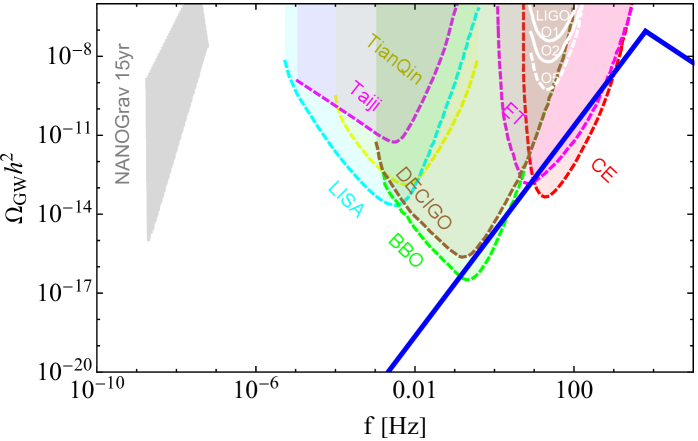
- For κ ∼ 10^-15 and λ ∼ 10^-33, Z2 is broken around 10^9 GeV, with GW peak at approximately 10^3–10^4 Hz, potentially detectable by BBO, CE, and ET.
- For κ ∼ 10^-38 and λ ∼ 10^-78, symmetry breaking occurs near 10 MeV, with GW peak near 10^-8 Hz, potentially explaining the NANOGrav 15-year signal and also detectable at higher frequencies by LISA, TianQin, DECIGO, and BBO.
- The GW peak amplitude today follows Ω_gw h^2_peak ≈ 9×10^-14 × (κ^4/λ^2) × (100/g_*(T_i))^{7/3}.
- The peak frequency today scales as f_gw_peak ≈ 2×10^11 Hz × sqrt(κ) × (100/g_*(T_i))^{1/3}.
- The model predicts a temperature-dependent domain-wall tension σ_wall(T) ∝ T^3, causing rapid decay of domain-wall energy density and avoiding the usual domain-wall overclosure problem.
- If κ is extremely small (∼10^-38) and λ very tiny, ultralight fermions with masses ∼10^-11 eV could arise, potentially linking to ultralight fermionic dark matter concepts.

Better researchstarts right now
From reading papers to final review, dramatically reduce your research time.
No credit card · Free plan available
This review was created by AI and reviewed by human editors.