
[Paper Review] Pure Spectroscopic Constraints on UV Luminosity Functions and Cosmic Star Formation History From 25 Galaxies at $z_\mathrm{spec}=8.61-13.20$ Confirmed with JWST/NIRSpec
The paper derives UV luminosity functions and cosmic star formation rate densities from 25 spectroscopically confirmed galaxies at high redshift ($z_{ m spec}=8.61-13.20$) using JWST/NIRSpec, providing pure spectroscopic constraints and lower limits that challenge certain rapid-evolution models.
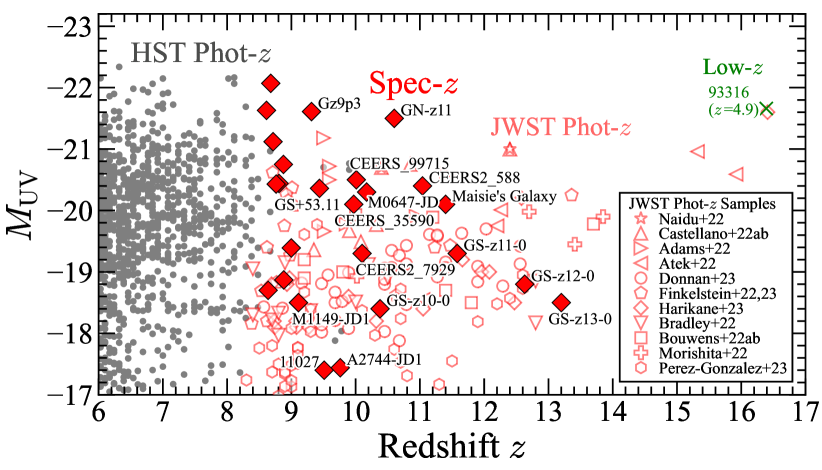
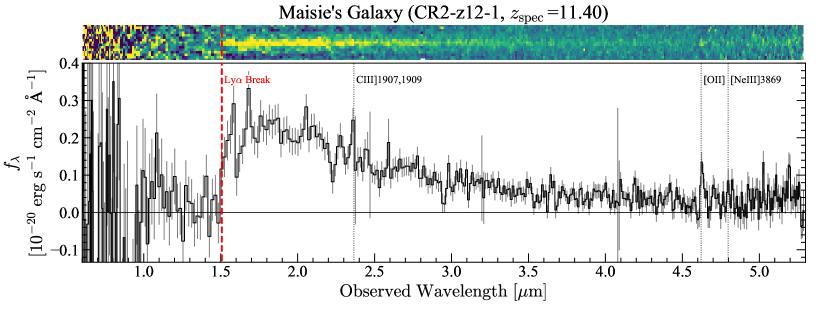
We present pure spectroscopic constraints on the UV luminosity functions and cosmic star formation rate (SFR) densities from 25 galaxies at $z_\mathrm{spec}=8.61-13.20$. By reducing the JWST/NIRSpec spectra taken in multiple programs of ERO, ERS, GO, and DDT with our analysis technique, we independently confirm 16 galaxies at $z_\mathrm{spec}=8.61-11.40$ including new redshift determinations, and a bright interloper at $z_\mathrm{spec}=4.91$ that was claimed as a photometric candidate at z~16. In conjunction with nine galaxies at redshifts up to $z_\mathrm{spec}=13.20$ in the literature, we make a sample of 25 spectroscopically-confirmed galaxies in total and carefully derive the best estimates and lower limits of the UV luminosity functions. These UV luminosity function constraints are consistent with the previous photometric estimates within the uncertainties and indicate mild redshift evolution towards z~12 showing tensions with some theoretical models of rapid evolution. With these spectroscopic constraints, we obtain firm lower limits of the cosmic SFR densities and spectroscopically confirm a high SFR density at z~12 beyond the constant star-formation efficiency models, which supports earlier claims from the photometric studies. While there are no spectroscopically-confirmed galaxies with very large stellar masses violating the $Λ$CDM model due to the removal of the bright interloper, we confirm star-forming galaxies at $z_\mathrm{spec}=11-13$ with stellar masses much higher than model predictions. Our results indicate possibilities of high star-formation efficiency (>5%), hidden AGN, top-heavy initial mass function (possibly with Pop-III), and large scatter/variance. Having these successful and unsuccessful spectroscopy results, we suggest observational strategies for efficiently removing low redshift interlopers for future JWST programs.
Motivation & Objective
- Motivate understanding of early galaxy formation through robust spectroscopic redshifts at $z>8$.
- Provide clean measurements of UV luminosity functions at $z\,\sim\,9-12$ and a lower limit on SFR densities.
- Assess evolution of the UV LF with redshift and test against rapid-evolution models.
- Explore implications for star formation efficiency, IMF, AGN activity, and interloper contamination in high-$z$ samples.
Proposed method
- Compile and reanalyze JWST/NIRSpec spectra from ERO, ERS, GO, and DDT programs to obtain secure redshifts.
- Augment with spectroscopically confirmed galaxies from the literature to build a sample of 25 objects at $z_{ m spec}=8.61-13.20$.
- Compute UV luminosity functions in three redshift bins ($z\sim9$, $z\sim10$, $z\sim12$) and an upper limit at $z\sim16$ using two effective volume estimation approaches.
- Estimate survey volumes using published effective volumes and, conservatively, NIRSpec field of view to account for selection effects.
- Derive cosmic SFR densities from the spectroscopic sample, including lower limits, and compare with models.
- Discuss strategies to identify and remove low-redshift interlopers in future JWST surveys.
Experimental results
Research questions
- RQ1What are the UV luminosity function constraints at $z\sim9$, $z\sim10$, and $z\sim12$ based on spectroscopically confirmed galaxies?
- RQ2Do the spectroscopic constraints indicate mild redshift evolution of the UV LF towards $z\sim12$?
- RQ3What are the resulting lower limits on the cosmic star formation rate densities at $z\sim9-12$, and how do they compare with constant-star-formation-efficiency models?
- RQ4Do the data reveal high stellar masses or other signatures (e.g., high star-formation efficiency, hidden AGN, top-heavy IMF) that challenge standard $\Lambda$CDM predictions?
- RQ5What observational strategies best mitigate low-redshift interlopers in JWST surveys targeting $z>10$ galaxies?
Key findings
- The UV luminosity function constraints from 25 spectroscopically confirmed galaxies are consistent with previous photometric estimates within uncertainties and show mild evolution toward $z\sim12$.
- There are firm lower limits on the cosmic SFR densities, and the data support a high SFR density at $z\sim12$ beyond constant star-formation efficiency models.
- Some spectroscopically confirmed galaxies at $z\sim11-13$ have stellar masses larger than model predictions, suggesting high star-formation efficiency or alternative processes.
- The removal of a bright interloper at $z_{spec}=4.91$ reduces tension with CDM predictions for bright $z\sim>10$ galaxies, though tensions remain in stellar mass and SFR implications.
- The study identifies potential roles for high-efficiency star formation, hidden AGN activity, a top-heavy IMF, and large scatter in high-$z$ galaxy properties, and discusses strategies to avoid low-$z$ interlopers in future JWST programs.
Better researchstarts right now
From reading papers to final review, dramatically reduce your research time.
No credit card · Free plan available
This review was created by AI and reviewed by human editors.