
[Paper Review] Quantifying Prediction Consistency Under Fine-Tuning Multiplicity in Tabular LLMs
This paper introduces a novel consistency metric to quantify prediction robustness in fine-tuned tabular LLMs without retraining multiple models. By sampling local neighborhoods in the embedding space and leveraging Bernstein’s inequality, the method provides probabilistic guarantees that high-consistency predictions remain stable across fine-tuning variants, outperforming confidence scores in predicting multiplicity susceptibility.
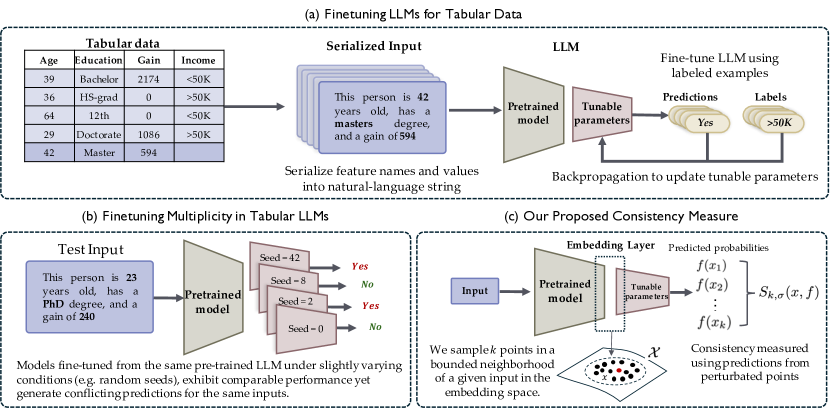
Fine-tuning LLMs on tabular classification tasks can lead to the phenomenon of fine-tuning multiplicity where equally well-performing models make conflicting predictions on the same input. Fine-tuning multiplicity can arise due to variations in the training process, e.g., seed, weight initialization, minor changes to training data, etc., raising concerns about the reliability of Tabular LLMs in high-stakes applications such as finance, hiring, education, healthcare. Our work formalizes this unique challenge of fine-tuning multiplicity in Tabular LLMs and proposes a novel measure to quantify the consistency of individual predictions without expensive model retraining. Our measure quantifies a prediction's consistency by analyzing (sampling) the model's local behavior around that input in the embedding space. Interestingly, we show that sampling in the local neighborhood can be leveraged to provide probabilistic guarantees on prediction consistency under a broad class of fine-tuned models, i.e., inputs with sufficiently high local stability (as defined by our measure) also remain consistent across several fine-tuned models with high probability. We perform experiments on multiple real-world datasets to show that our local stability measure preemptively captures consistency under actual multiplicity across several fine-tuned models, outperforming competing measures.
Motivation & Objective
- To formalize fine-tuning multiplicity in tabular LLMs, where equally accurate models produce conflicting predictions due to training variations.
- To address the impracticality of retraining multiple models to assess multiplicity in LLMs.
- To develop a computationally efficient metric that quantifies prediction robustness without retraining.
- To provide theoretical probabilistic guarantees on prediction consistency across fine-tuned model variants.
Proposed method
- Proposes a consistency metric $ S_{k, ho}(x,f) = \frac{1}{k}\sum_{x_i \in N_{x,k}} \left( f(x_i) - |f(x) - f(x_i)| \right) $, which evaluates local model behavior around an input in the embedding space.
- Samples $ k $ points from a hypersphere of radius $ \sigma $ centered at input $ x $, using the model’s embedding space for neighborhood exploration.
- Uses Bernstein’s Inequality to derive probabilistic robustness guarantees: high consistency implies high probability of prediction stability across fine-tuned models.
- Empirically evaluates consistency against standard multiplicity metrics (e.g., Arbitrariness, Pairwise Disagreement) on real tabular datasets.
- Compares consistency scores with predicted probabilities to demonstrate superior correlation with multiplicity.
- Validates the method on Adult, German Credit, and Diabetes datasets across 128-shot, 64-shot, and 512-shot settings.
Experimental results
Research questions
- RQ1To what extent do fine-tuned tabular LLMs exhibit prediction multiplicity despite similar performance?
- RQ2Can a single model’s local behavior in embedding space reliably predict susceptibility to fine-tuning multiplicity?
- RQ3How does the proposed consistency metric compare to prediction confidence in identifying multiplicity-prone predictions?
- RQ4Can theoretical probabilistic guarantees be derived for prediction consistency under fine-tuning variations?
- RQ5Is the consistency metric computationally feasible and more informative than confidence scores in practice?
Key findings
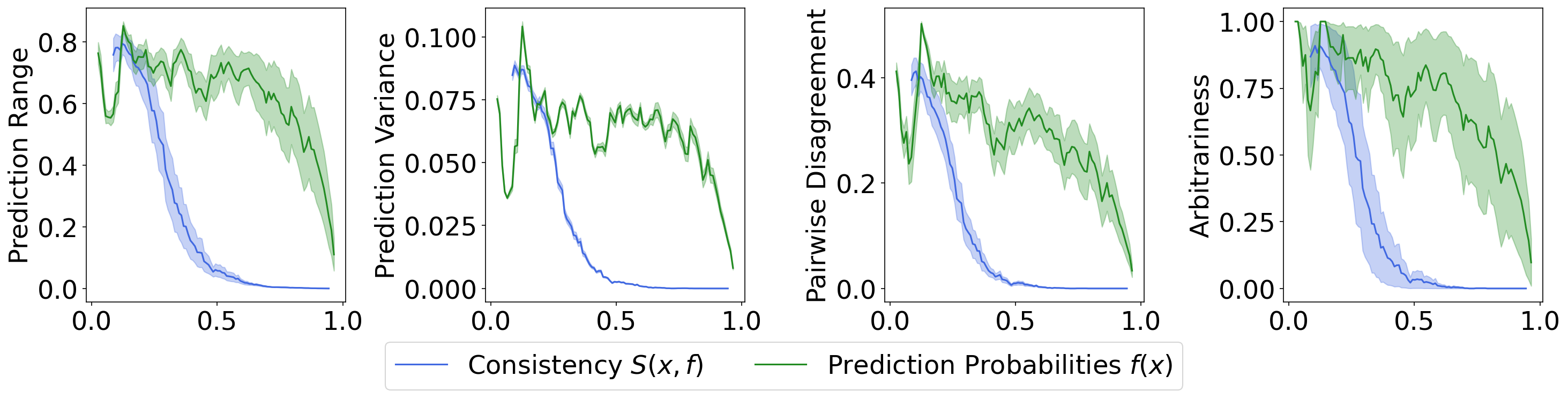
- The consistency metric shows strong Spearman correlation (up to 0.96) with multiplicity metrics like Pairwise Disagreement, significantly outperforming prediction probabilities.
- On the Adult dataset, consistency achieved a 0.80 correlation with Arbitrariness, while prediction confidence only reached 0.67.
- High prediction confidence does not imply low multiplicity; some high-confidence predictions showed high inconsistency across fine-tuned models.
- In the Diabetes dataset, consistency correlated at 0.95 with Prediction Range, indicating strong alignment with multiplicity severity.
- Theoretical guarantees via Bernstein’s Inequality confirm that high-consistency predictions are highly likely to remain consistent across fine-tuned variants.
- The method reduces the need for expensive retraining by enabling multiplicity assessment using only one model and inference on local neighborhoods.
Better researchstarts right now
From reading papers to final review, dramatically reduce your research time.
No credit card · Free plan available
This review was created by AI and reviewed by human editors.