
[Paper Review] Quantum Computing-Enhanced Algorithm Unveils Novel Inhibitors for KRAS
A hybrid quantum-classical generative model (QCBM-LSTM) trained on quantum hardware/designs KRAS inhibitors; two compounds show experimental activity, including a pan-KRAS inhibitor.
The discovery of small molecules with therapeutic potential is a long-standing challenge in chemistry and biology. Researchers have increasingly leveraged novel computational techniques to streamline the drug development process to increase hit rates and reduce the costs associated with bringing a drug to market. To this end, we introduce a quantum-classical generative model that seamlessly integrates the computational power of quantum algorithms trained on a 16-qubit IBM quantum computer with the established reliability of classical methods for designing small molecules. Our hybrid generative model was applied to designing new KRAS inhibitors, a crucial target in cancer therapy. We synthesized 15 promising molecules during our investigation and subjected them to experimental testing to assess their ability to engage with the target. Notably, among these candidates, two molecules, ISM061-018-2 and ISM061-22, each featuring unique scaffolds, stood out by demonstrating effective engagement with KRAS. ISM061-018-2 was identified as a broad-spectrum KRAS inhibitor, exhibiting a binding affinity to KRAS-G12D at $1.4 μM$. Concurrently, ISM061-22 exhibited specific mutant selectivity, displaying heightened activity against KRAS G12R and Q61H mutants. To our knowledge, this work shows for the first time the use of a quantum-generative model to yield experimentally confirmed biological hits, showcasing the practical potential of quantum-assisted drug discovery to produce viable therapeutics. Moreover, our findings reveal that the efficacy of distribution learning correlates with the number of qubits utilized, underlining the scalability potential of quantum computing resources. Overall, we anticipate our results to be a stepping stone towards developing more advanced quantum generative models in drug discovery.
Motivation & Objective
- Motivate and demonstrate the use of quantum-enhanced generative modeling to accelerate small-molecule design.
- Develop a hybrid quantum-classical framework integrating a QCBM prior with an LSTM generator for ligand design.
- Curate large, diverse KRAS-inhibitor datasets and train a model to generate synthesizable, drug-like molecules.
- Experimentally synthesize and evaluate top candidates to validate predictions against KRAS targets.
Proposed method
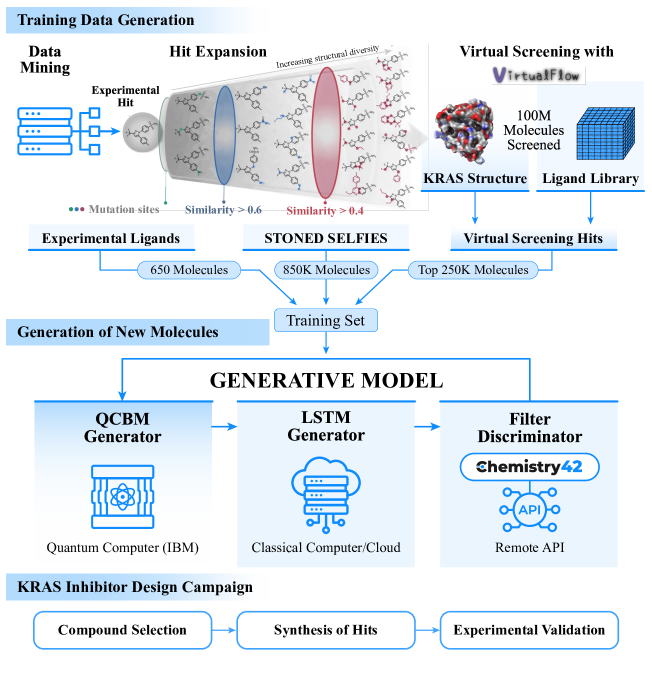
- Construct a training dataset from ~650 known KRAS inhibitors and expand to ~1 million molecules via STONED-SELFIES and virtual screening (REAL library).
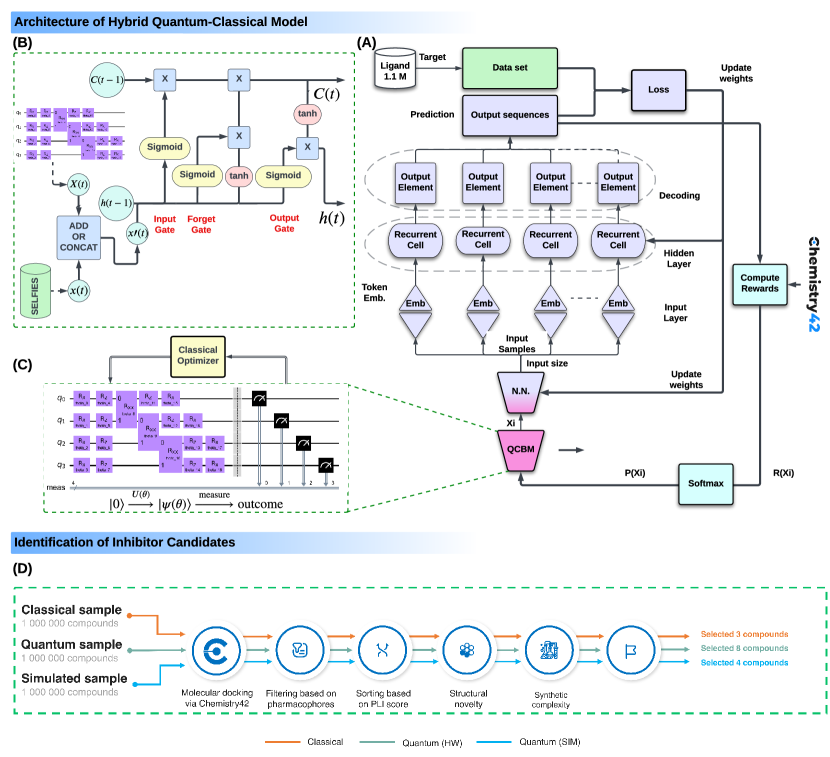
- Implement a hybrid generator with a 16-qubit QCBM as a prior and an LSTM-based classical model, using Chemistry42 as a reward signal.
- Train the model iteratively with quantum priors sampling from hardware, then merge quantum and molecular information for LSTM input.
- Evaluate generated molecules with Tartarus local filters and Chemistry42 scoring; synthesize 15 promising candidates for experimental testing.
- Experimentally validate binding and functional activity via SPR and MaMTH-DS assays; analyze structure-activity across KRAS mutants.
Experimental results
Research questions
- RQ1Does integrating a quantum prior improve the quality and diversity of generated KRAS inhibitors compared to classical baselines?
- RQ2How does the number of qubits in the quantum prior affect distribution learning and molecule quality?
- RQ3Can a quantum-enhanced generative model yield experimentally validated KRAS inhibitors?
- RQ4How do quantum-generated candidates compare to classical methods in docking scores, synthesizability, and target engagement?
Key findings
- Two synthesized compounds, ISM061-018-2 and ISM061-22, showed experimental engagement with KRAS.
- ISM061-018-2 binds KRAS-G12D with 1.4 μM affinity and acts as a pan-KRAS inhibitor.
- ISM061-22 shows mutant-selective activity, notably against KRAS G12R and Q61H mutants, with limited G12D binding.
- Quantum priors improved distribution learning and molecule quality in Tartarus benchmark tests.
- The success rate correlates roughly linearly with the number of qubits used for the quantum prior.
- This work reports the first experimentally confirmed hits attributed to a quantum algorithm in drug discovery.
Better researchstarts right now
From reading papers to final review, dramatically reduce your research time.
No credit card · Free plan available
This review was created by AI and reviewed by human editors.