
[Paper Review] Quantum Neural Networks: Concepts, Applications, and Challenges
This paper provides a comprehensive overview of quantum neural networks (QNNs), explaining their foundations in variational quantum circuits (VQCs) and their application in quantum deep learning. It outlines how QNNs use parameterized quantum gates and measurement-based optimization to perform tasks like classification and function approximation, while identifying key challenges such as barren plateaus, NISQ-era hardware limitations, and the need for clear quantum advantage over classical models.
Quantum deep learning is a research field for the use of quantum computing techniques for training deep neural networks. The research topics and directions of deep learning and quantum computing have been separated for long time, however by discovering that quantum circuits can act like artificial neural networks, quantum deep learning research is widely adopted. This paper explains the backgrounds and basic principles of quantum deep learning and also introduces major achievements. After that, this paper discusses the challenges of quantum deep learning research in multiple perspectives. Lastly, this paper presents various future research directions and application fields of quantum deep learning.
Motivation & Objective
- To provide a foundational understanding of quantum neural networks (QNNs) and their integration with deep learning principles.
- To examine the role of variational quantum circuits (VQCs) in enabling hybrid quantum-classical machine learning algorithms.
- To identify and analyze critical challenges in quantum deep learning, including gradient vanishing (barren plateaus), NISQ device limitations, and the need for verifiable quantum advantage.
- To explore practical applications of QNNs in emerging fields such as IoT, millimeter-wave networks, blockchain, and video streaming.
- To guide future research by outlining open problems and potential algorithmic designs that balance performance and near-term hardware constraints.
Proposed method
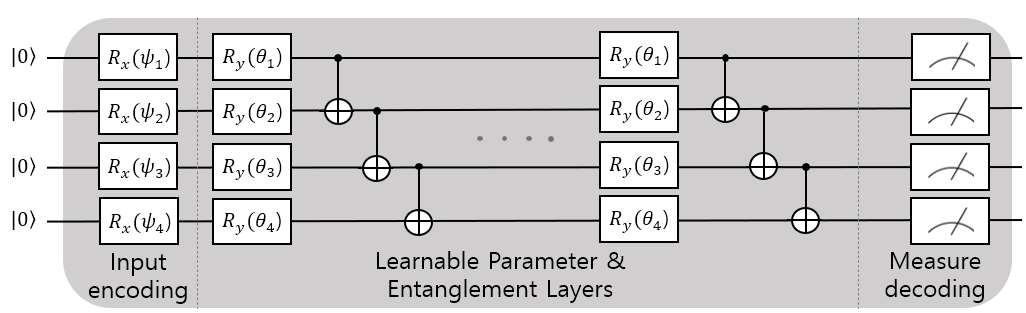
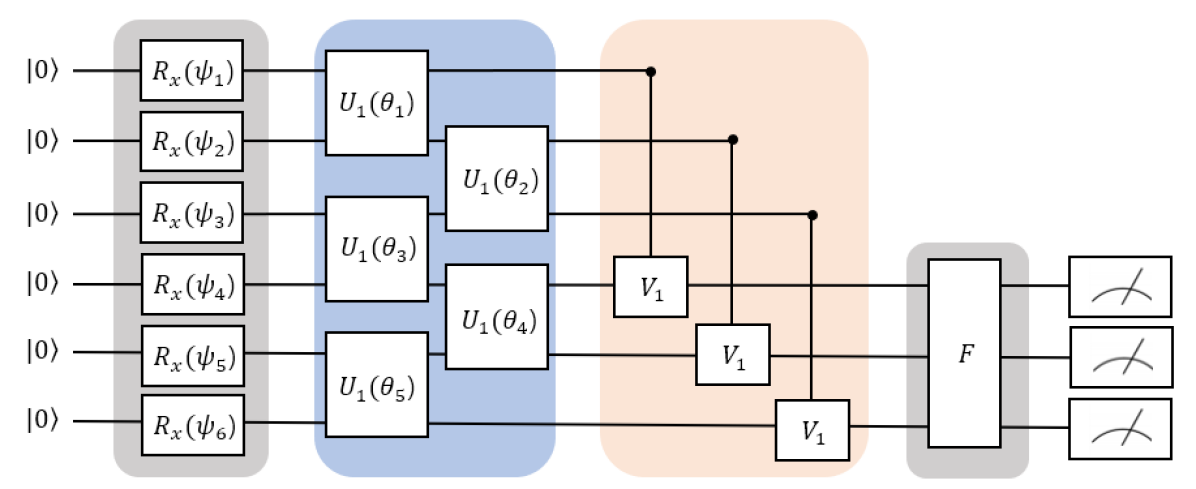
- Uses variational quantum circuits (VQCs) with parameterized rotation and entangling gates to implement quantum neural networks.
- Employs quantum state preparation to encode classical data into qubit states using amplitude or angle encoding.
- Applies measurement-based optimization by evaluating expectation values of Pauli operators (e.g., ⟨Z⟩) to extract classical outputs.
- Utilizes gradient descent for parameter optimization in a hybrid quantum-classical training loop, similar to classical backpropagation.
- Analyzes quantum advantage through theoretical analysis of universal approximation and computational speedup potential in specific tasks.
- Considers hardware constraints by evaluating circuit depth, qubit count, and error rates in near-term NISQ devices.
Experimental results
Research questions
- RQ1How can quantum circuits be structured to emulate the function of artificial neural networks using quantum superposition and entanglement?
- RQ2What are the primary challenges hindering the scalability and efficiency of quantum neural networks in current noisy intermediate-scale quantum (NISQ) devices?
- RQ3In what scenarios can quantum neural networks demonstrate a computational advantage over classical deep learning models?
- RQ4How do barren plateaus emerge in quantum neural networks, and what strategies can mitigate their impact on training?
- RQ5What are the most promising application domains for quantum deep learning in communication and network systems?
Key findings
- Quantum neural networks (QNNs) based on variational quantum circuits (VQCs) can approximate any continuous function due to their universal approximation property.
- Barren plateaus—regions of exponentially vanishing gradients—become increasingly likely as the number of qubits increases, posing a major challenge for training large-scale QNNs.
- Current NISQ devices with tens of noisy qubits and high error rates limit the practical implementation of complex quantum circuits, especially those relying on multi-qubit entangling gates.
- Despite theoretical potential, only a few variational quantum algorithms have demonstrated verifiable quantum advantage, emphasizing the need for careful algorithmic design to ensure real performance gains.
- Applications in communication networks, such as IoT, caching, video scheduling, and blockchain, are promising use cases for QNNs due to their ability to accelerate distributed computation.
- The absence of traditional activation functions in QNNs necessitates alternative strategies to avoid gradient collapse, distinguishing their training dynamics from classical deep neural networks.
Better researchstarts right now
From reading papers to final review, dramatically reduce your research time.
No credit card · Free plan available
This review was created by AI and reviewed by human editors.