
[Paper Review] Quasi-planar ICME sheath: a cause of first two-step extreme geomagnetic storm of 25th solar cycle observed on 23 April 2023
This study identifies a quasi-planar magnetic structure (PMS) within the sheath of an interplanetary coronal mass ejection (ICME) as the key driver of the first two-step extreme geomagnetic storm of Solar Cycle 25 on 23 April 2023, with Sym-H ≈ −231 nT. The less adiabatic expansion in the quasi-PMS enhanced the southward component of the interplanetary magnetic field, enabling efficient energy and plasma transfer into Earth’s magnetosphere, causing the magnetopause to compress to <6.6 RE and affecting geosynchronous satellites.
Interplanetary Coronal Mass Ejections (ICMEs) are prominent drivers of space weather disturbances and mainly lead to intense or extreme geomagnetic storms. The reported studies suggested that the planar ICME sheath and planar magnetic clouds (MCs) cause extreme storms. Here, we investigated the severe two-step geomagnetic storm ($Dst \sim -187$ nT) of 25$^{th}$ solar cycle. Our analysis demonstrates flattened (pancaked) ICME structures, i.e., quasi-planar magnetic structures (PMS). The study corroborates our earlier reported finding that the less adiabatic expansion in quasi-PMS transformed ICME enhanced the strength of the southward magnetic field component. It contributes to the efficient transfer of plasma and energy in the Earth's magnetosphere to cause the observed severe storm.
Motivation & Objective
- To investigate the physical mechanisms behind the first two-step extreme geomagnetic storm of Solar Cycle 25, observed on 23 April 2023.
- To determine the role of the ICME sheath in driving extreme storm conditions, particularly focusing on magnetic field structure and plasma dynamics.
- To examine how quasi-planar magnetic structures (PMS) in the sheath enhance the southward component of the interplanetary magnetic field (IMF).
- To assess the impact of reduced magnetopause standoff distance (<6.6 RE) on geosynchronous satellite operations.
- To validate the hypothesis that less adiabatic expansion in quasi-PMS structures intensifies energy and plasma transfer into the magnetosphere.
Proposed method
- Analysis of in-situ solar wind and magnetic field data from multiple spacecraft to identify the ICME sheath and its magnetic structure.
- Application of magnetic field geometry and PMS detection techniques to identify quasi-planar configurations in the sheath region.
- Quantitative assessment of the southward IMF component (Bz) within the quasi-PMS to evaluate its role in driving ring current intensification.
- Estimation of magnetopause standoff distance using solar wind dynamic pressure and magnetic pressure balance models.
- Correlation of observed Sym-H index minima (≈−231 nT) with the duration and intensity of the southward IMF and PMS structure.
- Use of established models for ring current dynamics and storm recovery to interpret the storm evolution.
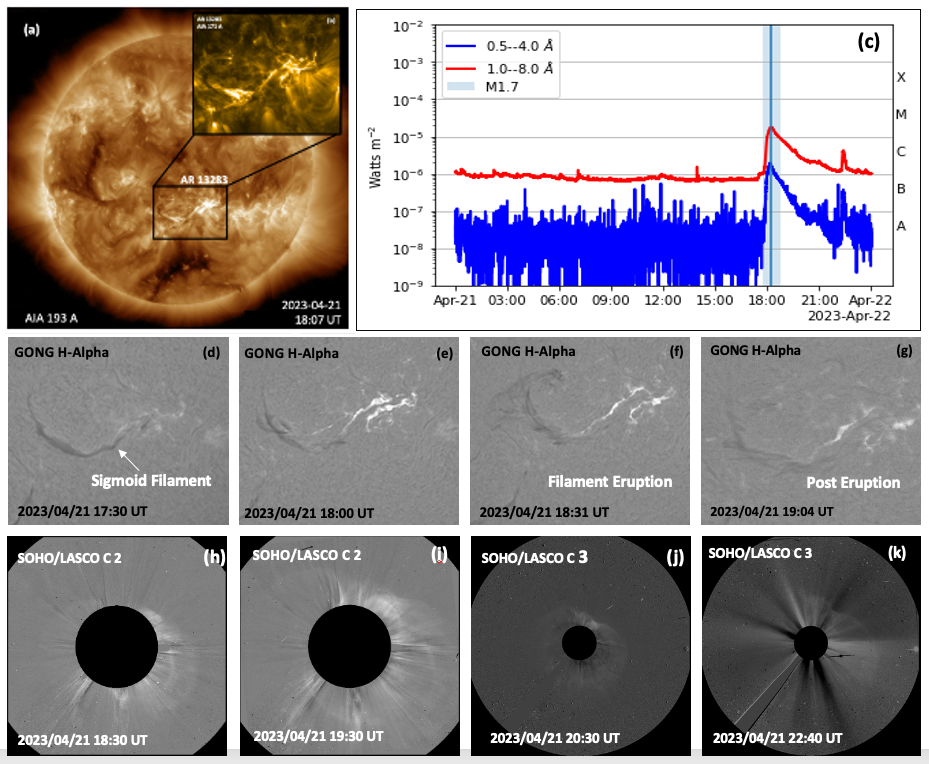
Experimental results
Research questions
- RQ1What structural features in the ICME sheath contributed to the extreme geomagnetic storm on 23 April 2023?
- RQ2How does the formation of a quasi-planar magnetic structure (PMS) in the sheath enhance the southward IMF component?
- RQ3What is the role of reduced adiabatic expansion in quasi-PMS regions in amplifying energy transfer to Earth’s magnetosphere?
- RQ4To what extent did the magnetopause compress due to the ICME impact, and what was the resulting standoff distance?
- RQ5How did the storm's two-step evolution relate to the temporal evolution of the sheath and PMS structure?
Key findings
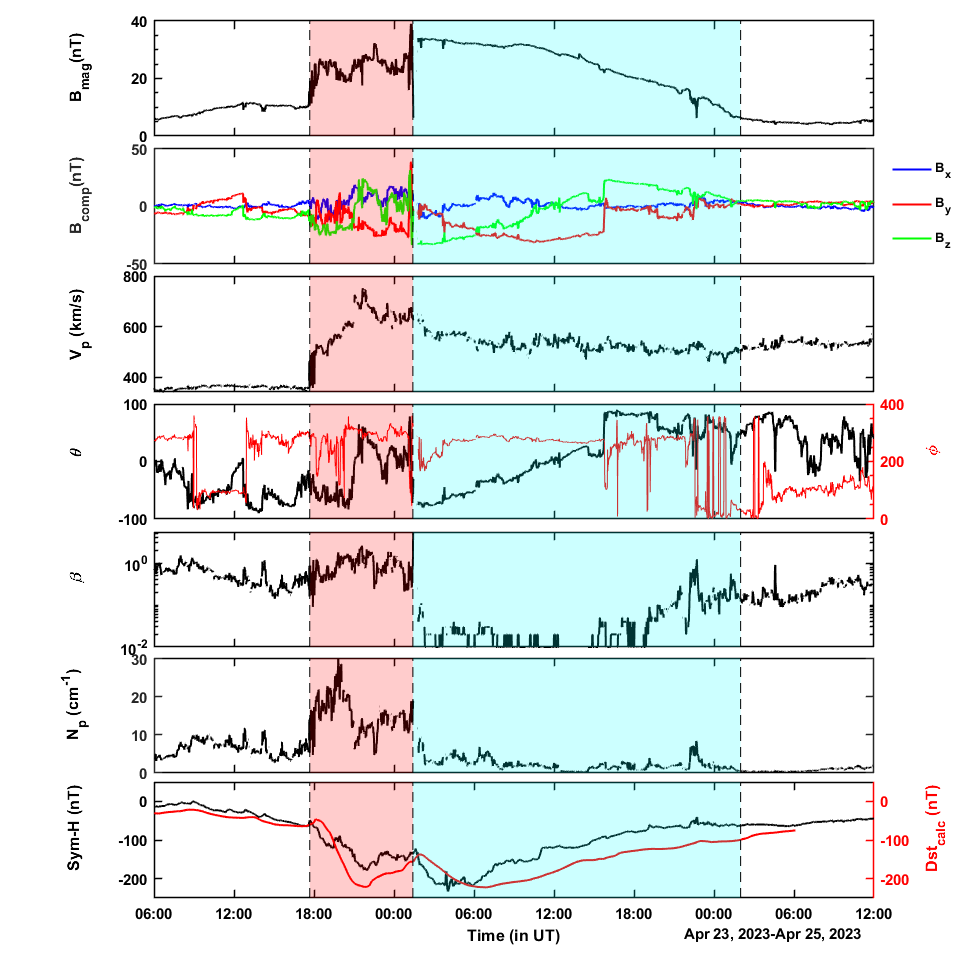
- The first two-step extreme geomagnetic storm of Solar Cycle 25 occurred on 23 April 2023, with a minimum Sym-H index of approximately −231 nT.
- The storm was driven by a quasi-planar magnetic structure (PMS) formed within the ICME sheath, which exhibited reduced adiabatic expansion compared to standard PMS models.
- This reduced adiabatic expansion enhanced the southward component of the interplanetary magnetic field (Bz), enabling prolonged and efficient coupling of solar wind energy into the magnetosphere.
- The magnetopause standoff distance compressed to less than 6.6 Earth radii (RE), significantly impacting geosynchronous satellites operating near 6 RE.
- The storm’s two-step nature was linked to the temporal evolution of the sheath and PMS, with distinct phases of Bz enhancement and sustained southward orientation.
- The findings support the hypothesis that quasi-PMS structures in ICME sheaths are critical for generating extreme geomagnetic storms due to enhanced energy transfer efficiency.
Better researchstarts right now
From reading papers to final review, dramatically reduce your research time.
No credit card · Free plan available
This review was created by AI and reviewed by human editors.