
[Paper Review] RealTime Health Monitoring Using 5G Networks: A Deep Learning-Based Architecture for Remote Patient Care
Proposes a real-time remote patient monitoring system that fuses a hybrid CNN-LSTM deep learning model with 5G URLLC to achieve sub-second latency and high prediction accuracy for multiple vital signs, evaluated on 1000 ICU patients.
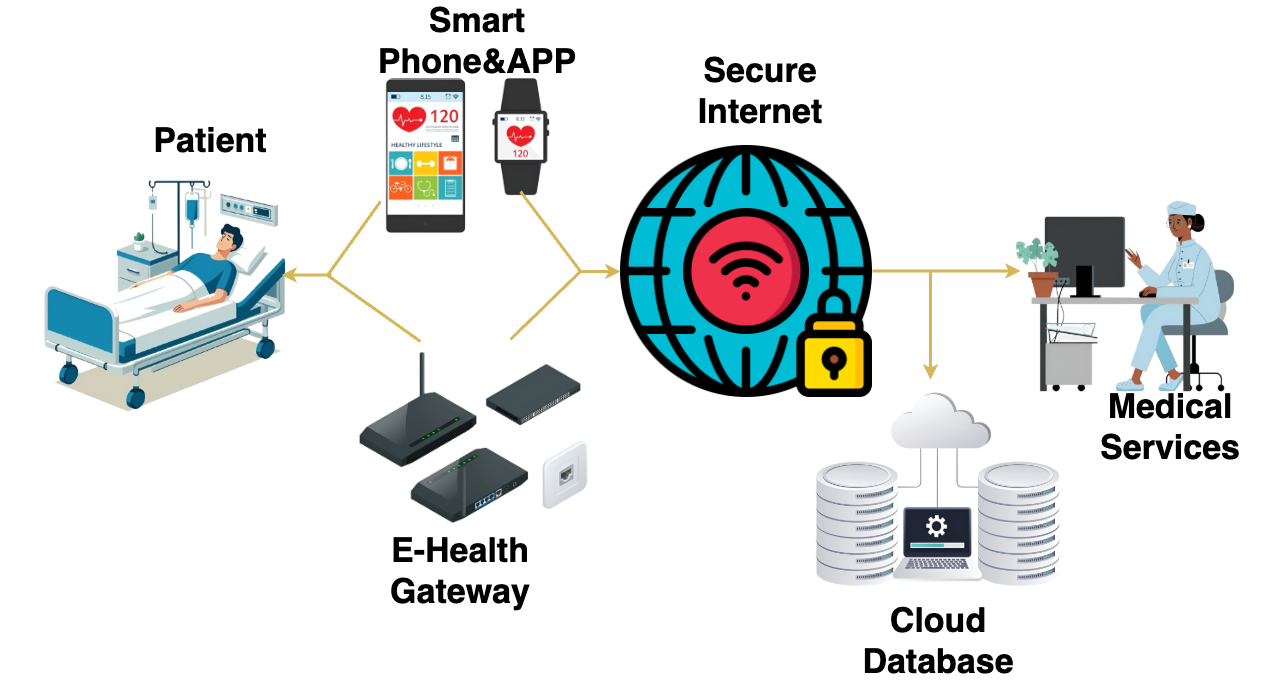
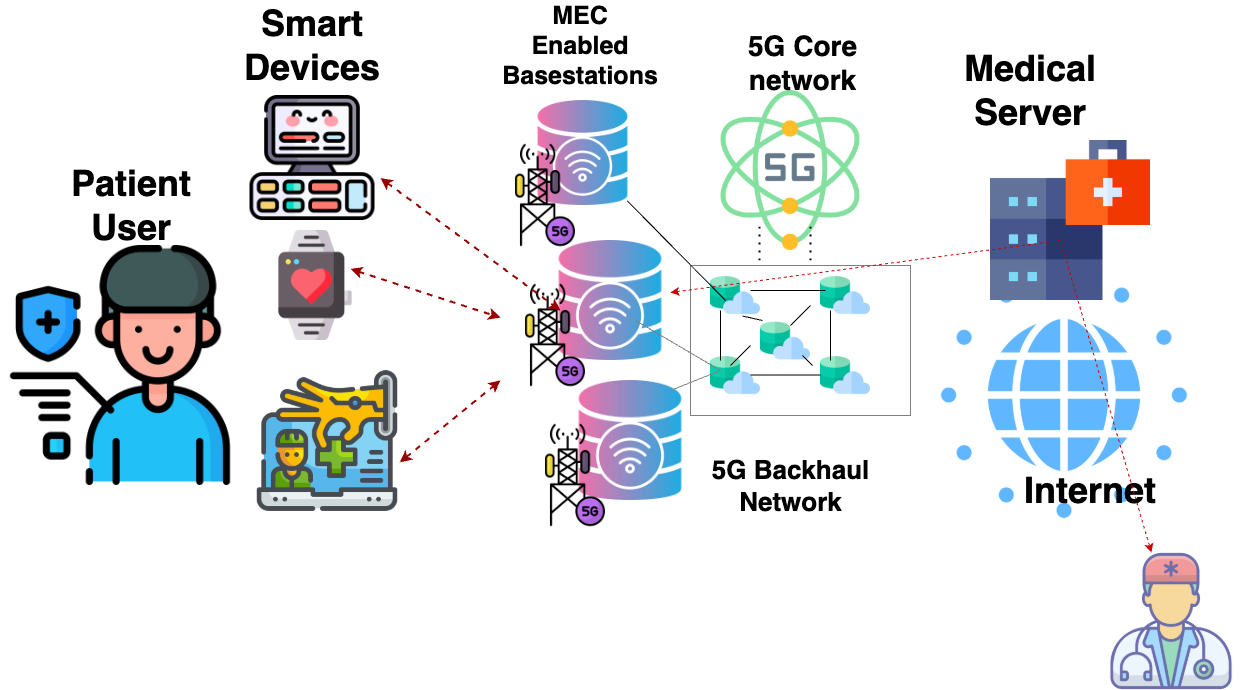
Remote patient monitoring is crucial in modern healthcare, but current systems struggle with real-time analysis and prediction of vital signs. This paper presents a novel architecture combining deep learning with 5G network capabilities to enable real-time vital sign monitoring and prediction. The proposed system utilizes a hybrid CNN-LSTM model optimized for edge deployment, paired with 5G Ultra-Reliable Low-Latency Communication (URLLC) for efficient data transmission. The architecture achieves end-to-end latency of 14.4ms while maintaining 96.5% prediction accuracy across multiple vital signs. Our system shows significant improvements over existing solutions, reducing latency by 47% and increasing prediction accuracy by 4.2% compared to current state-of-the-art systems. Performance evaluations conducted over three months with data from 1000 patients validate the system's reliability and scalability in clinical settings. The results demonstrate that integrating deep learning with 5G technology can effectively address the challenges of real-time patient monitoring, leading to early detection of deteriorating conditions and improved clinical outcomes. This research establishes a framework for reliable, real-time vital sign monitoring and prediction in digital healthcare.
Motivation & Objective
- Address the limitations of existing remote patient monitoring (RPM) systems in real-time vital sign analysis and prediction.
- Develop a deep learning framework optimized for edge deployment to process multivariate vital signs in real time.
- Leverage 5G URLLC with network slicing to minimize transmission latency and improve reliability.
- Demonstrate end-to-end real-time performance with sub-second latency and high predictive accuracy across vital signs.
- Validate the approach with large-scale clinical data and assess scalability and practicality in clinical settings.
Proposed method
- Develops a hybrid CNN-LSTM neural network with an attention mechanism for multivariate vital sign analysis.
- Implements edge deployment and model quantization to meet real-time constraints.
- Integrates 5G URLLC with network slicing to guarantee QoS and sub-millisecond latency for vital sign data.
- Employs a data processing pipeline with sliding windows (500 samples, stride 100) and adaptive filtering for signal quality.
- Trains and optimizes the model using Bayesian optimization (Optuna), with a cosine-annealing learning rate schedule.
- Evaluates end-to-end latency and accuracy on data from 1000 ICU patients using a three-month deployment.
Experimental results
Research questions
- RQ1Can a CNN-LSTM architecture with attention provide accurate real-time predictions of multiple vital signs?
- RQ2How much latency can be reduced by integrating 5G URLLC and edge computing for RPM?
- RQ3What is the end-to-end performance (accuracy and latency) of the proposed system in clinical settings with 1000 patients?
- RQ4How does the proposed system compare to existing RPM solutions in terms of accuracy, latency, and resource efficiency?
- RQ5What deployment and data-processing strategies are required to scale the solution in real-world healthcare environments?
Key findings
- End-to-end latency achieved: 14.4 ms with sub-10 ms processing in stages and 18.9 ms peak.
- Prediction MAEs: Heart Rate 1.82%, Blood Pressure 2.14%, Respiratory Rate 1.95%.
- Overall system accuracy: 96.5% across critical care, 95.8% post-operative, 97.2% general ward.
- Proposed system outperforms Systems A–C in latency and accuracy, with 47% latency reduction and 4.2% higher accuracy over the next-best system.
- Resource utilization remains efficient with CPU ~45%, GPU ~38%, memory ~52%, network ~6.2 Mbps under 10 Mbps allocation.
- End-to-end latency breakdown confirms sub-millisecond network transmission and impactful edge processing.
Better researchstarts right now
From paper design to paper writing, dramatically reduce your research time.
No credit card · Free plan available
This review was created by AI and reviewed by human editors.