
[Paper Review] Reformulation and generalisation of the air-gap element
This paper reformulates the air-gap macro element for electromagnetic finite element analysis, enabling efficient and accurate modeling of rotor rotation, skewing, and eccentricity using Fast Fourier Transforms and the Conjugate Gradient method. The approach achieves computational efficiency comparable to sliding-surface and moving-band techniques while restoring the air-gap element's viability for complex 2D and 3D machine simulations.
The air-gap macro element is reformulated such that rotation, rotor or stator skewing and rotor eccentricity can be incorporated easily. The air-gap element is evaluated using Fast Fourier Transforms which in combination with the Conjugate Gradient algorithm leads to highly efficient and memory inexpensive iterative solution scheme. The improved air-gap element features beneficial approximation properties and is competitive to moving-band and sliding-surface technique.
Motivation & Objective
- Address the numerical inefficiency of the traditional air-gap element, which introduces dense blocks in sparse finite element systems.
- Rehabilitate the air-gap element approach by enabling efficient iterative solution strategies suitable for industrial-scale simulations.
- Extend the air-gap element to naturally incorporate rotor rotation, skewing, and dynamic eccentricity in 2D and 3D electromagnetic models.
- Develop a stable, high-accuracy method for computing torque and unbalanced magnetic pull using harmonic decomposition of the air-gap field.
Proposed method
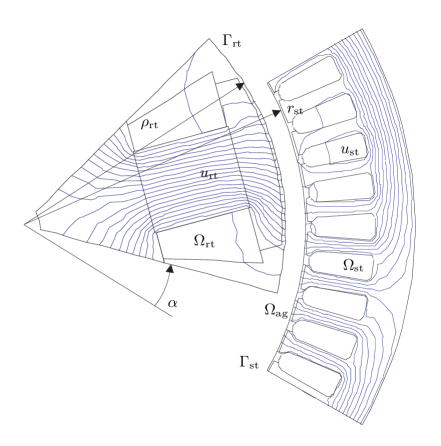
- Reformulate the air-gap element as a spectral-element discretization in the air gap using harmonic basis functions.
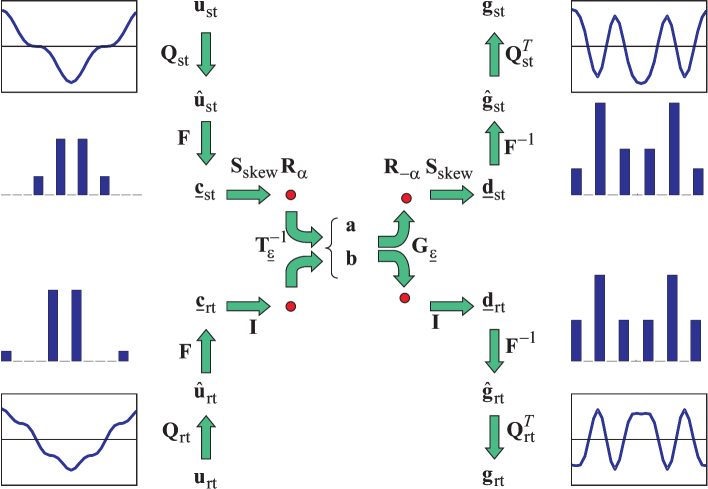
- Use Fast Fourier Transforms (FFT) to compute harmonic coefficients of the air-gap field, enabling efficient system assembly.
- Integrate rotor rotation, skewing, and eccentricity into the air-gap operator via time- and angle-dependent transformation matrices.
- Apply the Conjugate Gradient (CG) method with algebraic multigrid (AMG) preconditioning for iterative solution of the coupled system.
- Model stator-rotor coupling via interface conditions at the air-gap, with harmonic weighting of tangential magnetic field components.
- Compute torque and unbalanced magnetic pull using closed-form expressions derived from harmonic field coefficients in the complex plane.
Experimental results
Research questions
- RQ1Can the air-gap element be reformulated to efficiently and naturally incorporate rotor rotation, skewing, and eccentricity?
- RQ2Does the FFT-based spectral formulation of the air-gap element lead to a memory-efficient and fast iterative solution scheme?
- RQ3How does the proposed method compare in computational cost and accuracy to established techniques like moving-band and sliding-surface methods?
- RQ4Can the harmonic decomposition of the air-gap field enable accurate and stable computation of torque and unbalanced magnetic pull?
- RQ5Is the reformulated air-gap element numerically stable under transient rotor motion, including small displacements and rotations?
Key findings
- The reformulated air-gap element enables natural and convenient modeling of rotor rotation, skewing, and eccentricity through parameterized transformation matrices.
- The use of FFTs for harmonic coefficient computation leads to a highly efficient and memory-inexpensive iterative solution scheme using CG with AMG preconditioning.
- The method achieves computational performance comparable to moving-band and sliding-surface techniques, despite the original air-gap element's dense matrix structure.
- Transient simulations show no torque ripple, confirming numerical stability under small rotor displacements and rotations.
- The harmonic-based formulation allows highly accurate computation of torque and unbalanced magnetic pull via closed-form expressions involving complex field coefficients.
- System setup time is significantly reduced during transient simulations, as only transformation parameters (not mesh reconstructions) need updating between time steps.
Better researchstarts right now
From reading papers to final review, dramatically reduce your research time.
No credit card · Free plan available
This review was created by AI and reviewed by human editors.