
[Paper Review] Relaxation of Multitime Statistics in Quantum Systems
This paper demonstrates that multitime correlation functions in generic isolated quantum many-body systems equilibrate to those of a thermalized process over long times, even when the system is initially out of equilibrium. Using the effective dimension as a key parameter, the authors show that most multitime observables become indistinguishable from equilibrium ones unless probed with an exponentially large number of measurements, implying that nonequilibrium features are effectively hidden in typical measurements.
Equilibrium statistical mechanics provides powerful tools to understand physics at the macroscale. Yet, the question remains how this can be justified based on a microscopic quantum description. Here, we extend the ideas of pure state quantum statistical mechanics, which focus on single time statistics, to show the equilibration of isolated quantum processes. Namely, we show that most multitime observables for sufficiently large times cannot distinguish a nonequilibrium process from an equilibrium one, unless the system is probed for an extremely large number of times or the observable is particularly fine-grained. A corollary of our results is that the size of non-Markovianity and other multitime characteristics of a nonequilibrium process also equilibrate.
Motivation & Objective
- To understand how equilibrium statistical mechanics emerges from unitary quantum dynamics in isolated systems.
- To investigate whether multitime correlation functions—beyond single-time expectation values—can distinguish nonequilibrium processes from equilibrium ones.
- To determine under what conditions multitime observables equilibrate, particularly in the context of non-Markovianity and operational quantum processes.
- To establish a general framework using process tensors and instruments to analyze equilibration of operationally relevant quantum features.
- To quantify the conditions under which nonequilibrium signatures become undetectable in practice, despite being theoretically present.
Proposed method
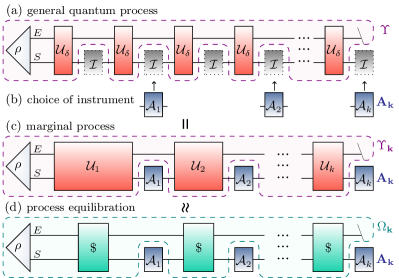
- The authors reformulate multitime correlation functions as expectation values of a single operator acting on a process tensor, enabling analysis of time-ordered observables.
- They define an equilibrium process Ω as a dephased version of the original unitary process Υ, using the dephasing map with respect to the system Hamiltonian.
- The key analytical tool is the effective dimension $ d_{\mathrm{eff}}[\sigma] = 1 / \mathrm{tr}[\$(\sigma)^2] $, which quantifies the complexity of the quantum state and determines the rate of equilibration.
- They use numerical simulations with random matrix Hamiltonians and random initial states to test equilibration of non-Markovianity and multitime observables across varying bath dimensions.
- The process is probed via multitime instruments (e.g., sequences of measurements), and the difference between the original process Υ and the equilibrium process Ω is computed for various instruments.
- The analysis includes both long-time and finite-time regimes, with results averaged over multiple random realizations of system-bath Hamiltonians and initial states.
Experimental results
Research questions
- RQ1Can multitime correlation functions in isolated quantum systems distinguish a nonequilibrium process from an equilibrium one?
- RQ2Under what conditions do multitime observables equilibrate, and how does the effective dimension influence this equilibration?
- RQ3To what extent are nonequilibrium features—such as non-Markovianity—effectively hidden from typical measurements?
- RQ4How does the number of required measurements scale to detect nonequilibrium behavior in multitime processes?
- RQ5Is the equilibration of multitime statistics a generic feature of generic many-body quantum systems?
Key findings
- For most multitime instruments, the expectation values of observables in a nonequilibrium unitary process Υ become indistinguishable from those in an equilibrium dephased process Ω, with error bounded by $ 1/d_{\mathrm{eff}} $.
- The average absolute difference in non-Markovianity between the unitary process Υℓ and the equilibrium process Ω was $ \sigma_{\rm av} = 1.8 \times 10^{-4} $, while for Υℓ it was $ 1.0 \times 10^{-3} $, indicating strong equilibration.
- The equilibration error scales inversely with the effective dimension $ d_{\mathrm{eff}} $, which grows exponentially with system size in realistic many-body systems.
- Numerical simulations with a single qubit coupled to a random matrix environment show that non-Markovianity equilibrates over long times, while short-time processes remain sensitive to initial conditions.
- The results imply that detecting nonequilibrium features in multitime processes requires an exponentially large number of measurements, making them effectively unobservable in typical scenarios.
- The framework successfully captures the equilibration of operationally relevant features such as non-Markovianity, confirming that such properties also relax to equilibrium values.

Better researchstarts right now
From reading papers to final review, dramatically reduce your research time.
No credit card · Free plan available
This review was created by AI and reviewed by human editors.