
[Paper Review] Reprogramming Pretrained Language Models for Protein Sequence Representation Learning
This paper introduces R2DL, a framework that reprograms pretrained English language models for protein sequence representation learning by learning a sparse linear mapping between English and protein vocabulary embeddings. R2DL achieves state-of-the-art performance with up to 10⁵× higher data efficiency than standard supervised and pretrained baselines across diverse protein property and function prediction tasks.
Machine Learning-guided solutions for protein learning tasks have made significant headway in recent years. However, success in scientific discovery tasks is limited by the accessibility of well-defined and labeled in-domain data. To tackle the low-data constraint, recent adaptions of deep learning models pretrained on millions of protein sequences have shown promise; however, the construction of such domain-specific large-scale model is computationally expensive. Here, we propose Representation Learning via Dictionary Learning (R2DL), an end-to-end representation learning framework in which we reprogram deep models for alternate-domain tasks that can perform well on protein property prediction with significantly fewer training samples. R2DL reprograms a pretrained English language model to learn the embeddings of protein sequences, by learning a sparse linear mapping between English and protein sequence vocabulary embeddings. Our model can attain better accuracy and significantly improve the data efficiency by up to $10^5$ times over the baselines set by pretrained and standard supervised methods. To this end, we reprogram an off-the-shelf pre-trained English language transformer and benchmark it on a set of protein physicochemical prediction tasks (secondary structure, stability, homology, stability) as well as on a biomedically relevant set of protein function prediction tasks (antimicrobial, toxicity, antibody affinity).
Motivation & Objective
- To address the challenge of limited labeled data in protein machine learning by enabling data-efficient representation learning.
- To develop a lightweight alternative to computationally expensive, domain-specific pretraining of large protein language models.
- To explore cross-domain transfer learning by repurposing high-capacity, off-the-shelf English language models for protein sequences.
- To improve data efficiency in protein representation learning without training models from scratch.
- To enable high-performance protein property and function prediction using minimal labeled data.
Proposed method
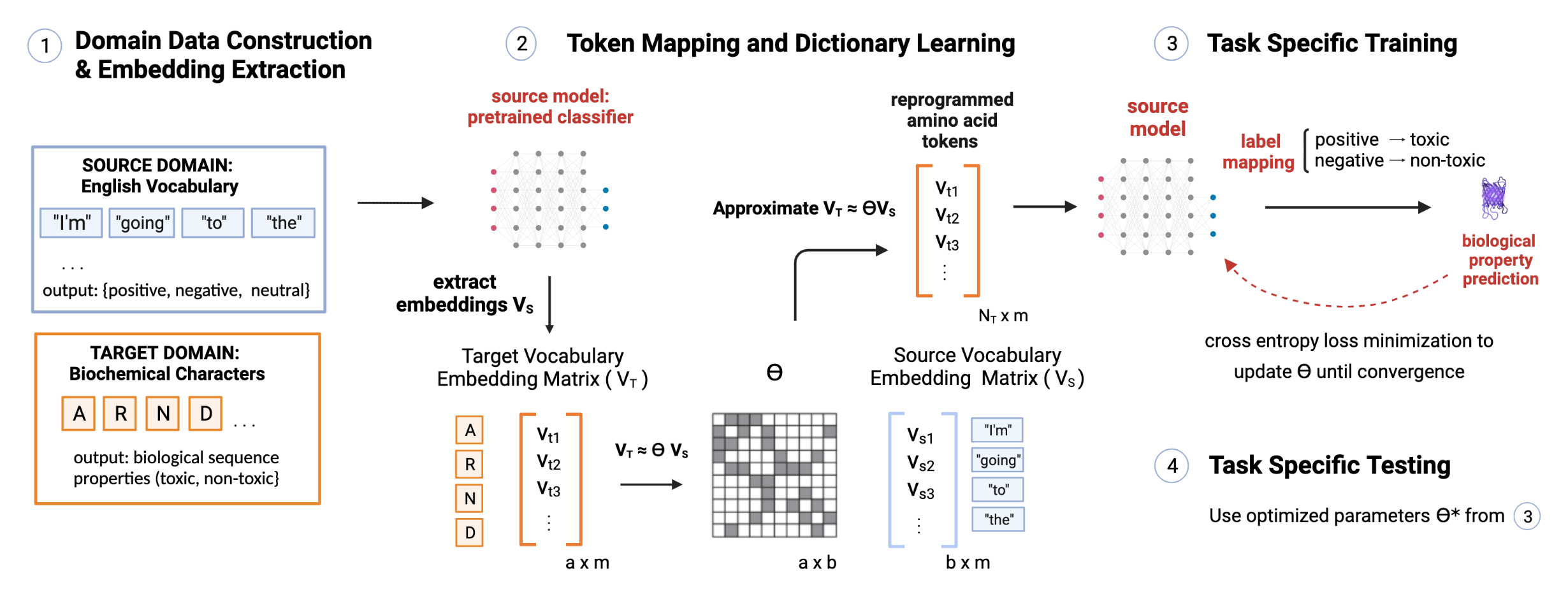
- R2DL reprograms a pretrained English transformer by learning a sparse linear transformation between its token embeddings and protein sequence embeddings.
- The method uses k-SVD-based dictionary learning to learn a sparse mapping from English language model embeddings to protein sequence embeddings.
- A regularized objective function with L₀ norm enforces sparsity in the learned transformation matrix to improve generalization and data efficiency.
- The framework is trained end-to-end on protein sequences using the learned mapping, without fine-tuning the original language model.
- The model leverages the pre-learned linguistic inductive biases of the English language model to capture biologically meaningful representations in protein sequences.
- The approach is evaluated across multiple protein tasks, including secondary structure, stability, solubility, homology, and function prediction (antimicrobial, toxicity, antibody affinity).
![Figure 1 : Left: Descriptions of considered predictive tasks. We select the set of physicochemical property prediction tasks from the well-studied domains in [ 6 ] , and the biomedical function prediction tasks from works with biomedically relevant small-szied labeled datasets [ 3 ; 14 ] . Center: W](https://ar5iv.labs.arxiv.org/html/2301.02120/assets/new_figs/fig_1.png)
Experimental results
Research questions
- RQ1Can a pretrained English language model be effectively reprogrammed to learn meaningful protein sequence representations without fine-tuning?
- RQ2To what extent can cross-domain transfer from natural language to protein sequences improve data efficiency in protein machine learning tasks?
- RQ3How does the performance of R2DL compare to standard supervised training and domain-specific pretraining in low-data regimes?
- RQ4Can sparse linear mapping between language model embeddings and protein sequences yield competitive results across diverse biological tasks?
- RQ5What is the upper bound of data efficiency achievable with reprogrammed foundation models in protein representation learning?
Key findings
- R2DL achieves state-of-the-art performance on all evaluated protein prediction tasks, including secondary structure, stability, solubility, homology, antimicrobial activity, toxicity, and antibody affinity prediction.
- The model improves data efficiency by up to 10⁵× compared to standard supervised training and pretrained baselines, enabling high accuracy with minimal labeled data.
- On the antimicrobial prediction task, R2DL achieves 88% accuracy with only 6,489 training samples, matching the performance of a pretrained transformer but with significantly fewer data requirements.
- On the toxicity prediction task, R2DL attains 93.78% accuracy using just 8,153 labeled samples, outperforming standard supervised methods in low-data settings.
- For the homology classification task, R2DL achieves 26% Top-1 accuracy with 10,438 training samples, matching the performance of an LSTM baseline but with a much more efficient framework.
- The framework demonstrates broad adaptability across diverse biological tasks, including physicochemical property prediction and biomedically relevant function prediction, with consistent gains in data efficiency.
Better researchstarts right now
From reading papers to final review, dramatically reduce your research time.
No credit card · Free plan available
This review was created by AI and reviewed by human editors.