
[Paper Review] Resource Allocation for Secure MISO-NOMA Cognitive Radios Relying on SWIPT
This paper proposes an artificial noise-aided cooperative jamming scheme to enhance physical-layer security in a multiple-input single-output (MISO) cognitive radio network using non-orthogonal multiple access (NOMA) and simultaneous wireless information and power transfer (SWIPT). By formulating a power minimization problem under a practical non-linear energy harvesting model and solving it via semidefinite relaxation and successive convex approximation, the scheme achieves secure communication with lower transmit power than conventional methods, demonstrating NOMA’s superiority over OMA in energy efficiency.
Cognitive radio (CR) and non-orthogonal multiple access (NOMA) are two promising technologies in the next generation wireless communication systems. The security of a NOMA CR network (CRN) is important but lacks of study. In this paper, a multiple-input single-output NOMA CRN relying on simultaneous wireless information and power transfer is studied. In order to improve the security of both the primary and secondary network, an artificial noise-aided cooperative jamming scheme is proposed. Different from the most existing works, a power minimization problem is formulated under a practical non-linear energy harvesting model. A suboptimal scheme is proposed to solve this problem based on semidefinite relaxation and successive convex approximation. Simulation results show that the proposed cooperative jamming scheme is efficient to achieve secure communication and NOMA outperforms the conventional orthogonal multiple access in terms of the power consumption.
Motivation & Objective
- Address the lack of security research in NOMA-based cognitive radio networks relying on SWIPT.
- Tackle the vulnerability of NOMA CRNs to eavesdropping by malicious energy-harvesting receivers (EHRs) due to the broadcast nature of RF signals.
- Minimize total transmit power while ensuring secrecy rates for primary and secondary users and meeting energy harvesting constraints.
- Integrate a realistic non-linear energy harvesting model into resource allocation for practical system design.
- Develop a joint beamforming and artificial noise covariance optimization framework to enhance physical-layer security in MISO-NOMA CRNs with SWIPT.
Proposed method
- Propose an artificial noise-aided cooperative jamming scheme to degrade eavesdropping channels while preserving legitimate user communication.
- Formulate a non-convex power minimization problem under quality-of-service (QoS) constraints for primary and secondary users and secrecy rate requirements.
- Incorporate a practical non-linear energy harvesting model to reflect real-world RF-to-DC conversion inefficiencies.
- Apply semidefinite relaxation (SDR) to handle rank constraints in beamforming design and transform the problem into a tractable form.
- Use successive convex approximation (SCA) to iteratively solve the non-convex optimization problem and converge to a suboptimal solution.
- Apply Gaussian randomization to recover suboptimal beamforming vectors when the rank of the solution matrices exceeds one.
Experimental results
Research questions
- RQ1How can physical-layer security be enhanced in a MISO-NOMA cognitive radio network that uses SWIPT?
- RQ2What is the impact of using a non-linear energy harvesting model on the design of secure resource allocation in NOMA CRNs?
- RQ3Can cooperative jamming with artificial noise improve secrecy rates while minimizing total transmit power in SWIPT-enabled NOMA CRNs?
- RQ4How does NOMA compare to conventional OMA in terms of power efficiency and security performance under the same SWIPT and security constraints?
- RQ5What is the convergence behavior and computational efficiency of the proposed joint beamforming and artificial noise optimization algorithm?
Key findings
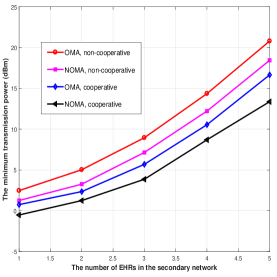
- The proposed cooperative jamming scheme significantly reduces the required transmit power compared to a scheme without jamming, enhancing security by degrading eavesdropper channels.
- The algorithm converges within a few iterations (as shown in Fig. 2b), indicating high computational efficiency and practical feasibility.
- NOMA outperforms OMA (specifically time-division multiple access) in terms of power consumption, demonstrating its advantage in spectral efficiency and energy efficiency.
- The use of a non-linear energy harvesting model leads to more accurate and realistic power constraints, resulting in better system performance compared to idealized linear models.
- Simulation results confirm that the proposed scheme satisfies all QoS and secrecy rate constraints while meeting minimum energy harvesting requirements for EHRs.
- The suboptimal solution via SCA and Gaussian randomization achieves near-optimal performance, validating the effectiveness of the proposed optimization framework.
Better researchstarts right now
From reading papers to final review, dramatically reduce your research time.
No credit card · Free plan available
This review was created by AI and reviewed by human editors.