
[Paper Review] Revealing Emergent Magnetic Charge in an Antiferromagnet with Diamond Quantum Magnetometry
This study demonstrates that diamond quantum magnetometry (DQM) enables direct detection of emergent magnetic charge distributions in the antiferromagnet hematite (α-Fe₂O₃), revealing monopolar, dipolar, and quadrupolar charge textures via mapping stray magnetic fields from canted moments. The key contribution is the experimental realization of a duality between staggered spin vorticity and emergent magnetic charge, establishing DQM as a transformative tool for probing topological spin textures in quantum materials.
Whirling topological textures play a key role in exotic phases of magnetic materials and offer promise for logic and memory applications. In antiferromagnets, these textures exhibit enhanced stability and faster dynamics with respect to ferromagnetic counterparts, but they are also difficult to study due to their vanishing net magnetic moment. One technique that meets the demand of highly sensitive vectorial magnetic field sensing with negligible backaction is diamond quantum magnetometry. Here, we show that the archetypal antiferromagnet, hematite, hosts a rich tapestry of monopolar, dipolar and quadrupolar emergent magnetic charge distributions. The direct readout of the previously inaccessible vorticity of an antiferromagnetic spin texture provides the crucial connection to its magnetic charge through a duality relation. Our work defines a novel paradigmatic class of magnetic systems to explore two-dimensional monopolar physics, and highlights the transformative role that diamond quantum magnetometry could play in exploring emergent phenomena in quantum materials.
Motivation & Objective
- To overcome the challenge of detecting topologically nontrivial spin textures in antiferromagnets due to their vanishing net magnetic moment.
- To establish a direct experimental link between staggered spin vorticity and emergent magnetic charge in antiferromagnets using vectorial magnetic field sensing.
- To demonstrate that diamond quantum magnetometry (DQM) can resolve previously inaccessible magnetic charge distributions in canted antiferromagnets like hematite.
- To validate the duality between spin texture vorticity and emergent magnetic charge through quantitative field imaging and magnetization reconstruction.
- To explore the topological classification of emergent magnetic charge in antiferromagnetic systems, distinguishing between monopolar and quadrupolar textures.
Proposed method
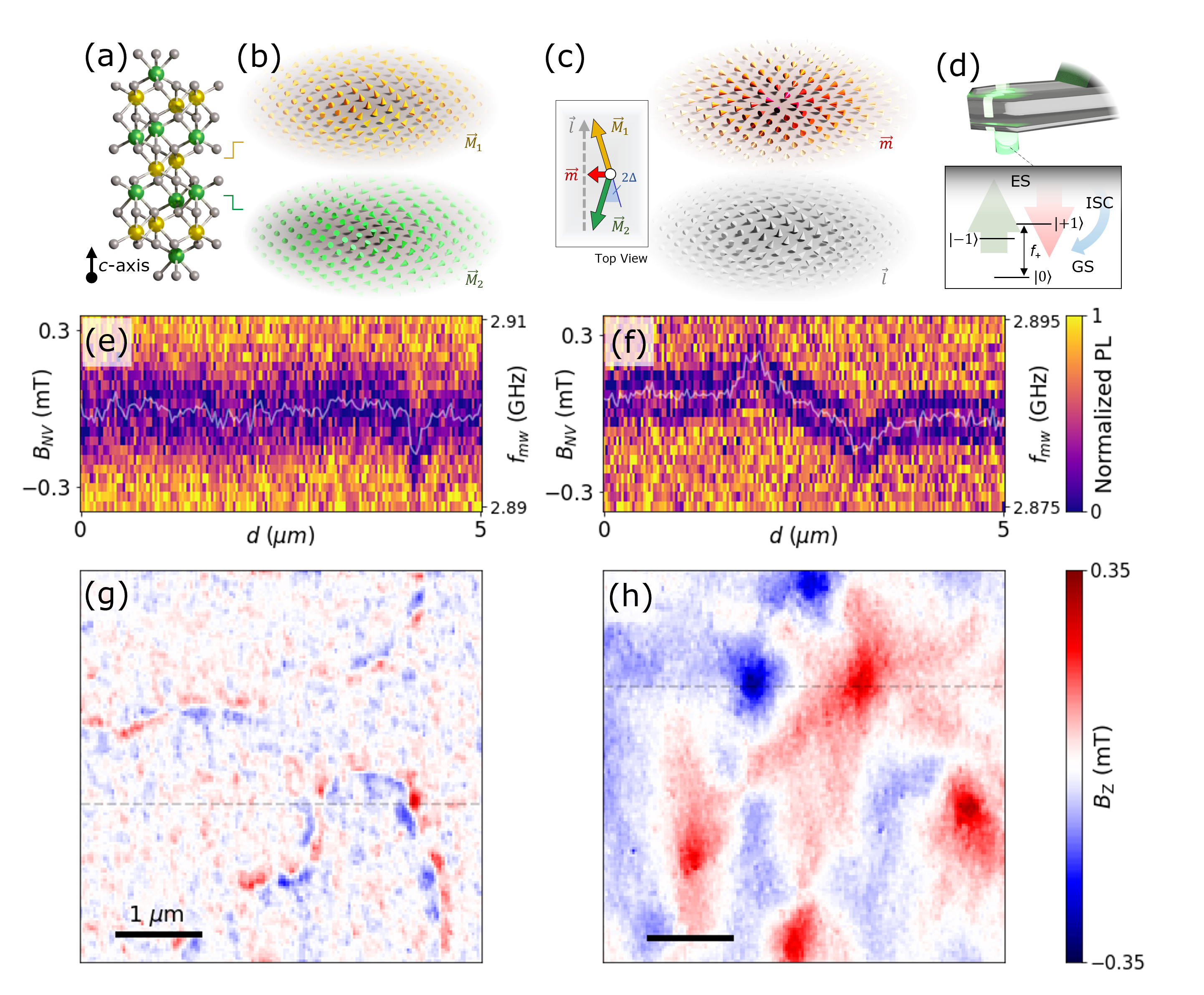
- Employing nitrogen-vacancy (NV) centers in diamond as ultrasensitive vectorial magnetic field sensors to map stray fields from hematite (α-Fe₂O₃) at cryogenic and room temperature.
- Using optically detected magnetic resonance (ODMR) to measure the Zeeman splitting of the NV center's spin sublevels, enabling high-sensitivity detection of local magnetic fields.
- Performing scanning NV magnetometry with sub-100 nm spatial resolution to image the z-component of the magnetic field (Bz) above the sample surface.
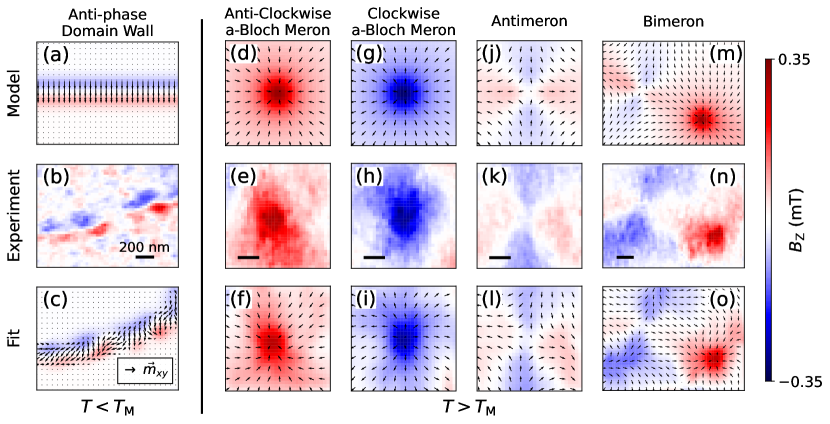
- Applying a regularization-based inverse problem approach to reconstruct the in-plane canted magnetization (m_xy) from measured Bz maps, using a minimization protocol with fixed magnitude masks.
- Utilizing a duality relation between the vorticity of the staggered magnetization (l) and emergent magnetic charge to interpret the reconstructed field patterns as topological charge distributions.
- Conducting in-situ and ex-situ magnetic field cycling experiments to probe the dynamics and annihilation of topological spin textures such as merons and antimerons.
Experimental results
Research questions
- RQ1Can diamond quantum magnetometry resolve emergent magnetic charge distributions in antiferromagnets with vanishing net magnetic moment?
- RQ2How is the vorticity of the staggered magnetization in hematite related to the distribution of emergent magnetic charges?
- RQ3What is the topological nature of the emergent magnetic charge in antiferromagnetic textures such as a-Bloch merons and antimerons?
- RQ4Can DQM imaging distinguish between topologically equivalent but oppositely charged magnetic monopoles and their quadrupolar counterparts in antiferromagnets?
- RQ5To what extent can the canted magnetization and associated stray fields be reconstructed from stray field measurements with high fidelity?
Key findings
- DQM successfully mapped the stray magnetic field (Bz) above hematite, revealing distinct field signatures associated with topological spin textures such as a-Bloch merons and antimerons.
- The reconstructed canted magnetization (m_xy) from Bz maps confirmed the presence of a right-handed (anti-clockwise) a-Bloch meron with a spatially extended emergent magnetic monopole.
- The study observed that positively and negatively charged monopolar textures are topologically equivalent, while their antiparticle exhibits a magnetic quadrupolar character.
- Field imaging at 4 K and 300 K showed clear differences in field patterns across the magnetic transition temperature (T_M), indicating temperature-dependent topological texture stability.
- In-situ and ex-situ magnetic field cycling experiments demonstrated the annihilation of merons and antimerons, confirming the topological nature of the observed textures.
- Large-area imaging at room temperature confirmed the coexistence of both right- and left-handed a-Bloch merons, indicating the absence of chiral interactions in hematite.
Better researchstarts right now
From reading papers to final review, dramatically reduce your research time.
No credit card · Free plan available
This review was created by AI and reviewed by human editors.