
[Paper Review] Revolutionizing Future Connectivity: A Contemporary Survey on AI-empowered Satellite-based Non-Terrestrial Networks in 6G
This paper proposes AI-driven solutions to overcome key challenges in satellite-based Non-Terrestrial Networks (NTN) for 6G, leveraging machine learning techniques like supervised and reinforcement learning to address long propagation delays, high Doppler shifts, dynamic handovers, and resource allocation. The integration of AI enables intelligent, adaptive management of NTN systems, enhancing performance, scalability, and reliability in future 6G networks.
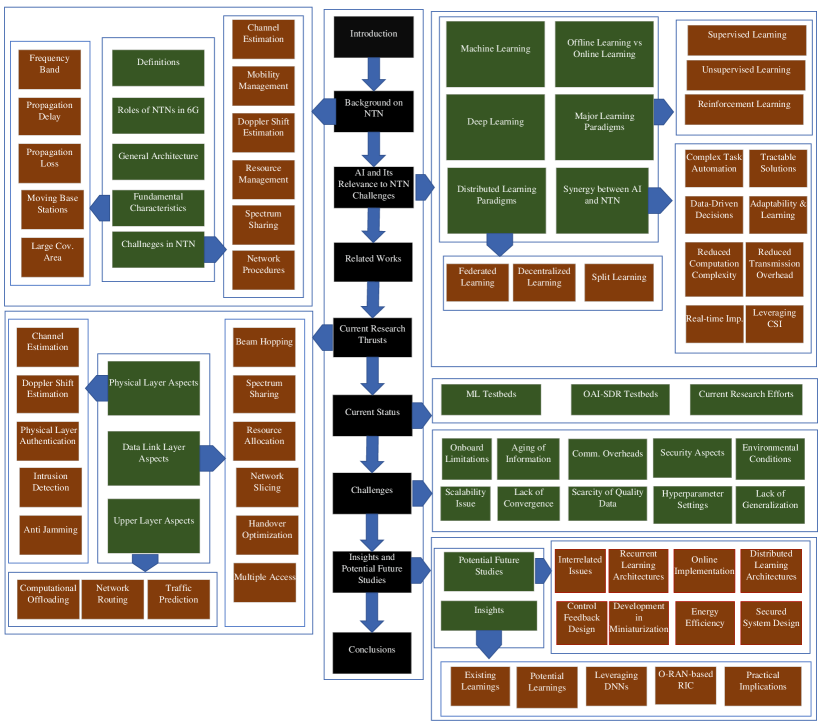
Non-Terrestrial Networks (NTN) are expected to be a critical component of 6th Generation (6G) networks, providing ubiquitous, continuous, and scalable services. Satellites emerge as the primary enabler for NTN, leveraging their extensive coverage, stable orbits, scalability, and adherence to international regulations. However, satellite-based NTN presents unique challenges, including long propagation delay, high Doppler shift, frequent handovers, spectrum sharing complexities, and intricate beam and resource allocation, among others. The integration of NTNs into existing terrestrial networks in 6G introduces a range of novel challenges, including task offloading, network routing, network slicing, and many more. To tackle all these obstacles, this paper proposes Artificial Intelligence (AI) as a promising solution, harnessing its ability to capture intricate correlations among diverse network parameters. We begin by providing a comprehensive background on NTN and AI, highlighting the potential of AI techniques in addressing various NTN challenges. Next, we present an overview of existing works, emphasizing AI as an enabling tool for satellite-based NTN, and explore potential research directions. Furthermore, we discuss ongoing research efforts that aim to enable AI in satellite-based NTN through software-defined implementations, while also discussing the associated challenges. Finally, we conclude by providing insights and recommendations for enabling AI-driven satellite-based NTN in future 6G networks.
Motivation & Objective
- Address the critical challenges of long propagation delay, high Doppler shift, and frequent handovers in satellite-based Non-Terrestrial Networks (NTN) for 6G.
- Overcome spectrum sharing complexities and dynamic resource allocation in integrated space-air-ground networks.
- Enable efficient task offloading, network routing, and network slicing in hybrid terrestrial-satellite 6G infrastructures.
- Integrate AI techniques—especially supervised and reinforcement learning—into NTN to achieve adaptive, real-time network optimization.
- Advance secure, energy-efficient, and compact system designs for onboard AI deployment in resource-constrained satellite platforms.
Proposed method
- Employ supervised learning (SL) for prediction and estimation tasks such as channel state estimation and beamforming optimization.
- Utilize reinforcement learning (RL) for closed-loop control in dynamic environments, including adaptive resource allocation and handover management.
- Implement software-defined radio (SDR) and O-RAN-based frameworks to enable flexible, AI-integrated protocol stacks for NTN testbeds.
- Design low-complexity, distributed learning architectures with efficient feedback mechanisms to support real-time AI inference on-board satellites.
- Integrate RAN Intelligent Controllers (RIC) with AI models to enable centralized intelligence for network slicing and service orchestration.
- Apply deep learning models to model complex, non-linear relationships in time-varying satellite channel conditions and user mobility patterns.
Experimental results
Research questions
- RQ1How can AI techniques such as supervised and reinforcement learning be effectively applied to mitigate long propagation delays and high Doppler shifts in satellite-based NTN?
- RQ2What are the optimal AI-driven strategies for dynamic beam and resource allocation in multi-beam, high-mobility satellite networks?
- RQ3How can AI enable seamless integration of NTN with terrestrial networks through efficient task offloading, network routing, and network slicing?
- RQ4What system-level design principles—especially in energy efficiency, security, and compactness—are essential for deploying AI on resource-constrained satellite platforms?
- RQ5How can AI-based intrusion detection and mitigation systems be designed to counter adversarial and DoS attacks in open, non-terrestrial environments?
Key findings
- AI techniques, particularly supervised and reinforcement learning, demonstrate strong potential in addressing dynamic and time-varying challenges such as Doppler shift and handover management in NTN.
- The integration of AI with software-defined and O-RAN-based architectures enables flexible, scalable, and real-time control of satellite-based networks.
- Low-complexity and distributed AI learning frameworks are essential for enabling real-time, onboard inference under strict power and computational constraints.
- Energy efficiency and compact system design are critical enablers for deploying AI on-board satellites, directly impacting the feasibility of AI-driven NTN operations.
- AI-driven security mechanisms, including anomaly detection and intrusion prevention, are necessary to counter emerging threats like adversarial attacks and data poisoning in open NTN environments.
- The convergence of AI and NTN enables a sustainable, high-performance foundation for 6G networks, supporting peak data rates up to 1 Tbps and user-experienced rates of 10 Gbps.
Better researchstarts right now
From reading papers to final review, dramatically reduce your research time.
No credit card · Free plan available
This review was created by AI and reviewed by human editors.