
[Paper Review] Robot Health Indicator: A Visual Cue to Improve Level of Autonomy Switching Systems
This paper proposes a 'Robot Health Bar'—a video game-inspired visual cue that displays real-time robot performance degradation using the Robot Vitals and Robot Health framework. In a pilot study with 8 participants, the health bar reduced reliance on manual control during low degradation but increased operator intervention during high degradation, improving risk mitigation despite slightly higher perceptual effort, and offering insights for transparent, low-workload human-robot teaming interfaces.
Using different Levels of Autonomy (LoA), a human operator can vary the extent of control they have over a robot's actions. LoAs enable operators to mitigate a robot's performance degradation or limitations in the its autonomous capabilities. However, LoA regulation and other tasks may often overload an operator's cognitive abilities. Inspired by video game user interfaces, we study if adding a 'Robot Health Bar' to the robot control UI can reduce the cognitive demand and perceptual effort required for LoA regulation while promoting trust and transparency. This Health Bar uses the robot vitals and robot health framework to quantify and present runtime performance degradation in robots. Results from our pilot study indicate that when using a health bar, operators used to manual control more to minimise the risk of robot failure during high performance degradation. It also gave us insights and lessons to inform subsequent experiments on human-robot teaming.
Motivation & Objective
- To reduce cognitive workload and perceptual effort in human-in-the-loop Level of Autonomy (LoA) switching systems for remote robot operation.
- To improve trust and transparency in human-robot interaction by visually conveying real-time robot performance degradation.
- To evaluate whether a video game-inspired visual cue (the Robot Health Bar) enhances operator decision-making during high-cognitive-load robot navigation tasks.
- To identify user preferences and design recommendations for health bar interfaces based on operator experience levels.
Proposed method
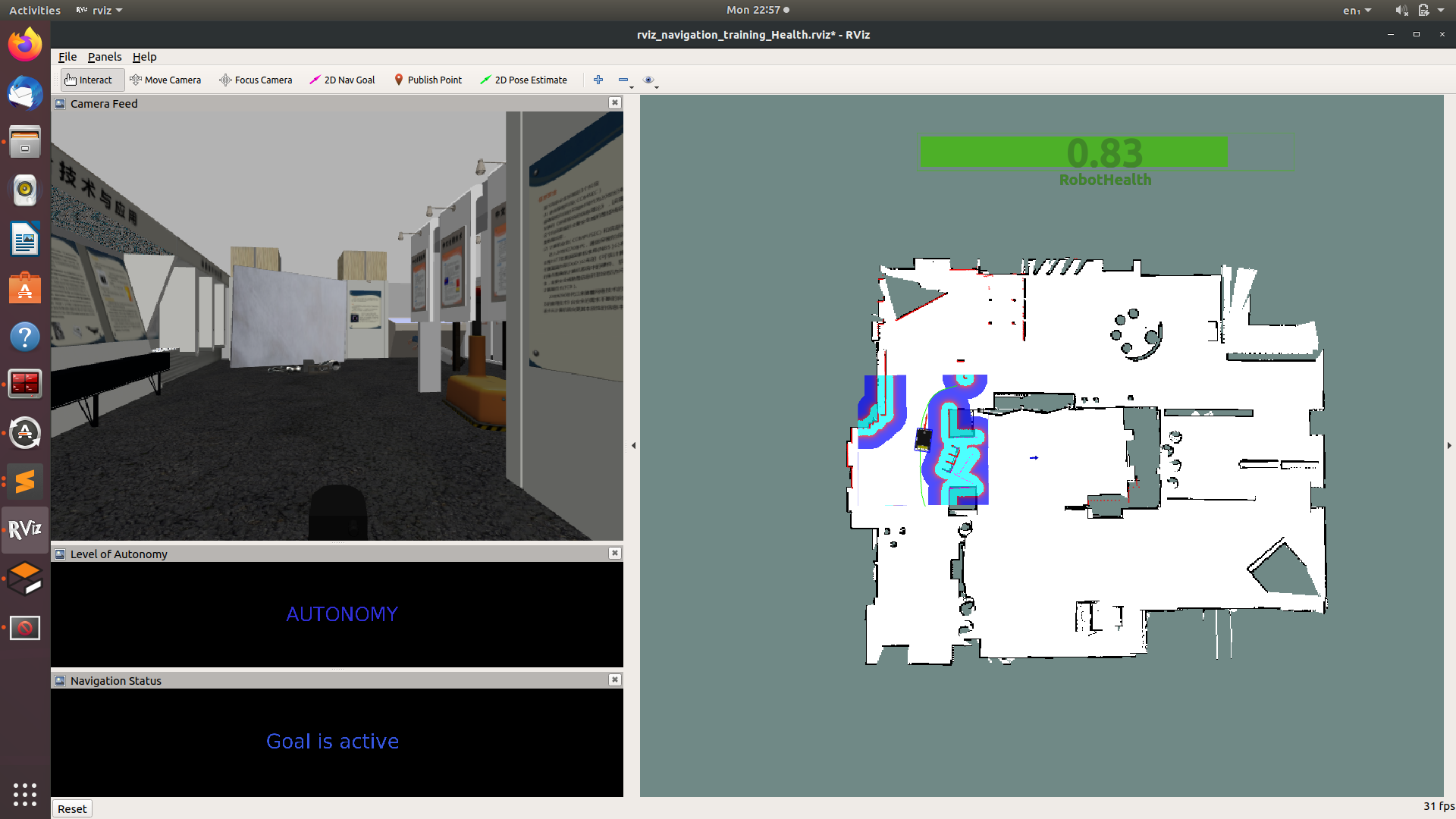
- The Robot Health Bar was implemented as a color-coded UI element reflecting total runtime performance degradation, derived from the Robot Vitals and Robot Health framework.
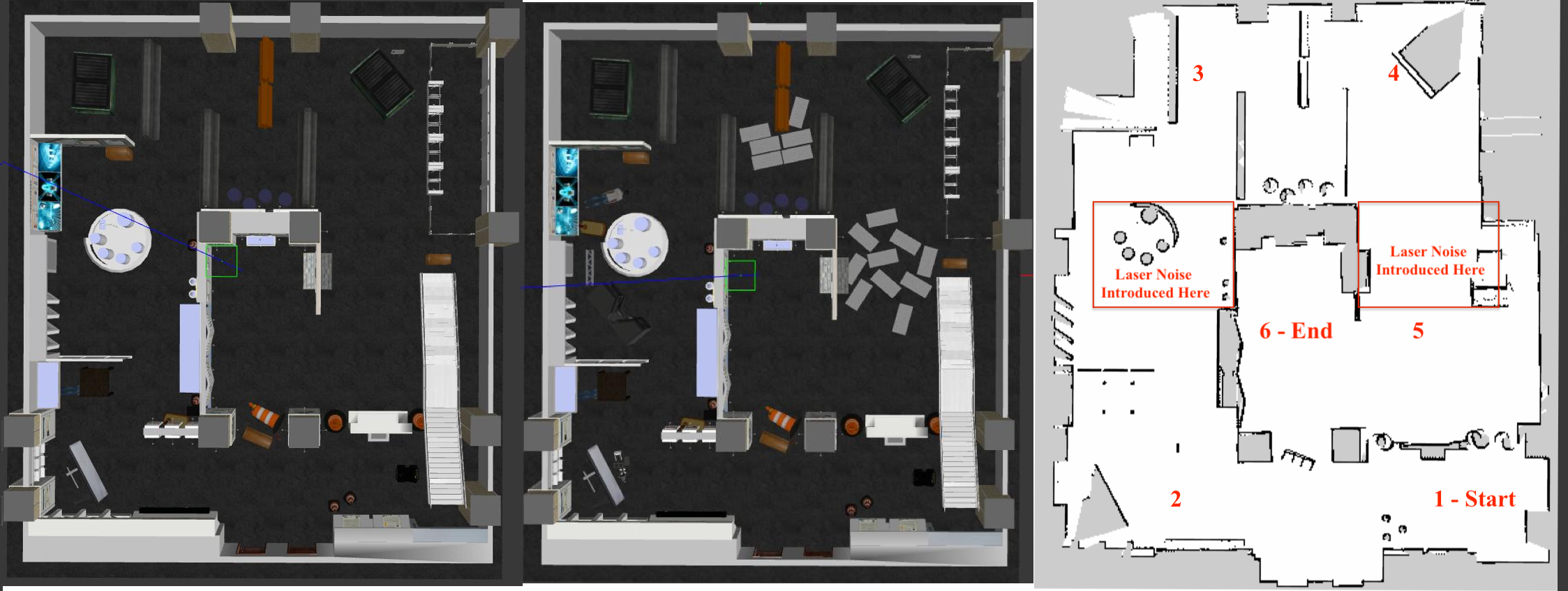
- The system was tested in a simulated mobile robot navigation task using a Clearpath Husky robot in Gazebo, with two conditions: with and without the health bar.
- Participants completed tasks under high cognitive workload in three arena conditions: empty, obstacle-ridden, and with laser noise-induced degradation.
- Performance was measured via task completion time, number of rotations, accuracy of responses, and perceptual effort using a questionnaire.
- Participants rated transparency, trust, and ease of understanding using a 5-point Likert scale across three levels of interface transparency.
- Qualitative feedback was collected to inform health bar design improvements, including salience, modality use, and value representation.
Experimental results
Research questions
- RQ1Does the inclusion of a Robot Health Bar reduce the perceptual effort required for Level of Autonomy (LoA) switching decisions?
- RQ2How does the Robot Health Bar affect operator trust, transparency, and decision-making during high-cognitive-load robot operation?
- RQ3How do novice and experienced operators differ in their perception and use of the health bar for LoA regulation?
- RQ4What design improvements can enhance the effectiveness and usability of the Robot Health Bar?
Key findings
- Operators used manual control more frequently when the Robot Health Bar was displayed, especially during high performance degradation, to mitigate failure risk.
- The health bar did not significantly increase cognitive workload or task completion time, but it led to significantly higher perceptual effort (p < 0.05) in condition A.
- Novice operators preferred simpler visual cues like color changes, while experienced operators desired more detailed information, indicating divergent mental models.
- The medium transparency level was rated lowest overall, suggesting that either too little or too much information can reduce perceived clarity.
- Six participants rated the highest transparency level most favorably for understanding LoA switching reasons, though two participants rated it lowest, highlighting individual variability.
- Participants recommended making the health bar more salient, using percentage values instead of [0,1] scales, avoiding dropdown menus, and adding multi-modal alerts (e.g., blinking, sound) for low health states.
Better researchstarts right now
From reading papers to final review, dramatically reduce your research time.
No credit card · Free plan available
This review was created by AI and reviewed by human editors.