
[Paper Review] Robustness of Gauge Digitization to Quantum Noise
This paper proposes a noise-aware digitization scheme for lattice gauge theories on quantum memory that enhances robustness to quantum noise by encoding gauge group structures onto qubits or qudits in a way that prioritizes the most noise-resilient physical qubits. By aligning group representations with hardware noise profiles and leveraging symmetry-preserving error channels, the method extends gauge symmetry preservation by 2–10× compared to standard digitizations, enabling longer-lived quantum simulations with reduced resource overhead.
Quantum noise limits the use of quantum memory in high energy physics simulations. In particular, it breaks the gauge symmetry of stored quantum states. We examine this effect for abelian and nonabelian theories and demonstrate that optimizing the digitization of gauge theories to quantum memory to account for noise channels can extend the lifetime before complete loss of gauge symmetry by $2-10 imes$ over some other digitizations. These constructions also allow for quantum error correction to integrate the symmetries of quantum fields and prioritize the largest gauge violations.
Motivation & Objective
- To address the challenge of gauge symmetry breaking in quantum simulations due to noise in current noisy intermediate-scale quantum (NISQ) devices.
- To improve the robustness of gauge theory simulations on quantum memory by optimizing digitization for hardware-specific noise channels.
- To enable longer coherence times for gauge-invariant states by embedding the most noise-sensitive group elements onto the cleanest qubits or qudits.
- To integrate gauge symmetry preservation into partial quantum error correction (QEC) strategies with reduced resource cost.
- To provide a framework for designing robust, hardware-aware digitizations applicable to both abelian and nonabelian gauge theories.
Proposed method
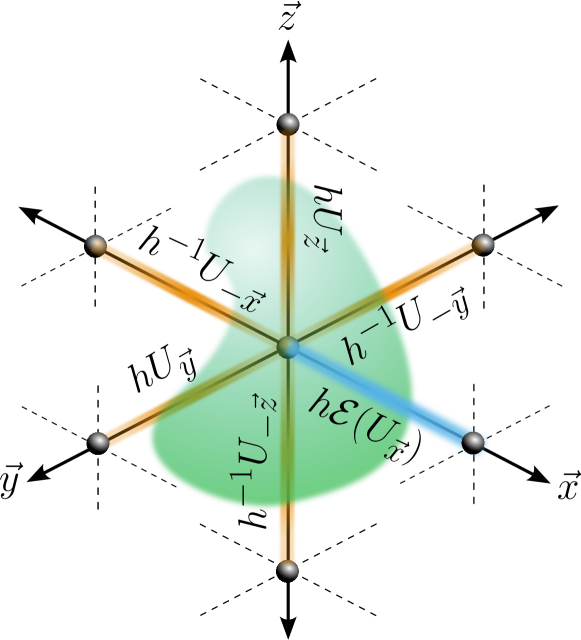
- The authors use a discrete subgroup approximation of gauge groups (e.g., Σ(36×3) for SU(3)) to map group elements to quantum registers.
- They encode group elements using binary integers or Gray codes on qubits, or use qudits to avoid forbidden states and preserve symmetry under noise.
- Noise channels are modeled as stochastic maps on density matrices, including Pauli errors (X, Y, Z), dephasing (Z), and qudit-specific errors (clock and phase shifts).
- The method assigns gauge group elements to quantum registers based on their susceptibility to noise, placing the most vulnerable representations on the most reliable qubits or qudits.
- It identifies residual gauge symmetries preserved under specific error channels (e.g., Z, χ, V) and uses these to define stabilizers for partial QEC.
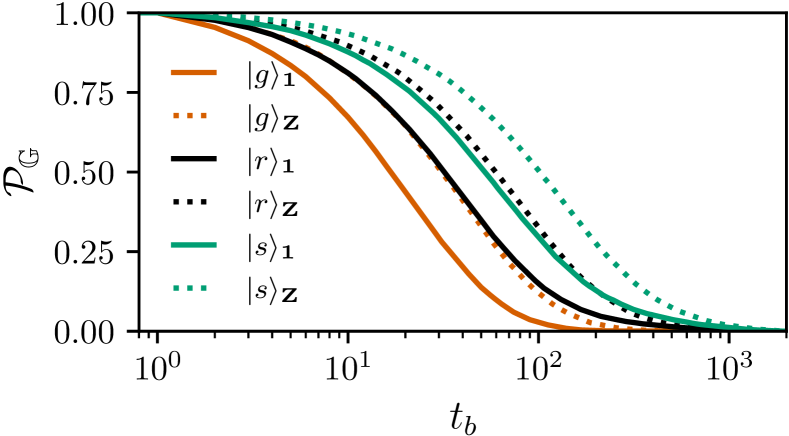
- Simulations compare the half-life of gauge symmetry (t₁/₂) and the probability of remaining in the gauge group (P_G) across different encodings and noise models.
Experimental results
Research questions
- RQ1How does the choice of digitization scheme affect the robustness of gauge symmetry under hardware noise in quantum simulations?
- RQ2Can encoding gauge group elements based on their noise susceptibility extend the lifetime of gauge-invariant states in quantum memory?
- RQ3To what extent can partial quantum error correction be implemented by prioritizing the largest gauge-violating error channels?
- RQ4What residual gauge symmetries are preserved under different error channels (e.g., dephasing, clock shifts) in qubit and qudit encodings?
- RQ5How do qudit-based encodings compare to qubit-based encodings in preserving gauge symmetry under noise?
Key findings
- The proposed noise-aware digitization extends the half-life of gauge symmetry (t₁/₂) by 2–10× compared to conventional digitizations, depending on the noise model.
- For the dephasing channel (E_Z), the half-life nearly doubles compared to standard encoding, demonstrating significant improvement.
- Qudit encodings preserve more residual gauge symmetry than qubit encodings: for example, the Z₃ symmetry is preserved under certain Z and V errors, while qubit encodings break symmetry to smaller subgroups like Z₂ or D₃.
- The ordered-product encoding of Σ(36×3) using 3 qutrits and 1 ququart avoids forbidden states and maintains higher symmetry preservation than 8-qubit qubit encodings with constraints.
- The method enables partial QEC by identifying and prioritizing the largest gauge-violating error channels, reducing resource demands for error correction.
- The framework is generalizable to other digitizations and can be applied to matter fields in future work.
Better researchstarts right now
From reading papers to final review, dramatically reduce your research time.
No credit card · Free plan available
This review was created by AI and reviewed by human editors.