
[Paper Review] Room-temperature optically detected coherent control of molecular spins
This paper demonstrates room-temperature optically detected coherent control of molecular spins using photoexcited triplet states in pentacene-doped para-terphenyl. It achieves >10% photoluminescence contrast and microsecond coherence times (T₂ ≈ 1 μs), enabling sensitive, ambient-operation quantum sensing via optical initialization, microwave manipulation, and fluorescence readout of spin states in both single crystals and thermally evaporated thin films.
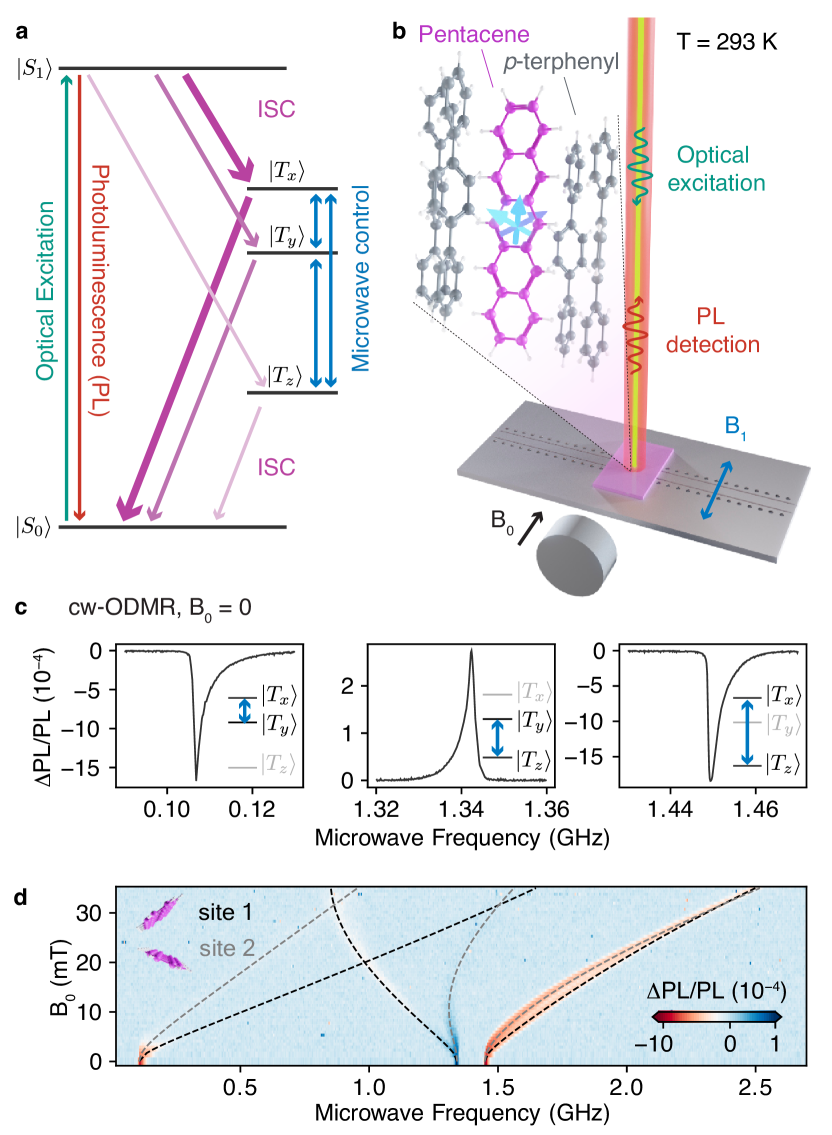
Benefiting from both molecular tunability and versatile methods for deployment, optically interfaced molecular spins are a promising platform for quantum technologies such as sensing and imaging. Room-temperature optically detected coherent spin control is a key enabler for many applications, combining sensitive readout, versatile spin manipulation, and ambient operation. Here we demonstrate such functionality in a molecular spin system. Using the photoexcited triplet state of organic chromophores (pentacene doped in a para-terphenyl host), we optically detect coherent spin manipulation with photoluminescence contrasts exceeding 10% and microsecond coherence times at room temperature. We further demonstrate how coherent control of multiple triplet sublevels can significantly enhance optical spin contrast, and extend optically detected coherent control to a thermally evaporated thin film, retaining high photoluminescence contrast and coherence times of order one microsecond. These results open opportunities for room-temperature quantum technologies that can be systematically tailored through synthetic chemistry.
Motivation & Objective
- To achieve coherent control of molecular spins at room temperature using optical detection.
- To leverage the spin-selective intersystem crossing in photoexcited pentacene for optical initialization and readout of spin states.
- To demonstrate high-contrast, coherent spin manipulation in both single-crystalline and thin-film forms of the material.
- To enable practical quantum sensing and imaging applications through synthetic tunability and ambient operation.
- To extend optically detected magnetic resonance to thermally evaporated organic films while preserving spin coherence and optical contrast.
Proposed method
- Utilized photoexcited triplet states of pentacene in a para-terphenyl host for spin initialization and optical readout via spin-selective intersystem crossing.
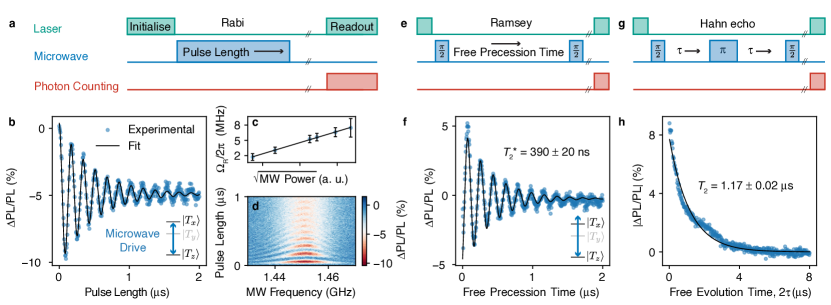
- Employed continuous-wave and pulsed microwave fields to drive Rabi oscillations and coherent spin manipulation at room temperature.
- Applied lock-in detection of photoluminescence contrast (ΔPL) referenced to microwave modulation frequency to detect spin states.
- Used single-mode fiber-coupled avalanche photodiodes and time-to-digital converters for single-photon-level detection of photoluminescence.
- Synchronized microwave and laser pulses via an arbitrary waveform generator to implement pulsed spin control protocols.
- Extended the method to thermally evaporated 100 nm pentacene:para-terphenyl thin films, maintaining high optical contrast and coherence.
Experimental results
Research questions
- RQ1Can optically detected coherent spin control be achieved at room temperature in a molecular spin system?
- RQ2What is the achievable photoluminescence contrast and spin coherence time (T₂) in pentacene-doped para-terphenyl at ambient conditions?
- RQ3Can coherent control of multiple triplet sublevels enhance optical spin contrast?
- RQ4Can the performance of optically detected coherent spin control be preserved in thermally evaporated thin films?
- RQ5To what extent can molecular spin systems be tailored for room-temperature quantum sensing and imaging applications?
Key findings
- Photoluminescence contrast exceeding 10% was achieved in optically detected coherent control of molecular spins at room temperature.
- Spin coherence time (T₂) was measured to be approximately 1 microsecond in pentacene:para-terphenyl single crystals under ambient conditions.
- Ensemble dephasing time (T₂*) was measured at 390 nanoseconds in the same system.
- Coherent control of multiple triplet sublevels significantly enhanced optical spin contrast, improving detection sensitivity.
- High photoluminescence contrast and microsecond coherence times were retained in a 100 nm thermally evaporated pentacene:para-terphenyl thin film.
- The results demonstrate a viable, chemically tunable platform for room-temperature quantum technologies such as sensing and imaging.
Better researchstarts right now
From reading papers to final review, dramatically reduce your research time.
No credit card · Free plan available
This review was created by AI and reviewed by human editors.