
[Paper Review] Running vacuum in Brans-Dicke theory: a possible cure for the $σ_8$ and $H_0$ tensions
This paper proposes a running vacuum model within Brans-Dicke theory (BD-RVM) to simultaneously alleviate the $\sigma_8$ and $H_0$ tensions in cosmology. By allowing both the Newtonian coupling $G_N$ and vacuum energy density $\rho_{\rm vac}$ to evolve dynamically via $\delta\rho_{\rm vac} \propto \nu\,m_{\rm Pl}^2(H^2 - H_0^2)$, the model achieves significantly better fit to cosmological data than the standard $\Lambda$CDM model, with strong statistical evidence ($\Delta$AIC, $\Delta$DIC > 12) favoring the BD-RVM scenario, especially when $H_0$ or $S_8$ priors are included.
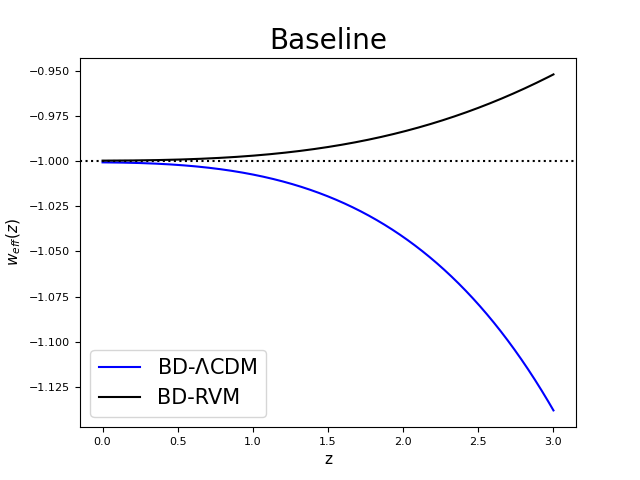
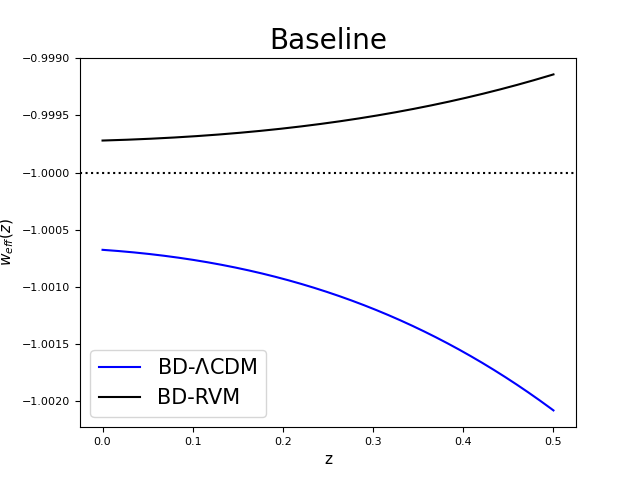
Extensions of the gravitational framework of Brans-Dicke (BD) are studied by considering two different scenarios: i) `BD-$Λ$CDM', in which a rigid cosmological constant, $Λ$, is included, thus constituting a BD version of the vanilla concordance $Λ$CDM model (the current standard model of cosmology with flat three-dimensional geometry), and ii) `BD-RVM', a generalization of i) in which the vacuum energy density (VED), $ρ_{ extrm{vac}}$, is a running quantity evolving with the square of the Hubble rate: $δρ_{ extrm{vac}}(H)\propto ν\, m^2_{ extrm{Pl}} (H^2-H_0^2)$ (with $|ν|\ll 1$). This dynamical scenario is motivated by recent studies of quantum field theory (QFT) in curved spacetime, which lead to the running vacuum model (RVM). We solve the background as well as the perturbation equations for each cosmological model and test their performance against the modern wealth of cosmological data, namely a compilation of the latest SNIa+$H(z)$+BAO+LSS+CMB observations. We utilize the AIC and DIC statistical information criteria in order to determine if they can fit better the observations than the concordance model. The two BD extensions are tested by considering three different datasets. According to the AIC and DIC criteria, both BD extensions i) and ii) are competitive, but the second one (the BD-RVM scenario) is particularly favored when it is compared with the vanilla model. This fact may indicate that the current observations favor a mild dynamical evolution of the Newtonian coupling $G_N$ as well as of the VED. This is in agreement with recent studies suggesting that the combination of these two features can be favorable for a possible resolution of the $σ_8$ and $H_0$ tensions. In this work, we show that the Brans-Dicke theory with running vacuum has the potential to alleviate the two tensions at the same time.
Motivation & Objective
- To address the persistent $\sigma_8$ and $H_0$ tensions in cosmology by extending Brans-Dicke theory with a dynamical vacuum energy density.
- To test whether a running vacuum model (RVM) in a Brans-Dicke framework can better fit current cosmological data than the standard $\Lambda$CDM model.
- To examine the viability of a dynamical Newtonian coupling $G_N$ and time-evolving vacuum energy density $\rho_{\rm vac}$ as a unified solution to multiple cosmological tensions.
- To evaluate the statistical preference of the BD-RVM model over the standard $\Lambda$CDM model using information criteria (AIC, DIC) and observational datasets including SNIa, $H(z)$, BAO, LSS, and CMB.
Proposed method
- Formulate a Brans-Dicke theory with a running vacuum energy density (BD-RVM), where $\delta\rho_{\rm vac} \propto \nu\,m_{\rm Pl}^2(H^2 - H_0^2)$ with $|\nu| \ll 1$, motivated by quantum field theory in curved spacetime.
- Construct a benchmark model (BD-$\Lambda$CDM) with a constant $\Lambda$ term in the Brans-Dicke framework to compare with the dynamical RVM extension.
- Solve the background and perturbation equations for both models within a spatially flat Friedmann-Lema\^{i}tre-Robertson-Walker (FLRW) framework.
- Constrain model parameters using a comprehensive dataset: SNIa, $H(z)$, BAO, LSS, and Planck 2018 CMB data (TT, TE, EE, lensing).
- Apply the Akaike (AIC) and Deviance (DIC) information criteria to statistically compare model performance against the standard $\Lambda$CDM model.
- Test model robustness by including external priors on $H_0$ and $S_8$ to assess their impact on parameter fitting and statistical preference.
Experimental results
Research questions
- RQ1Can a running vacuum model in Brans-Dicke theory simultaneously alleviate the $\sigma_8$ and $H_0$ tensions observed in cosmological data?
- RQ2Does the inclusion of a dynamical vacuum energy density, evolving with the Hubble rate, lead to a statistically preferred model over the standard $\Lambda$CDM model?
- RQ3How do the parameters $\epsilon$ (related to $G_N$ evolution) and $\nu$ (related to $\rho_{\rm vac}$ running) constrain the model when external priors on $H_0$ or $S_8$ are applied?
- RQ4To what extent does the inclusion of CMB polarization data enhance the statistical preference for the BD-RVM model over the standard model?
- RQ5What is the significance of the non-zero fitting values of $\nu$ and $\epsilon$ in the BD-RVM model, and do they indicate a fundamental departure from the standard model?
Key findings
- The BD-RVM model achieves a strong statistical preference over the standard $\Lambda$CDM model, with $\Delta$AIC and $\Delta$DIC exceeding 12 when $H_0$ or $S_8$ priors are included.
- The fitting value of $\nu = 0.00348^{+0.00077}_{-0.00064}$ corresponds to a 4.94$\sigma$ confidence level, indicating strong evidence for a non-zero, dynamically evolving vacuum energy density.
- The parameter $\epsilon = -0.0077^{+0.0012}_{-0.0021}$ is constrained at 4.67$\sigma$ confidence level, supporting a non-vanishing, evolving Newtonian coupling $G_N$.
- When the $H_0$ prior is included, the BD-RVM model successfully accommodates a high $H_0 \approx 70.47^{+0.70}_{-0.59}$ km/s/Mpc and a low $\sigma_8 \approx 0.762 \pm 0.018$, resolving both tensions simultaneously.
- The inclusion of CMB polarization data enhances the statistical performance of both BD models, with the BD-RVM model showing particularly strong evidence ($\Delta$AIC, $\Delta$DIC $\sim$ 14) in the Baseline+ $S_8$ case.
- The BD-RVM model remains favored even when the $H_0$ prior is applied, whereas the BD-$\Lambda$CDM model loses statistical preference, highlighting the unique capability of the running vacuum in resolving the $H_0$ tension.
Better researchstarts right now
From reading papers to final review, dramatically reduce your research time.
No credit card · Free plan available
This review was created by AI and reviewed by human editors.