
[Paper Review] Scalarization for Multi-Task and Multi-Domain Learning at Scale
This paper investigates scalarization—training multi-task and multi-domain models by minimizing a weighted average of task losses—as a simple yet effective alternative to complex multi-task optimization (MTO) methods. Through large-scale experiments across diverse architectures and datasets, it demonstrates that optimal scalarization weights significantly boost performance, especially in imbalanced settings, and proposes population-based training to efficiently search these weights at scale, achieving SOTA performance with minimal computational overhead.
Training a single model on multiple input domains and/or output tasks allows for compressing information from multiple sources into a unified backbone hence improves model efficiency. It also enables potential positive knowledge transfer across tasks/domains, leading to improved accuracy and data-efficient training. However, optimizing such networks is a challenge, in particular due to discrepancies between the different tasks or domains: Despite several hypotheses and solutions proposed over the years, recent work has shown that uniform scalarization training, i.e., simply minimizing the average of the task losses, yields on-par performance with more costly SotA optimization methods. This raises the issue of how well we understand the training dynamics of multi-task and multi-domain networks. In this work, we first devise a large-scale unified analysis of multi-domain and multi-task learning to better understand the dynamics of scalarization across varied task/domain combinations and model sizes. Following these insights, we then propose to leverage population-based training to efficiently search for the optimal scalarization weights when dealing with a large number of tasks or domains.
Motivation & Objective
- To understand the training dynamics of scalarization in multi-task and multi-domain learning across diverse model capacities and data distributions.
- To investigate the impact of scalarization weights on gradient conflicts and model performance in imbalanced task/domain settings.
- To address the scalability challenge of hyperparameter search for large numbers of tasks or domains.
- To evaluate whether simple scalarization can match or exceed complex MTO methods in performance while reducing computational cost.
Proposed method
- Conduct a large-scale empirical analysis of scalarization across multiple vision benchmarks, model architectures (from ViT-S/4 to full-width ViT), and task/domain combinations.
- Systematically vary scalarization weights using population-based training (PBT) to efficiently explore the high-dimensional hyperparameter space.
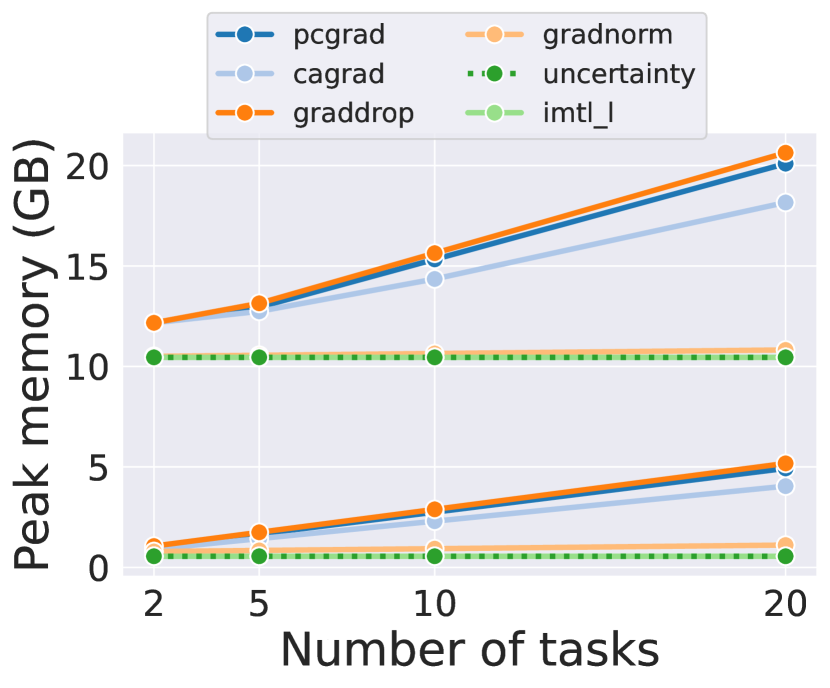
- Compare scalarization with state-of-the-art MTO methods, including loss-based (e.g., uncertainty, IMTL-L) and gradient-based (e.g., CAGrad, PCGrad) approaches.
- Analyze gradient conflicts across layers and learning rates to assess their role in task interference.
- Use PBT to search for optimal scalarization weights in settings with many tasks, reducing search cost while maintaining performance.
- Report results across multiple metrics and standard deviations to ensure statistical robustness.
Experimental results
Research questions
- RQ1How does model capacity affect the performance gain of multi-task and multi-domain learning via scalarization?
- RQ2To what extent do optimal scalarization weights improve performance in imbalanced multi-task and multi-domain settings?
- RQ3How do gradient conflicts vary across layers and learning rates, and do they correlate with task interference?
- RQ4Can population-based training efficiently identify optimal scalarization weights for large-scale multi-task and multi-domain learning?
- RQ5Does uniform scalarization (equal weighting) perform comparably to complex MTO methods, or is weight tuning essential?
Key findings
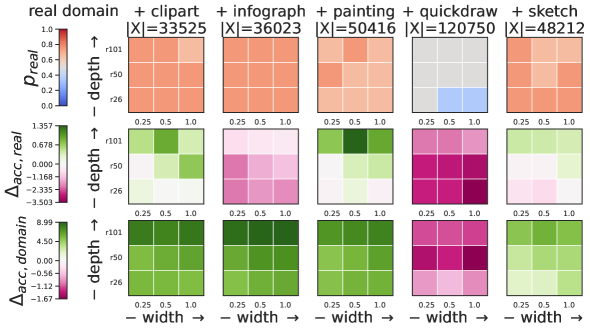
- Larger model capacities amplify the benefits of multi-task and multi-domain learning, with performance gains increasing significantly as model size grows.
- Optimal scalarization weights are crucial for high-performance multi-task and multi-domain learning in imbalanced settings, but their relative ranking remains consistent across model sizes within the same architecture family.
- Gradient conflicts between tasks or domains are a natural and persistent phenomenon during training, but they are largely unaffected by model capacity or scalarization weight choices.
- Population-based training (PBT) enables efficient and effective search for optimal scalarization weights, achieving performance on par with complex MTO methods while reducing computational cost.
- Scalarization with learned weights outperforms uniform scalarization and matches or exceeds state-of-the-art MTO methods (e.g., CAGrad, PCGrad) across all evaluated benchmarks and model sizes.
- The performance of scalarization is highly sensitive to weight tuning, with even small changes in weights leading to significant performance shifts in imbalanced settings.
Better researchstarts right now
From reading papers to final review, dramatically reduce your research time.
No credit card · Free plan available
This review was created by AI and reviewed by human editors.