
[Paper Review] Scaling and localization in multipole-conserving diffusion
This paper investigates diffusion in systems conserving multipole moments, such as center of mass (dipole) or higher moments, showing that such constraints lead to nonlinear diffusion with dynamical exponent z = 4 + d in d dimensions. It derives a nonlinear Fokker-Planck-like equation for dipole-conserving dynamics, reveals exponentially localized equilibrium states, and demonstrates a crossover from z = 5 (zero background) to z = 4 (nonzero background), with implications for quantum systems exhibiting real-space Fermi surfaces or Bose-Einstein condensation.
We study diffusion in systems of classical particles whose dynamics conserves the total center of mass. This conservation law leads to several interesting consequences. In finite systems, it allows for equilibrium distributions that are exponentially localized near system boundaries. It also yields an unusual approach to equilibrium, which in $d$ dimensions exhibits scaling with dynamical exponent $z = 4+d$. Similar phenomena occur for dynamics that conserves higher moments of the density, which we systematically classify using a family of nonlinear diffusion equations. In the quantum setting, analogous fermionic systems are shown to form real-space Fermi surfaces, while bosonic versions display a real-space analog of Bose-Einstein condensation.
Motivation & Objective
- To understand how conservation of multipole moments (e.g., center of mass) alters diffusive behavior in classical and quantum systems.
- To derive a nonlinear diffusion equation governing dipole-conserving dynamics, showing its scaling behavior and steady-state solutions.
- To identify the crossover in dynamical exponent from z=5 (zero background) to z=4 (nonzero background) in one-dimensional systems.
- To generalize the analysis to higher multipole conservation (e.g., quadrupole), showing Gaussian steady states.
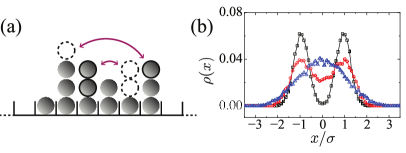
- To explore quantum analogs, demonstrating real-space Fermi surfaces in fermions and real-space Bose-Einstein condensation in bosons.
Proposed method
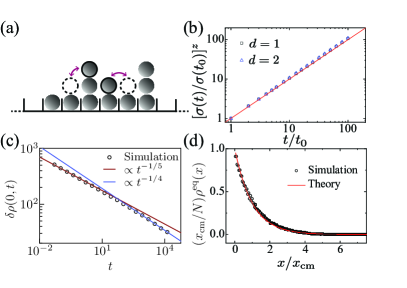
- Derive a lattice master equation for a natural dipole-conserving hopping process, leading to a nonlinear current expression: J = D[ρ∂x²ρ − (∂xρ)²] = Dρ²∂x²ln(ρ).
- Perform scaling analysis of the nonlinear diffusion equation, yielding dynamical exponent z = 4 + d in d dimensions.
- Use entropy maximization with Lagrange multipliers to derive the exponentially localized equilibrium density profile ρ^eq(x) = (N/x_cm)e^(-x/x_cm) in 1D half-space.
- Apply linearization around a nonzero background density ρ̄ to recover the z=4 subdiffusive scaling, consistent with prior hydrodynamic models.
- Derive the corresponding Langevin equation with multiplicative noise, showing consistency with fluctuation-dissipation in small fluctuations.
- Extend the formalism to higher multipole conservation (e.g., quadrupole), showing that conservation of σ leads to Gaussian steady states.
Experimental results
Research questions
- RQ1How does the conservation of the center of mass in classical particle systems alter the scaling of relaxation dynamics?
- RQ2What is the form of the nonlinear diffusion equation that governs dipole-conserving dynamics, and what is its dynamical exponent?
- RQ3Why does the system exhibit a crossover from z=5 to z=4 in the dynamical exponent depending on the background density?
- RQ4What are the equilibrium density profiles in systems with multipole conservation, and how are they derived from entropy maximization?
- RQ5How do quantum analogs of these systems—fermions and bosons—exhibit real-space Fermi surfaces and Bose-Einstein condensation?
Key findings
- The nonlinear diffusion equation ∂tρ = −∂x²J with J = Dρ²∂x²ln(ρ) governs dipole-conserving dynamics in zero-density backgrounds, yielding a dynamical exponent z = 5 in one dimension.
- In the presence of a nonzero background density ρ₀, small fluctuations relax with z = 4, consistent with prior hydrodynamic models.
- The equilibrium density profile for dipole-conserving particles on a half-line is exponentially localized: ρ^eq(x) = (N/x_cm)e^(-x/x_cm), derived via entropy maximization.
- Numerical simulations confirm a crossover from z=5 (for initial density profiles in zero background) to z=4 (for density differences relative to equilibrium) in one-dimensional systems.
- For quadrupole-conserving dynamics, the steady-state density is Gaussian, with conservation of the standard deviation preventing spreading.
- Quantum analogs exhibit real-space Fermi surfaces in fermionic systems and a real-space analog of Bose-Einstein condensation in bosonic systems, where a macroscopic number of bosons occupy a single site.
Better researchstarts right now
From reading papers to final review, dramatically reduce your research time.
No credit card · Free plan available
This review was created by AI and reviewed by human editors.