
[Paper Review] Scientific CMOS sensors in Astronomy: IMX455 and IMX411
This paper evaluates the QHY600M Pro and QHY411M scientific CMOS cameras, based on Sony's IMX455 and IMX411 sensors, for astronomical use. It demonstrates their low dark current (0.007–0.011 e⁻ px⁻¹ s⁻¹ at −10°C), stable warm pixels, and photometric precision within a few millimagnitudes, proving them suitable for wide-field, high-cadence surveys despite challenges like random telegraph noise and salt-and-pepper defects.
Scientific complementary metal-oxide-semiconductor (CMOS) detectors have developed quickly in recent years thanks to their low cost and high availability. They also have some advantages over charge-coupled devices (CCDs), such as high frame rate or typically lower readout noise. These sensors started to be used in astronomy following the development of the first back-illuminated models. Therefore, it is worth studying their characteristics, advantages, and weaknesses. One of the most widespread CMOS sensors are those from the Sony IMX series, which are included in large astronomical survey projects based on small and fast telescopes because of their low cost, and capability for wide-field and high-cadence surveys. In this paper, we aim to characterize the IMX455M and IMX411M sensors, which are integrated into the QHY600 and QHY411 cameras, respectively, for use in astronomical observations. These are large (36 $ imes$ 24 and 54 $ imes$ 40 mm) native 16 bit sensors with 3.76 $μ$m pixels and are sensitive in the optical range. We present the results of the laboratory characterization of both cameras. They showed a very low dark current of 0.011 and 0.007 e$^{-}$ px$^{-1}$ s$^{-1}$ @$-$10 C for the QHY600 and QHY411 cameras, respectively. They also show the presence of warm pixels, $\sim$0.024% in the QHY600 and 0.005% in the QHY411. Warm pixels proved to be stable and linear with exposure time, and are therefore easily corrected using dark frames. Pixels affected by the Salt \& Pepper noise are $\sim$2% of the total and a method to correct for this effect is presented. Both cameras were attached to night telescopes and several on-sky tests were performed to prove their capabilities. On-sky tests demonstrate that these CMOS behave as well as CCDs of similar characteristics and (for example) they can attain photometric accuracies of a few milli-magnitudes.
Motivation & Objective
- To assess the suitability of the QHY600M Pro and QHY411M cameras—featuring IMX455 and IMX411 sCMOS sensors—for scientific astronomical imaging.
- To characterize key performance parameters such as dark current, readout noise, linearity, and non-uniformities in laboratory and on-sky conditions.
- To evaluate the impact of noise sources like random telegraph noise and salt-and-pepper defects on photometric accuracy.
- To test the cameras' performance in real astronomical observations using both fast and slow telescopes.
- To identify computational challenges and propose solutions for processing large 16-bit sCMOS data sets efficiently using GPU-accelerated methods.
Proposed method
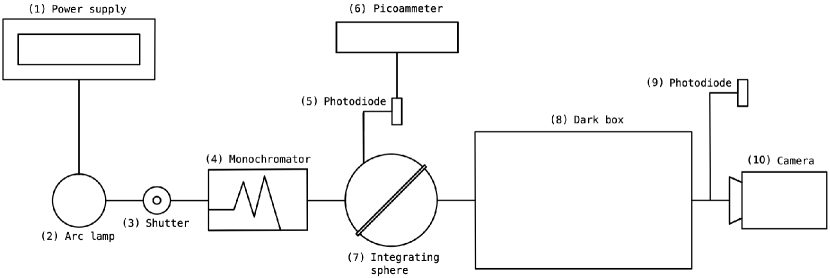
- Conducted laboratory characterization of the QHY600M Pro and QHY411M cameras using a calibrated optical test bench with a monochromator, integrating sphere, and reference photodiodes.
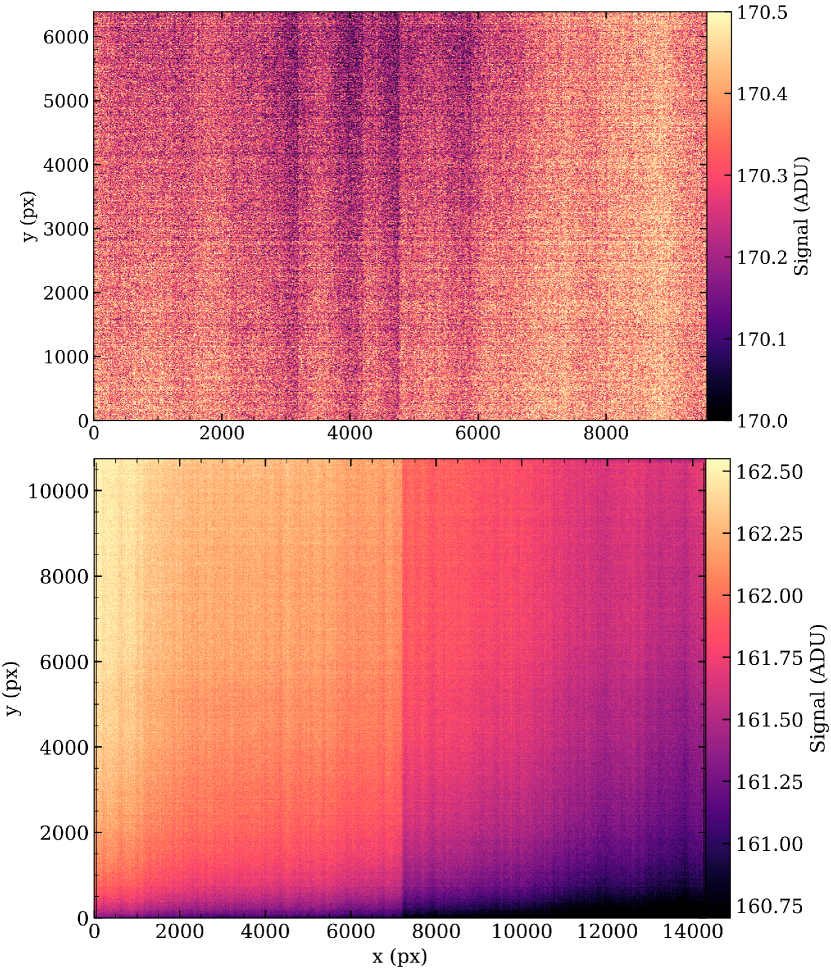
- Measured dark current and bias levels across multiple exposures at −10°C to assess stability and linearity over time.
- Performed on-sky observations with the Two-meter Twin Telescope at Teide Observatory to validate photometric performance.
- Applied dark frame subtraction to correct for warm pixels and used median filtering and frame differencing to mitigate salt-and-pepper noise.
- Evaluated the effectiveness of sigma-clipping and convolution-based algorithms for noise reduction in high-frame-rate sequences.
- Explored GPU-based processing pipelines to handle large 120–300 MB raw image files efficiently, especially for high-cadence surveys.
Experimental results
Research questions
- RQ1How do the IMX455 and IMX411 sCMOS sensors perform in terms of dark current, readout noise, and linearity under controlled laboratory conditions?
- RQ2To what extent do warm pixels and salt-and-pepper noise affect photometric accuracy, and can they be effectively corrected?
- RQ3Can these sCMOS cameras achieve photometric precision comparable to traditional CCDs in real astronomical observations?
- RQ4What are the computational challenges in processing high-frame-rate, 16-bit sCMOS data, and how can GPU-accelerated algorithms improve efficiency?
- RQ5How do the sensors perform in wide-field, high-cadence survey scenarios with fast telescopes?
Key findings
- The QHY600M Pro and QHY411M cameras exhibit extremely low dark current of 0.011 e⁻ px⁻¹ s⁻¹ and 0.007 e⁻ px⁻¹ s⁻¹, respectively, at −10°C, with stable and linear behavior over time.
- Warm pixels are present at a rate of 0.024% in the QHY600M Pro and 0.005% in the QHY411M, and their signals scale linearly with exposure time, enabling effective correction via dark frame subtraction.
- Salt-and-pepper noise affects approximately 2% of pixels, but the study presents a method to mask and correct these pixels using median interpolation or frame-based filtering.
- On-sky tests confirm photometric accuracy within a few millimagnitudes, demonstrating performance comparable to CCDs of similar specifications.
- The sensors show no charge persistence or edge glow, and quantum efficiency peaks at 80% around 475 nm, dropping to 40% at 700 nm and 10% at 900 nm.
- Random telegraph noise introduces significant photometric deviations in low-signal regimes, and simple averaging or sigma-clipping is insufficient to mitigate its effects.
Better researchstarts right now
From reading papers to final review, dramatically reduce your research time.
No credit card · Free plan available
This review was created by AI and reviewed by human editors.