
[Paper Review] Scientific Talent Leaks Out of Funding Gaps
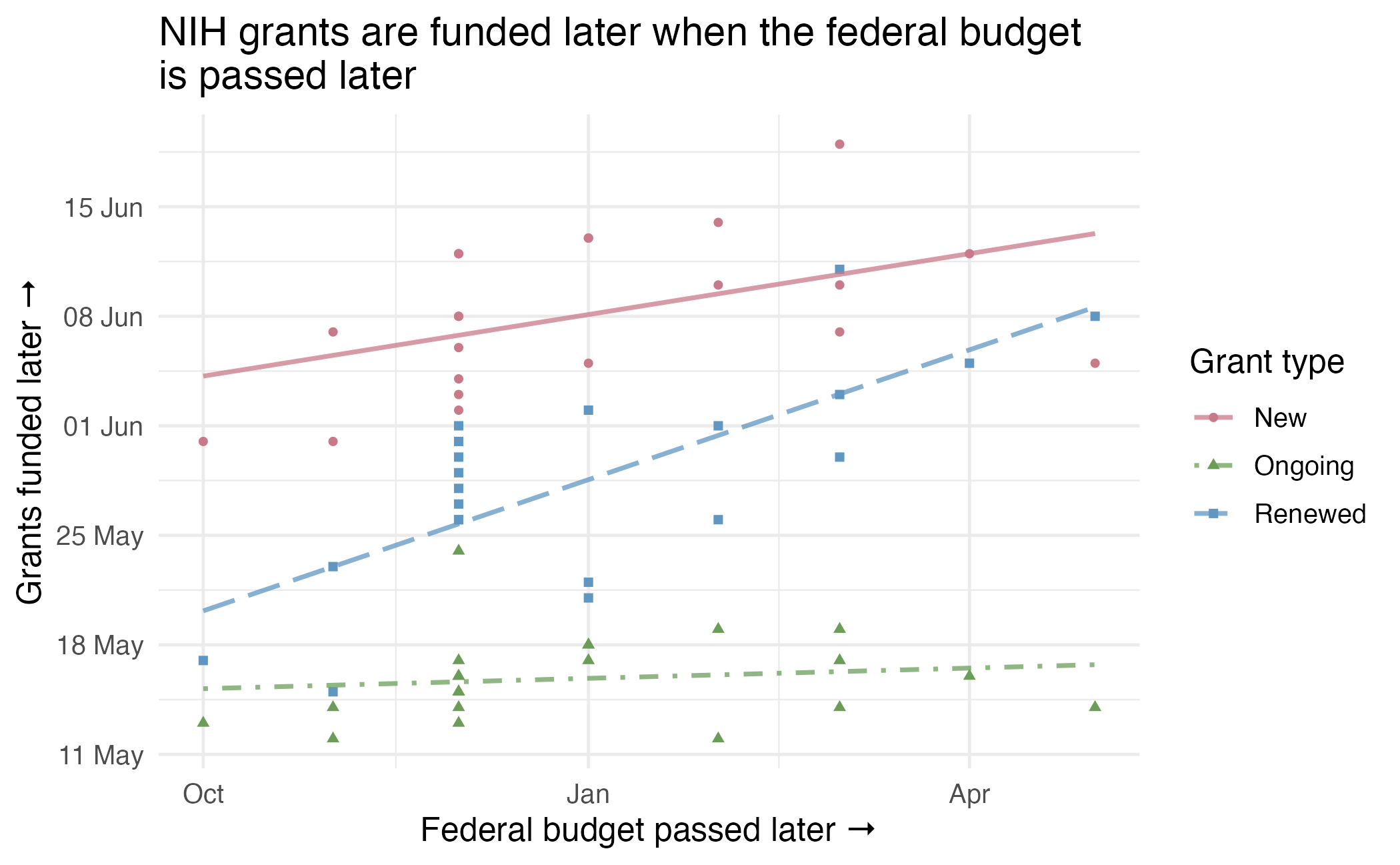
This study uses U.S. Census tax records and NIH grant data to show that funding delays exceeding 30 days significantly disrupt the scientific workforce: 40% higher likelihood of non-U.S. employment among lab personnel in single-R01 labs, with 5% of nonemployment nationally attributable to funding gaps. Trainees face steeper declines in earnings and publication rates, highlighting systemic instability in academic research funding.
We study how delays in NIH grant funding affect the career outcomes of research personnel. Using comprehensive earnings and tax records linked to university transaction data along with a difference-in-differences design, we find that a funding interruption of more than 30 days has a substantial effect on job placements for personnel who work in labs with a single NIH R01 research grant, including a 3 percentage point (40%) increase in the probability of not working in the US. Incorporating information from the full 2020 Decennial Census and data on publications, we find that about half of those induced into nonemployment appear to permanently leave the US and are 90% less likely to publish in a given year, with even larger impacts for trainees (postdocs and graduate students). Among personnel who continue to work in the US, we find that interrupted personnel earn 20% less than their continuously-funded peers, with the largest declines concentrated among trainees and other non-faculty personnel (such as staff and undergraduates). Overall, funding delays account for about 5% of US nonemployment in our data, indicating that they have a meaningful effect on the scientific labor force at the national level.
Motivation & Objective
- To assess how delays in NIH R01 grant disbursement affect the career trajectories of research personnel.
- To quantify the impact of funding interruptions on employment location, earnings, and publication activity among scientists.
- To evaluate whether funding instability—particularly in labs reliant on a single R01 grant—drives talent loss and labor market disruption.
- To examine the broader implications of annual budgeting cycles and funding uncertainty on scientific human capital retention.
Proposed method
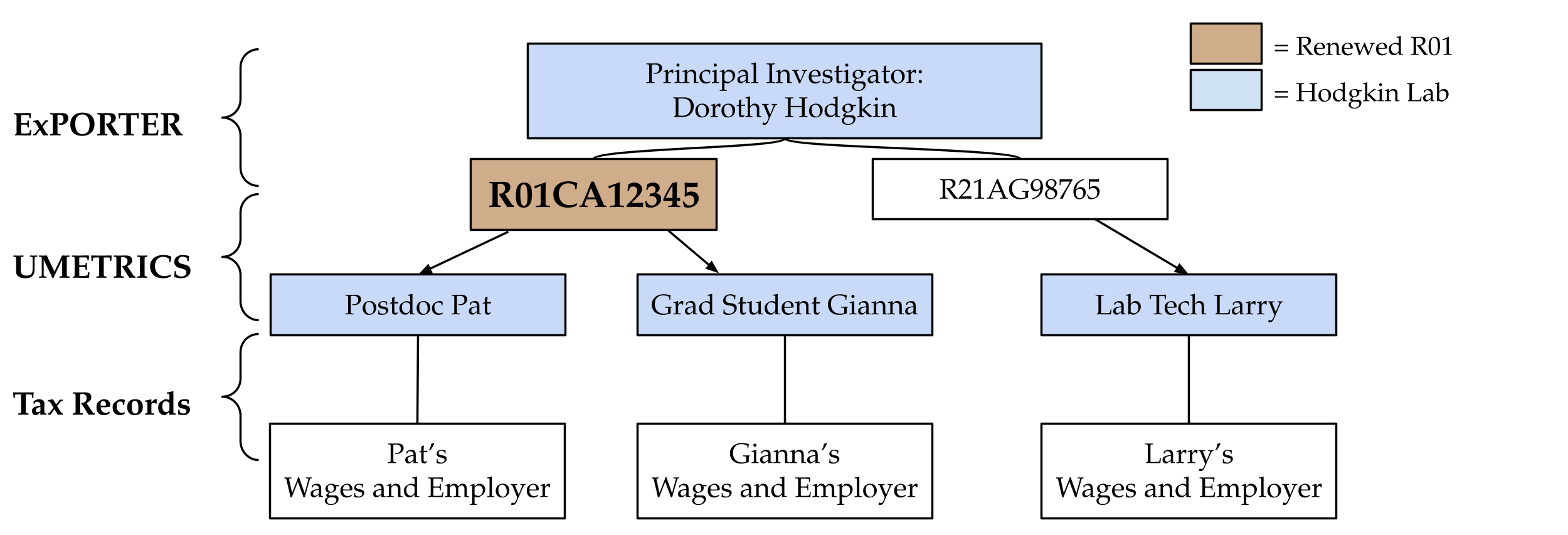
- Utilizes linked earnings and tax records from the U.S. Census Bureau with university transaction data on NIH R01 grants.
- Employs a difference-in-differences design comparing personnel in labs with delayed funding versus those with continuous funding.
- Incorporates 2020 Decennial Census data and publication records to assess long-term outcomes like international migration and research productivity.
- Analyzes funding delay effects separately across personnel types (e.g., postdocs, graduate students, staff, faculty).
- Estimates the national-scale impact of funding delays on nonemployment and labor market outcomes.
- Controls for confounding factors such as country of origin, training level, and institutional characteristics.
Experimental results
Research questions
- RQ1How do funding delays exceeding 30 days affect the probability of research personnel leaving the U.S. workforce?
- RQ2What is the impact of funding interruptions on earnings and publication rates among affected researchers?
- RQ3How do the effects of funding delays vary across different types of research personnel (e.g., trainees vs. faculty)?
- RQ4To what extent do funding delays contribute to national-level nonemployment in the scientific workforce?
- RQ5What mechanisms underlie the observed labor market disruptions due to funding instability?
Key findings
- A funding interruption of over 30 days increases the probability of not working in the U.S. by 3 percentage points (a 40% relative increase) for personnel in labs with a single R01 grant.
- Approximately half of those induced into nonemployment permanently leave the U.S., and they are 90% less likely to publish in a given year.
- Among those who remain in the U.S., interrupted personnel earn 20% less than continuously funded peers, with the largest earnings declines among trainees and non-faculty staff.
- Funding delays account for about 5% of nonemployment in the scientific workforce within the study’s sample, indicating a nationally significant impact.
- The negative effects are most pronounced for trainees (postdocs and graduate students), who experience steeper declines in earnings and publication output.
- The findings suggest that funding instability—especially in single-grant labs—has substantial, measurable consequences for scientific talent retention and productivity.
Better researchstarts right now
From reading papers to final review, dramatically reduce your research time.
No credit card · Free plan available
This review was created by AI and reviewed by human editors.