
[Paper Review] Search for new phenomena in two-body invariant mass distributions using unsupervised machine learning for anomaly detection at $\sqrt{s} = 13$ TeV with the ATLAS detector
This study presents a model-independent search for new physics using unsupervised machine learning to detect anomalies in two-body invariant mass distributions at 13 TeV with the ATLAS detector. An autoencoder is trained on Standard Model events and used to identify deviations in kinematic features; no significant anomalies are observed in 140 fb⁻¹ of data, setting limits on new physics across multiple benchmark BSM models.
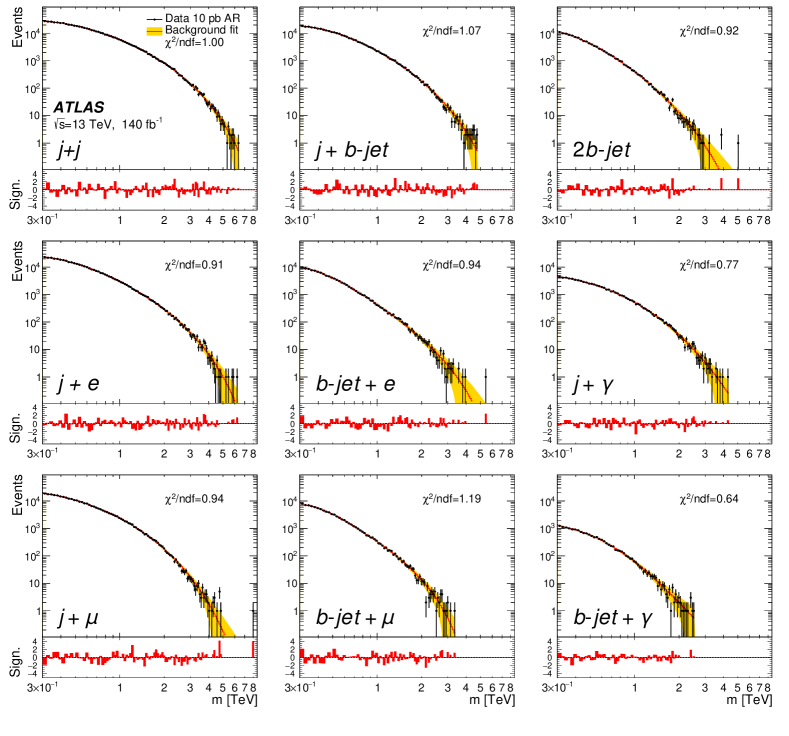
Searches for new resonances are performed using an unsupervised anomaly-detection technique. Events with at least one electron or muon are selected from 140 fb$^{-1}$ of $pp$ collisions at $\sqrt{s} = 13$ TeV recorded by ATLAS at the Large Hadron Collider. The approach involves training an autoencoder on data, and subsequently defining anomalous regions based on the reconstruction loss of the decoder. Studies focus on nine invariant mass spectra that contain pairs of objects consisting of one light jet or $b$-jet and either one lepton ($e$, $μ$), photon, or second light jet or $b$-jet in the anomalous regions. No significant deviations from the background hypotheses are observed.
Motivation & Objective
- To develop a model-independent search strategy for new physics beyond the Standard Model using unsupervised machine learning.
- To detect anomalies in two-body invariant mass distributions without prior assumptions on signal topology.
- To apply autoencoder-based reconstruction loss to identify events deviating from Standard Model expectations.
- To evaluate the sensitivity of the method across diverse benchmark BSM models with resonances near 2 TeV.
- To set exclusion limits on new physics processes using 140 fb⁻¹ of 13 TeV proton-proton collision data.
Proposed method
- An autoencoder (AE) is trained on 140 fb⁻¹ of ATLAS data enriched with Standard Model background events.
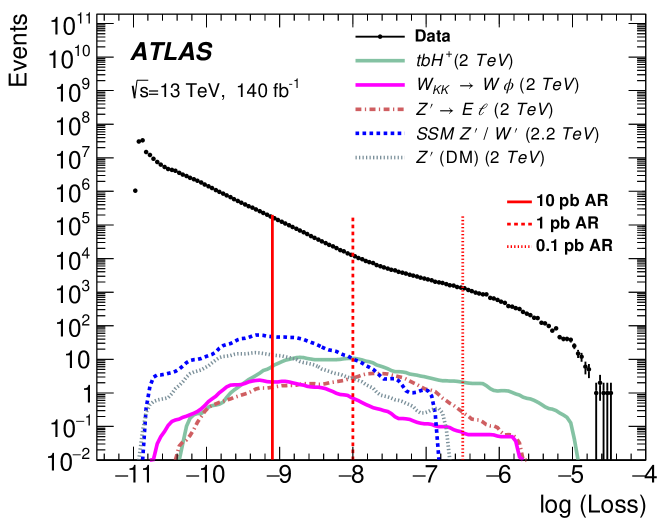
- The AE reconstructs input events, and the reconstruction loss is used as an anomaly score to identify atypical events.
- Anomalous regions (ARs) are defined based on high reconstruction loss, independent of invariant mass distributions.
- Nine two-body final states are studied: jet + lepton, photon, or second jet (light or b-jet), with leading or subleading objects selected.
- Triggering on isolated electrons or muons enables access to low-mass resonances below 1 TeV, avoiding trigger threshold effects.
- Benchmark BSM models (e.g., charged Higgs, W'K, Z', dark matter models) are simulated to assess sensitivity and define anomaly regions.
Experimental results
Research questions
- RQ1Can unsupervised machine learning detect new physics signals in two-body invariant mass spectra without assuming specific signal models?
- RQ2How effective is the autoencoder-based anomaly detection method in identifying deviations from Standard Model backgrounds in multivariate event topologies?
- RQ3What are the sensitivity limits of this method for various benchmark BSM models with resonances near 2 TeV?
- RQ4How does lepton-triggering improve the exploration of low-mass resonances compared to jet-triggered searches?
- RQ5What is the observed significance of deviations in the anomaly score distributions across different final states and benchmark models?
Key findings
- No significant deviations from the Standard Model background hypothesis are observed in any of the nine two-body final states studied.
- The anomaly score distributions for five benchmark BSM models (e.g., H⁺, W'K, Z', W', Z' dark matter) are consistent with background expectations, with no excesses in the anomaly regions.
- The observed limits on visible cross sections in the anomaly regions range from 0.05 to 0.5 fb, depending on the model and final state.
- The method successfully identifies kinematic features inconsistent with SM expectations, with reconstruction loss serving as a robust anomaly metric.
- The search achieves sensitivity to resonances with masses around 2 TeV across diverse final states, including leptonic, hadronic, and diphoton channels.
- The absence of significant signals sets new exclusion limits on new physics models, particularly for resonances decaying to final states involving b-jets, photons, and leptons.
Better researchstarts right now
From reading papers to final review, dramatically reduce your research time.
No credit card · Free plan available
This review was created by AI and reviewed by human editors.