
[Paper Review] Search for the lepton-flavor violating decay of the Higgs boson and additional Higgs bosons in the e$μ$ final state in proton-proton collisions at $\sqrt{s}$ = 13 TeV
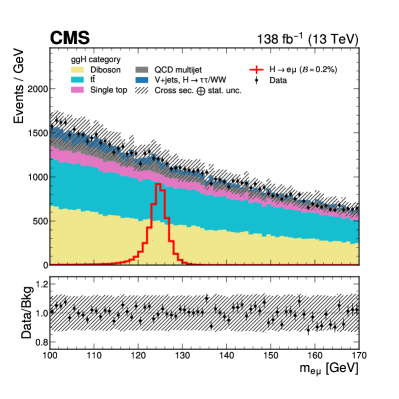
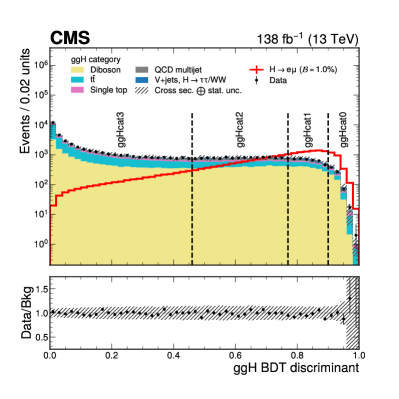
This paper presents a direct search for lepton-flavor violating Higgs boson decays to an electron-muon final state in proton-proton collisions at √s = 13 TeV using 138 fb⁻¹ of CMS data. No significant excess is observed; the observed (expected) upper limit on the branching fraction for H→eμ is 4.4×10⁻⁵ (4.7×10⁻⁵) at 95% confidence level, setting the most stringent direct limit to date.
A search for the lepton-flavor violating decay of the Higgs boson and potential additional Higgs bosons with a mass in the range 110-160 GeV to an e$^{\pm}μ^{\mp}$ pair is presented. The search is performed with a proton-proton collision dataset at a center-of-mass energy of 13 TeV collected by the CMS experiment at the LHC, corresponding to an integrated luminosity of 138 fb$^{-1}$. No excess is observed for the Higgs boson. The observed (expected) upper limit on the e$^{\pm}μ^{\mp}$ branching fraction for it is determined to be 4.4 (4.7) $ imes$ 10$^{-5}$ at 95% confidence level, the most stringent limit set thus far from direct searches. The largest excess of events over the expected background in the full mass range of the search is observed at an e$^{\pm}μ^{\mp}$ invariant mass of approximately 146 GeV with a local (global) significance of 3.8 (2.8) standard deviations.
Motivation & Objective
- To search for lepton-flavor violating (LFV) decays of the Higgs boson and additional Higgs bosons in the eμ final state at the LHC.
- To test beyond-the-Standard Model (BSM) theories predicting LFV Higgs decays via off-diagonal Yukawa couplings.
- To improve constraints on LFV Higgs decays by performing a direct search, complementing indirect limits that rely on assumptions about SM Yukawa couplings.
- To explore the parameter space of models such as Type-III two Higgs doublet models (2HDM), where LFV decays of heavier Higgs bosons are significant.
Proposed method
- Analyze proton-proton collision data at √s = 13 TeV collected by the CMS experiment, corresponding to 138 fb⁻¹ of integrated luminosity.
- Use event reconstruction to identify prompt, oppositely-charged electron-muon pairs from Higgs boson decays.
- Optimize the analysis for dominant Higgs production modes: gluon fusion (gg→H) and vector boson fusion (VBF), excluding vector boson-associated production.
- Apply event selection criteria to suppress dominant backgrounds, including Drell-Yan and top-quark processes.
- Model signal and background contributions using data-driven techniques and Monte Carlo simulations, with detailed systematic uncertainty estimation.
- Perform a blinded analysis and set upper limits on the branching fraction using profile-likelihood ratio methods at 95% confidence level.
Experimental results
Research questions
- RQ1What is the upper limit on the branching fraction for the Higgs boson decaying into an electron-muon pair (H→eμ) in the 110–160 GeV mass range?
- RQ2Is there any evidence for a new Higgs boson decaying into eμ in the same mass window?
- RQ3How do the results constrain models with off-diagonal lepton-flavor violating Yukawa couplings, such as in Type-III 2HDM?
- RQ4How does the direct limit on H→eμ compare to indirect limits derived from processes like μ→eγ?
- RQ5What is the significance of any observed excess in the eμ invariant mass distribution?
Key findings
- No significant excess is observed in the Higgs boson decay channel H→eμ across the 110–160 GeV mass range.
- The observed (expected) upper limit on the branching fraction for H→eμ is 4.4×10⁻⁵ (4.7×10⁻⁵) at 95% confidence level, representing the most stringent direct limit to date.
- The largest local (global) significance of 3.8σ (2.8σ) is observed at an eμ invariant mass of approximately 146 GeV, but this does not exceed the significance threshold for discovery.
- The analysis sets a new benchmark for direct searches of LFV Higgs decays, improving upon the previous ATLAS limit of 6.2×10⁻⁵ (observed).
- The results constrain BSM models predicting LFV Higgs decays, particularly in the context of Type-III two Higgs doublet models where heavier Higgs bosons could decay into eμ.
- The study demonstrates the sensitivity of the CMS detector to rare LFV processes and highlights the importance of direct searches in the absence of assumptions about SM Yukawa couplings.
Better researchstarts right now
From reading papers to final review, dramatically reduce your research time.
No credit card · Free plan available
This review was created by AI and reviewed by human editors.