
[Paper Review] Secrecy Outage Analysis of Energy Harvesting Relay-based Mixed UOWC-RF Network with Multiple Eavesdroppers
This paper analyzes the physical layer security of an energy-harvesting relay in a mixed underwater optical (UOWC)-RF network with multiple eavesdroppers. It derives closed-form expressions for secrecy outage probability, probability of strictly positive secrecy capacity, and effective secrecy throughput under both colluding and non-colluding eavesdropper scenarios, showing that colluding eavesdroppers severely degrade secrecy performance, while heterodyne detection and diversity combining significantly improve security.
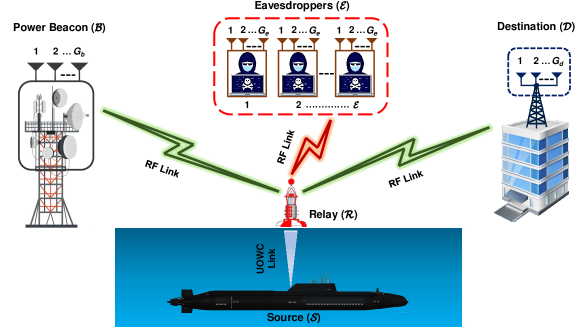
This work deals with the physical layer security performance of a dual-hop underwater optical communication (UOWC)-radio frequency (RF) network under the intruding attempts of multiple eavesdroppers via RF links. The intermediate decode and forward relay node between the underwater source and the destination transforms the optical signal into electrical form and re-transmits it to the destination node with the help of harvested energy by the relay from an integrated power beacon within the system. The source-to-relay link (UOWC) follows a mixture exponential generalized Gamma turbulence with pointing error impairments whereas all the remaining links (RF) undergo $κ-μ$ shadowed fading. With regards to the types of intruders, herein two scenarios are considered, i.e., colluding ( extit{Scenario-I}) and non-colluding ( extit{Scenario-II}) eavesdroppers and the analytical expressions of secure outage probability, probability of strictly positive secrecy capacity, and effective secrecy throughput are derived in closed form for each scenario. Furthermore, the impacts of UOWC and RF channel parameters as well as detection techniques on secrecy capacity are demonstrated, and following this a comparison between the two considered scenarios is demonstrated that reveals the collusion between the eavesdroppers imposes the most harmful threat on secrecy throughput but a better secrecy level can be attained adopting diversity at the destination and power beacon nodes along with heterodyne detection rather than intensity modulation and direct detection technique. Finally, all the derived expressions are corroborated via Monte Carlo simulations.
Motivation & Objective
- To evaluate the physical layer security performance of a dual-hop UOWC-RF network with an energy-harvesting decode-and-forward relay.
- To model and compare the impact of colluding versus non-colluding eavesdroppers on secrecy metrics in a mixed UOWC-RF environment.
- To investigate how channel parameters (e.g., fading severity, pointing errors) and detection techniques affect secrecy throughput and outage.
- To demonstrate that diversity at the destination and power beacon nodes, along with heterodyne detection, enhances secrecy performance.
Proposed method
- Models the source-to-relay link using a mixture exponential generalized Gamma distribution with pointing error impairments, representing UOWC fading.
- Models the relay-to-destination and relay-to-eavesdropper links using the κ-μ shadowed fading distribution, representing RF channels.
- Derives closed-form expressions for secrecy outage probability (SOP), probability of strictly positive secrecy capacity (SPSC), and effective secrecy throughput (EST) for both colluding (Scenario-I) and non-colluding (Scenario-II) eavesdropper cases.
- Uses statistical channel models and moment generating function (MGF)-based techniques to derive analytical expressions under imperfect channel state information.
- Validates all analytical results via Monte Carlo simulations across various channel conditions and system parameters.
- Compares the secrecy performance under different detection techniques (heterodyne vs. IM/DD) and system configurations (diversity, beacon power).
Experimental results
Research questions
- RQ1How does the secrecy outage probability vary under colluding versus non-colluding eavesdropper scenarios in a UOWC-RF mixed network with energy harvesting?
- RQ2What is the impact of UOWC turbulence and pointing errors on the probability of achieving strictly positive secrecy capacity?
- RQ3How do fading parameters (κ, μ, m) in the RF links affect the effective secrecy throughput?
- RQ4To what extent does heterodyne detection improve secrecy performance compared to intensity modulation and direct detection (IM/DD)?
- RQ5Can diversity combining at the destination and power beacon nodes mitigate the negative impact of eavesdropper collusion?
Key findings
- The colluding eavesdropper scenario results in significantly worse secrecy performance than the non-colluding case, with EST values being lower under collusion due to coordinated decoding.
- An increase in the κ and μ parameters of the relay-to-destination and relay-to-eavesdropper links improves the probability of strictly positive secrecy capacity (SPSC), indicating that higher fading severity enhances secrecy in the relay link.
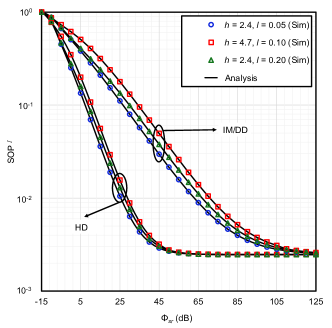
- Heterodyne detection achieves better effective secrecy throughput than IM/DD, especially under high pointing error and turbulence conditions.
- Increasing the energy conversion efficiency (ηr) of the relay significantly improves secrecy outage probability (SOP), demonstrating that higher harvested energy leads to more reliable transmission.
- Diversity combining at the destination and power beacon nodes substantially enhances secrecy performance, particularly in high-eavesdropping-attack scenarios.
- The system's secrecy performance is dominated by the worse hop, and the source-to-relay (UOWC) link is the most critical bottleneck due to turbulence and pointing errors.
Better researchstarts right now
From reading papers to final review, dramatically reduce your research time.
No credit card · Free plan available
This review was created by AI and reviewed by human editors.