
[Paper Review] SENSEI: First Direct-Detection Results on sub-GeV Dark Matter from SENSEI at SNOLAB
SENSEI reports first direct-detection results for sub-GeV dark matter using six Skipper-CCDs at SNOLAB, providing world-leading constraints on DM-electron scattering, Migdal-based DM-nucleus scattering, and dark-photon DM absorption, with 534.9 g-days exposure and detailed background-mitigation analyses.
We present the first results from a dark matter search using six Skipper-CCDs in the SENSEI detector operating at SNOLAB. We employ a bias-mitigation technique of hiding approximately 46% of our total data and aggressively mask images to remove backgrounds. Given a total exposure after masking of 100.72 gram-days from well-performing sensors, we observe 55 two-electron events, 4 three-electron events, and no events containing 4 to 10 electrons. The two-electron events are consistent with pileup from one-electron events. Among the 4 three-electron events, 2 appear in pixels that are likely impacted by detector defects, although not strongly enough to trigger our "hot-pixel" mask. We use these data to set world-leading constraints on sub-GeV dark matter interacting with electrons and nuclei.
Motivation & Objective
- Motivate searching for sub-GeV dark matter with sub-electron threshold detectors in an underground lab setting.
- Present the first results from SENSEI at SNOLAB with six Skipper-CCDs and 534.9 g-days exposure.
- Develop and apply a suite of background-reduction masks to isolate potential DM signals.
- Quantify limits on DM-electron scattering, Migdal-mediated DM-nucleus scattering, and dark-photon DM absorption using a likelihood framework.
Proposed method
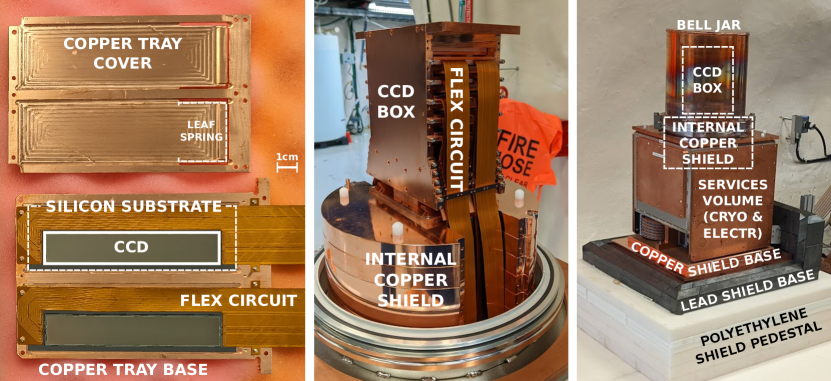
- Use six Skipper-CCD sensors with single-electron resolution to detect low-energy electron-hole pairs.
- Define thresholded charges per pixel and identify clusters as contiguous groups of nonzero pixels.
- Apply a multi-stage background-masking strategy (hot images, readout noise, bad pixels/columns, full-well events, low-energy cluster radius, cluster shape, horizontal clusters) to construct a clean data set.
- Model diffusion and mis-identification efficiencies to compute the effective exposure after masking.
- Estimate pileup backgrounds from 1 e- events and propagate uncertainties in exposure and background to the limit-setting procedure.
- Perform a likelihood-ratio test, incorporating known pileup backgrounds, to derive 90% C.L. limits on various DM interaction hypotheses.
Experimental results
Research questions
- RQ1What are the constraints on sub-GeV dark matter interacting with electrons in silicon with Skipper-CCD technology at SNOLAB?
- RQ2Can Migdal effect-based DM-nucleus scattering and dark-photon DM absorption be probed with the SENSEI SNOLAB data?
- RQ3How do background-mitigation strategies affect sensitivity to low-mass DM signals in Skipper-CCDs?
- RQ4What are the resulting 90% C.L. upper limits for DM-electron scattering with light/heavy mediators, DM-nucleon scattering via Migdal effect, and dark-photon absorption for the analyzed exposure?
- RQ5Are the observed low-energy 2e and 3e events compatible with expected backgrounds or hints of detector-specific effects?
Key findings
- Observed 55 events with 2 e- and 4 events with 3 e- after masking, consistent with pileup backgrounds for 2 e- and with detector effects for 3 e-.
- No events with 4–10 e-; 26-e- event observed but consistent with Compton background (one notable high-energy event).
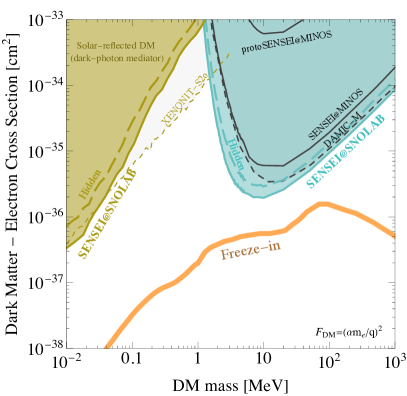
- Set world-leading 90% C.L. limits on halo DM-electron scattering for light and heavy mediators, on Migdal-based DM-nucleus scattering via the Migdal effect, and on dark-photon DM absorption, improving on previous SENSEI bounds in several mass/mediator regimes.
- Combined data yield tighter limits than prior results, e.g., maximum-likelihood 2e- rate: 8.57×10^-2 g^-1-day^-1 (hidden data) with 90% C.L. upper limit 3.25×10^-1 g^-1-day^-1; for 3e-: maximum-likelihood 6.85×10^-2 g^-1-day^-1 with 90% C.L. upper limit 1.49×10^-1 g^-1-day^-1.
- The analysis emphasizes background modeling, quadrant-based hot-image masking, and low-energy cluster masking to control systematics and isolate potential DM signals.
- Future runs with larger datasets and improved masking are expected to further enhance sensitivity to low-mass DM.
Better researchstarts right now
From paper design to paper writing, dramatically reduce your research time.
No credit card · Free plan available
This review was created by AI and reviewed by human editors.