
[Paper Review] Shallower radius valley around low-mass hosts: Evidence for icy planets, collisions or high-energy radiation scatter
This study analyzes 72 small exoplanets around low-mass stars using high-cadence Kepler light curves to refine planetary parameters and assess the radius valley's depth. It finds a shallower radius valley around low-mass hosts than predicted by photoevaporation models, suggesting additional mechanisms such as icy planet formation or collisional evolution are at play, with mass measurements needed to distinguish between them.
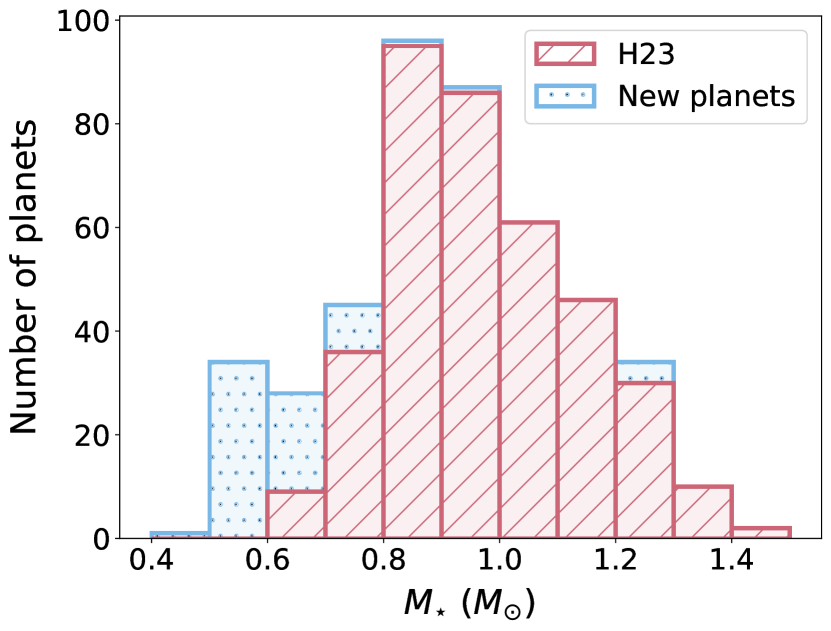
The radius valley, i.e., a dearth of planets with radii between 1.5 and 2 Earth radii, provides insights into planetary formation and evolution. Using homogenously revised planetary parameters from Kepler 1-minute short cadence light curves, we remodel transits of 72 small planets mostly orbiting low-mass stars, improving the precision and accuracy of planet parameters. By combining this sample with a similar sample of planets around higher-mass stars, we determine the depth of the radius valley as a function of stellar mass. We find that the radius valley is shallower for low-mass stars compared to their higher mass counterparts. Upon comparison, we find that theoretical models of photoevaporation under-predict the number of planets observed inside the radius valley for low-mass stars: with decreasing stellar mass, the predicted fraction of planets inside the valley remains approximately constant whereas the observed fraction increases. We argue that this provides evidence for the presence of icy planets around low-mass stars. Alternatively, planets orbiting low-mass stars undergo more frequent collisions and scatter in the stars' high-energy output may also cause planets to fill the valley. We predict that more precise mass measurements for planets orbiting low mass stars would be able to distinguish between these scenarios.
Motivation & Objective
- To improve the precision of planetary parameters for small planets orbiting low-mass stars using high-cadence Kepler light curves.
- To investigate how the depth of the radius valley—defined as a paucity of planets between 1.5 and 2 Earth radii—varies with stellar mass.
- To test whether standard photoevaporation models can explain the observed radius valley in low-mass star systems.
- To evaluate alternative mechanisms such as icy planet formation, planetary collisions, or XUV radiation scattering as explanations for the shallower valley.
- To identify observational constraints and future directions, particularly the need for precise mass and age measurements to distinguish between competing formation scenarios.
Proposed method
- Re-analyzed 72 transiting exoplanets around low-mass stars using Kepler 1-minute short cadence light curves to improve transit fitting accuracy.
- Applied hierarchical Bayesian modeling (Hamiltonian Monte Carlo) to derive posterior distributions for planetary radii and orbital parameters.
- Combined the refined sample with a similar dataset from Ho & Van Eylen (2023) to compare the depth of the radius valley across stellar mass bins.
- Quantified the observed fraction of planets inside the radius valley and compared it to predictions from photoevaporation models, including observational biases and dispersion in initial conditions.
- Estimated the expected envelope fraction assuming rocky cores to assess whether the observed population supports icy planets or collisional histories.
- Used the NASA Exoplanet Archive to supplement the sample and evaluate population-level trends in planetary composition and structure.
Experimental results
Research questions
- RQ1Does the depth of the radius valley vary systematically with host star mass, particularly for low-mass M-dwarfs?
- RQ2To what extent do theoretical photoevaporation models reproduce the observed fraction of planets inside the radius valley around low-mass stars?
- RQ3Is the observed shallowing of the radius valley around low-mass stars consistent with the presence of icy planets or planetary collisions?
- RQ4How do uncertainties in stellar age and planetary mass affect the interpretation of planetary composition and evolutionary pathways?
- RQ5Can future missions like TESS and PLATO help resolve the ambiguity between icy planet formation and collisional scenarios?
Key findings
- The radius valley is significantly shallower around low-mass stars compared to higher-mass FGK-type hosts, with the observed depth decreasing as stellar mass decreases.
- Photoevaporation models under-predict the number of planets inside the radius valley for low-mass stars: the observed fraction increases with decreasing stellar mass, while the model-predicted fraction remains approximately constant.
- The discrepancy between observations and photoevaporation models cannot be explained by observational biases or dispersion in initial conditions, indicating the need for additional physical mechanisms.
- The data are consistent with the presence of icy planets or increased collision frequency around low-mass stars, though neither scenario is uniquely favored by current population statistics.
- The lack of precise mass and age measurements for most planets limits the ability to definitively distinguish between icy planet formation and collisional evolution as the dominant cause of the shallow valley.
- Future high-precision mass measurements and improved age estimates—enabled by TESS and PLATO—will be critical to resolving the underlying formation mechanisms.
Better researchstarts right now
From reading papers to final review, dramatically reduce your research time.
No credit card · Free plan available
This review was created by AI and reviewed by human editors.