
[Paper Review] Should ChatGPT and Bard Share Revenue with Their Data Providers? A New Business Model for the AI Era
This paper proposes a novel revenue-sharing model where large AI models like ChatGPT and Bard share profits with their training data providers based on a prompt-based scoring system. Using text classification and similarity models to measure data engagement, the model enables fair, scalable revenue distribution, transforming adversarial data relationships into a collaborative, utilitarian AI ecosystem.
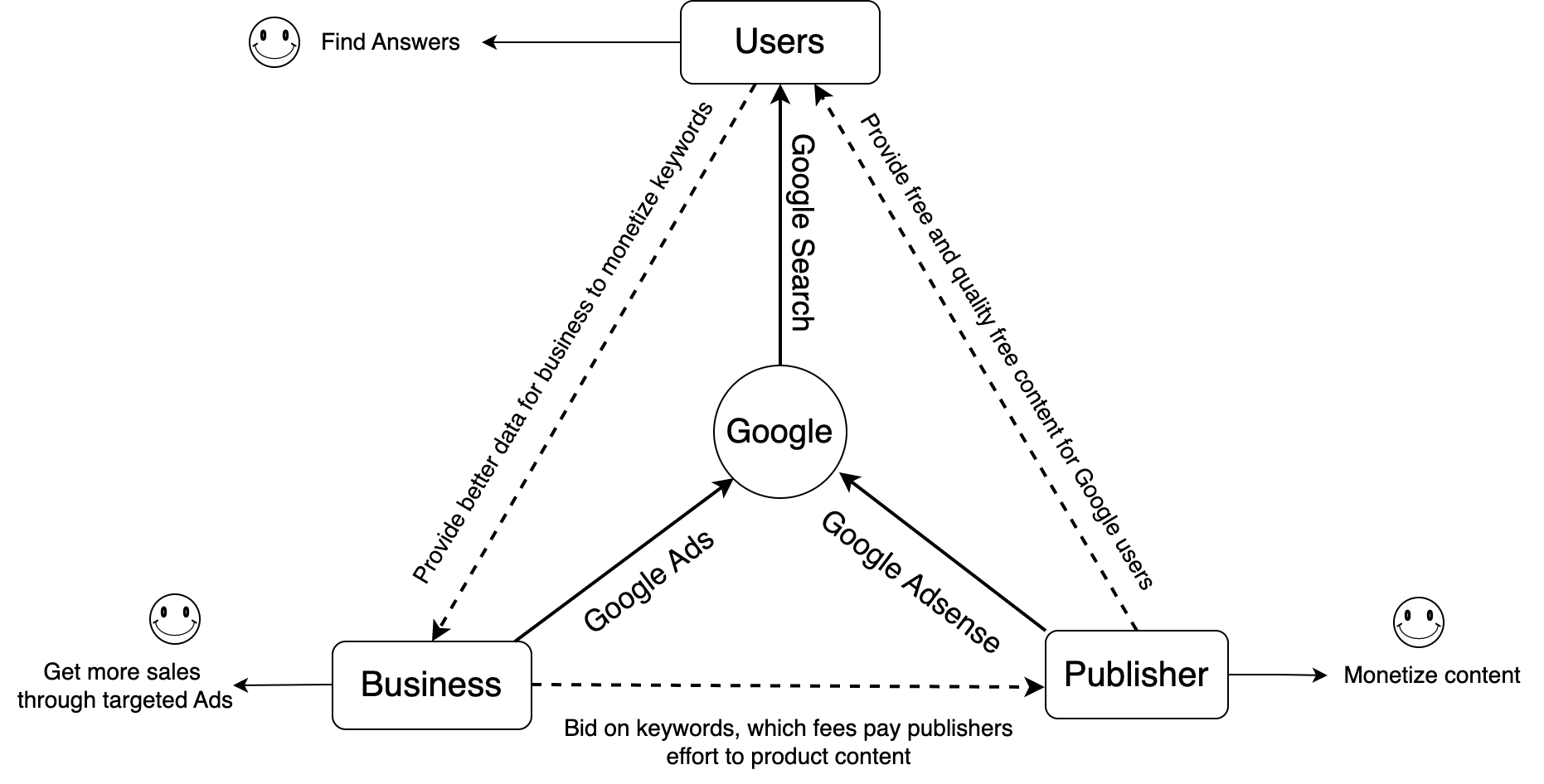
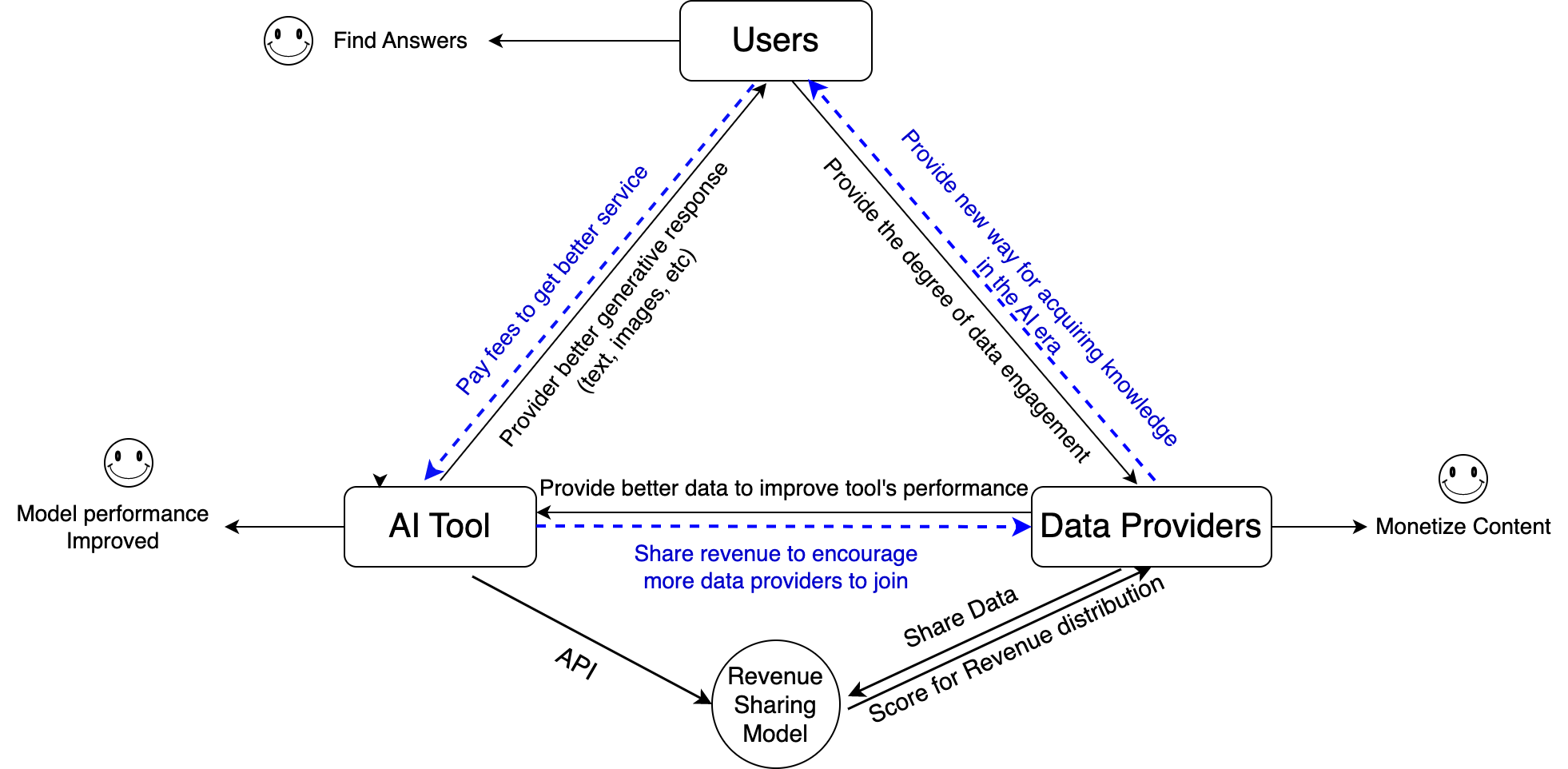
With various AI tools such as ChatGPT becoming increasingly popular, we are entering a true AI era. We can foresee that exceptional AI tools will soon reap considerable profits. A crucial question arise: should AI tools share revenue with their training data providers in additional to traditional stakeholders and shareholders? The answer is Yes. Large AI tools, such as large language models, always require more and better quality data to continuously improve, but current copyright laws limit their access to various types of data. Sharing revenue between AI tools and their data providers could transform the current hostile zero-sum game relationship between AI tools and a majority of copyrighted data owners into a collaborative and mutually beneficial one, which is necessary to facilitate the development of a virtuous cycle among AI tools, their users and data providers that drives forward AI technology and builds a healthy AI ecosystem. However, current revenue-sharing business models do not work for AI tools in the forthcoming AI era, since the most widely used metrics for website-based traffic and action, such as clicks, will be replaced by new metrics such as prompts and cost per prompt for generative AI tools. A completely new revenue-sharing business model, which must be almost independent of AI tools and be easily explained to data providers, needs to establish a prompt-based scoring system to measure data engagement of each data provider. This paper systematically discusses how to build such a scoring system for all data providers for AI tools based on classification and content similarity models, and outlines the requirements for AI tools or third parties to build it. Sharing revenue with data providers using such a scoring system would encourage more data owners to participate in the revenue-sharing program. This will be a utilitarian AI era where all parties benefit.
Motivation & Objective
- To address the ethical and economic imbalance in AI training by proposing that AI tools share revenue with data providers.
- To overcome the limitations of traditional revenue-sharing models, which rely on outdated metrics like clicks, in the context of generative AI.
- To design a scalable, technically feasible, and explainable scoring system that measures data provider engagement based on prompt interactions.
- To extend the model beyond large language models to other AI applications, including image generation and healthcare AI.
- To promote a virtuous cycle of innovation by aligning incentives across AI developers, users, and data providers.
Proposed method
- Develop a prompt-based scoring system that quantifies data engagement by measuring text similarity between user prompts/generations and training data from each provider.
- Use universal or model-specific text embedding techniques to convert documents into vectors for similarity computation.
- Apply supervised classification models to group data by provider, enabling scalable provider-level scoring.
- Calculate averaged text similarity scores across multiple prompts to generate a cumulative engagement score per data provider.
- Implement real-time scoring with optimized computational complexity to support production-scale AI systems.
- Extend the framework to multimodal AI by developing modality-specific scoring systems for images and other data types.
Experimental results
Research questions
- RQ1How can a fair and scalable revenue-sharing mechanism be designed for large language models that accounts for data provider contributions?
- RQ2What metrics and technical components are required to measure data engagement in generative AI systems, replacing traditional web traffic metrics?
- RQ3How can data providers be scored based on prompt interactions without relying on user-level tracking or centralized data storage?
- RQ4Can the same framework be adapted for non-LLM AI tools such as text-to-image generators and healthcare AI systems?
- RQ5What are the technical and economic feasibility constraints of implementing such a system at scale?
Key findings
- A prompt-based scoring system using text similarity and classification models can effectively measure data provider engagement in generative AI applications.
- The use of text embeddings enables quantification of data contribution even when training data sources are not fully disclosed.
- The proposed model supports real-time scoring and can be extended to multimodal data, including images and medical data.
- For image-based AI, a similar system can be built using image classification and similarity models, with individual artwork engagement scores.
- The framework allows for temporary scoring of data providers not yet in the training dataset, enabling early participation in revenue-sharing programs.
- The model is technically feasible and can be implemented using existing NLP and computer vision techniques, such as the Pile and LIOAN-5B datasets for benchmarking.
Better researchstarts right now
From reading papers to final review, dramatically reduce your research time.
No credit card · Free plan available
This review was created by AI and reviewed by human editors.