
[Paper Review] Simulation of ODMR Spectra from Nitrogen-Vacancy Ensembles in Diamond for Electric Field Sensing
This paper presents an open-source Python simulation tool for modeling optically detected magnetic resonance (ODMR) spectra in nitrogen-vacancy (NV) centers in diamond under arbitrary electric and magnetic fields. It enables accurate prediction of ODMR transition strengths and shot-noise-limited sensitivity, revealing that optimal electric field sensing requires careful alignment of the bias magnetic field and microwave polarization, and introduces a novel scheme for full vector electrometry without dynamic magnetic field reorientation, significantly reducing experimental complexity.
Solid state spins in diamond, in particular negatively charged nitrogen-vacancy centers (NV), are leading contenders in the field of quantum sensing. While addressing of single NVs offers nanoscale spatial resolution, many implementations benefit from using large ensembles to increase signal magnitude and therefore sensitivity. However, sensing with ensembles brings its own challenges given the random orientation of the spin quantization axis within the diamond crystal lattice. Here, we present an open source simulation tool that models the influence of arbitrary electric and magnetic fields on the electronic and nuclear spin states of NV ensembles, and can be extended to other color centers. Specifically, the code computes the transition strengths and predicts the sensitivity under shot-noise-limited optically-detected magnetic resonance. We illustrate the use of the code in the context of electric field sensing, a promising emerging functionality of NV centers with applications in biosensing and electronics, and bring several subtle features to light that are due to the interplay between different NV orientations and the external electric and microwave fields. Moreover, we show that our code can be used to optimize sensitivity in situations where usual arguments based on neglecting terms in the full Hamiltonian would give sub-optimal results. Finally, we propose a novel sensing scheme which allows to perform full vector electrometry without the need for precise bias magnetic field alignment, thus reducing the experimental complexity and speeding up the measurement procedure.
Motivation & Objective
- To develop a comprehensive, open-source simulation tool for modeling ODMR spectra in NV ensembles under arbitrary electric and magnetic fields.
- To enable accurate prediction of shot-noise-limited sensitivity in NV-based quantum sensors.
- To address the challenge of interpreting ODMR spectra in NV ensembles due to random NV orientations and environmental perturbations.
- To optimize sensing configurations where analytical approximations fail, particularly in electric field sensing.
- To propose a novel electrometry scheme that eliminates the need for dynamic bias magnetic field reorientation, reducing experimental complexity.
Proposed method
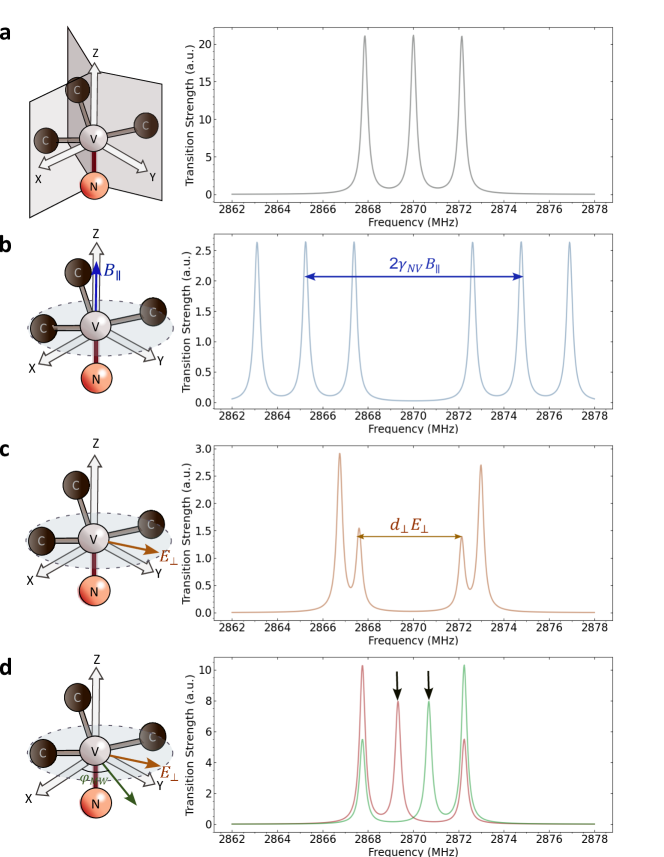
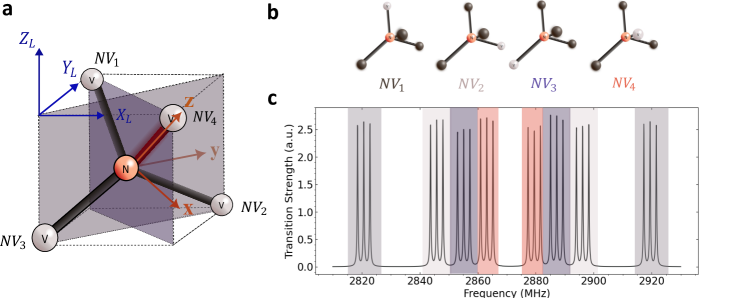
- The simulation computes the electronic energy levels and transition strengths of NV centers in 12C and 14N isotopic diamond, accounting for all four NV crystallographic orientations and NV/VN configurations.
- It models the full Hamiltonian including Zeeman, hyperfine, and Stark interactions under arbitrary external electric and magnetic fields.
- The code computes ODMR spectra for continuous-wave excitation, calculating transition amplitudes as a function of microwave frequency and polarization angle.
- Sensitivity is computed under shot-noise-limited conditions, with optimization over bias magnetic field magnitude and direction.
- The method enables simulation of both single NV and ensemble responses, with user-defined field directions and experimental parameters.
- The tool is extensible to other color centers and can be adapted for different diamond cuts (e.g., <111> surfaces) or isotopic compositions (e.g., 15N implantation).
Experimental results
Research questions
- RQ1How does the orientation of NV centers and the direction of the bias magnetic field affect the sensitivity of electric field sensing in NV ensembles?
- RQ2In what experimental configurations do standard analytical approximations for ODMR sensitivity break down, and how can numerical simulation improve optimization?
- RQ3Can full vector electrometry be achieved without dynamically reorienting the bias magnetic field, and if so, how?
- RQ4What is the impact of microwave polarization angle on ODMR transition amplitudes for different NV orientations, and how can this be exploited for sensing?
- RQ5How do experimental imperfections, such as misalignment of the bias magnetic field, degrade electric field sensing performance?
Key findings
- The simulation reveals that the sensitivity of electric field sensing strongly depends on the relative orientation between the bias magnetic field and the electric field, with optimal configurations requiring precise alignment that is not captured by simplified models.
- For NV centers oriented along <001>, the transition amplitude varies periodically with microwave polarization angle, and the phase offset allows unambiguous determination of the transverse electric field component in the NV frame.
- By choosing a bias magnetic field along the <011> direction, two NV orientations become simultaneously sensitive to transverse electric fields, enabling vector field reconstruction from a single measurement setup.
- The method achieves full vector electrometry without dynamic reorientation of the magnetic field, relying instead on electrically controlled microwave polarization rotation, which is faster and less complex.
- The simulation identifies regimes where standard analytical formulas for sensitivity fail, demonstrating that numerical optimization via the code yields significantly better performance than heuristic approaches.
- The code successfully predicts that the maximum transition amplitude for a given NV orientation occurs at a specific microwave polarization angle, which can be used to extract the direction of the transverse electric field with high precision.
Better researchstarts right now
From reading papers to final review, dramatically reduce your research time.
No credit card · Free plan available
This review was created by AI and reviewed by human editors.