
[Paper Review] Simultaneously Localize, Segment and Rank the Camouflaged Objects
The paper introduces a joint model that localizes discriminative regions, segments camouflaged objects, and ranks their level of camouflage, supported by a new CAM-FR dataset and a large testing set NC4K.
Camouflage is a key defence mechanism across species that is critical to survival. Common strategies for camouflage include background matching, imitating the color and pattern of the environment, and disruptive coloration, disguising body outlines [35]. Camouflaged object detection (COD) aims to segment camouflaged objects hiding in their surroundings. Existing COD models are built upon binary ground truth to segment the camouflaged objects without illustrating the level of camouflage. In this paper, we revisit this task and argue that explicitly modeling the conspicuousness of camouflaged objects against their particular backgrounds can not only lead to a better understanding about camouflage and evolution of animals, but also provide guidance to design more sophisticated camouflage techniques. Furthermore, we observe that it is some specific parts of the camouflaged objects that make them detectable by predators. With the above understanding about camouflaged objects, we present the first ranking based COD network (Rank-Net) to simultaneously localize, segment and rank camouflaged objects. The localization model is proposed to find the discriminative regions that make the camouflaged object obvious. The segmentation model segments the full scope of the camouflaged objects. And, the ranking model infers the detectability of different camouflaged objects. Moreover, we contribute a large COD testing set to evaluate the generalization ability of COD models. Experimental results show that our model achieves new state-of-the-art, leading to a more interpretable COD network.
Motivation & Objective
- Motivate modeling camouflage conspicuousness to better understand camouflage and evolution.
- Propose a ranking-based camouflaged object detection (COD) framework that localizes discriminative regions and segments camouflaged objects.
- Provide new datasets (CAM-FR and NC4K) to support localization, segmentation, and ranking tasks in COD.
- Develop a triplet-task learning model that integrates fixation-based localization, segmentation, and camouflage ranking.
- Demonstrate state-of-the-art performance and interpretability for COD through quantitative and qualitative results.
Proposed method
- Introduce camouflaged object ranking (COR) and camouflaged object localization (COL) as new tasks with corresponding annotations.
- Relabel existing COD datasets with eye-tracking based fixation maps and detection delays to produce CAM-FR, a dataset for localization and ranking.
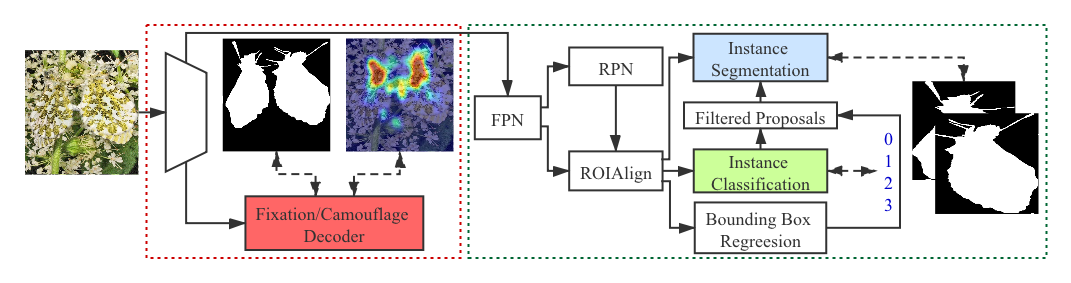
- Design a joint framework with a Fixation Decoder and a Camouflage Decoder to localize discriminative regions and segment camouflage using a backbone and dual residual attention (DRA) modules.
- Incorporate a reverse attention mechanism to guide segmentation from discriminative regions to full camouflage.
- Extend a Mask R-CNN–based pipeline to perform instance segmentation and ranking (camouflage level) with a ranking loss that can be adjusted by a similarity prior S_p to reflect progressive ranks.
Experimental results
Research questions
- RQ1Can camouflaged objects be effectively localized and segmented while also ranking their level of camouflage?”,“Does incorporating fixation-based discriminative region localization improve COD performance?”,“How well does a joint framework perform CAM-FR tasks compared to task-specific models?”,“What is the impact of a prior on rank-label similarity in ranking camouflaged instances?”],
- RQ2key_findings_1_6List0/
- RQ3
Key findings
- The proposed Ours model achieves competitive or superior results across COD benchmarks when trained on CAM-FR, including discrimination localization, camouflage detection, and ranking.
- Discriminative region localization yields reliable regions driving camouflage visibility, validated by fixation-based metrics.
- The ranking component (Ours_rank_new) outperforms several baselines (e.g., SOLOv2, MS-RCNN) in r_mae on ranking tasks.
- The integrated joint framework benefits discriminative region localization and CAM-based detection, with ablations showing improved performance when all three tasks are trained jointly.
- The authors provide a new large testing dataset NC4K (4,121 images) to assess generalization, alongside CAM-FR for training.
![Figure 3: Overview of the joint fixation and segmentation prediction network. The first part indicates the pipeline that the Fixation Decoder and Camouflage Decoder generates the corresponding maps. The second part is the structrue of the decoders, where “ASPP” is the denseaspp module [ 57 ] . The t](https://ar5iv.labs.arxiv.org/html/2103.04011/assets/figures/joint_fix_camo_overview.png)
Better researchstarts right now
From reading papers to final review, dramatically reduce your research time.
No credit card · Free plan available
This review was created by AI and reviewed by human editors.