
[Paper Review] Simultaneously probing the sound speed and equation of state of the early Universe with pulsar timing arrays
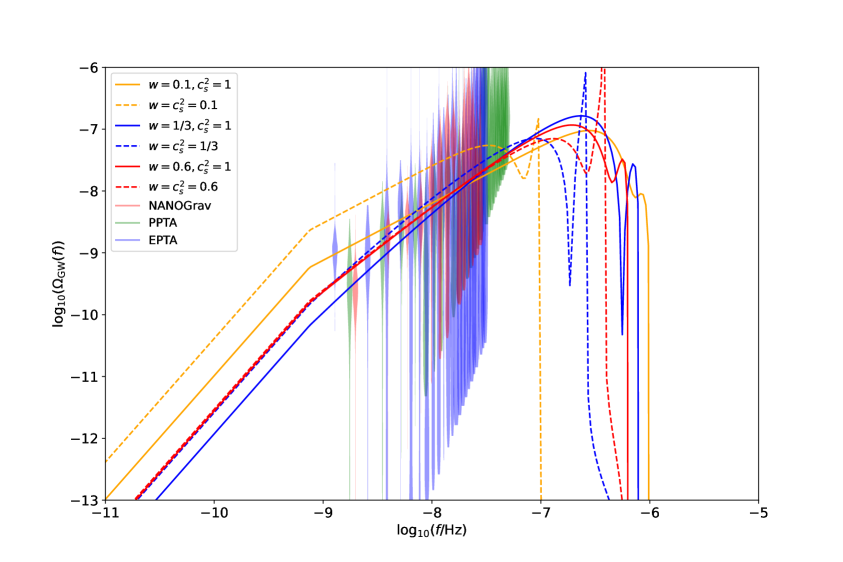
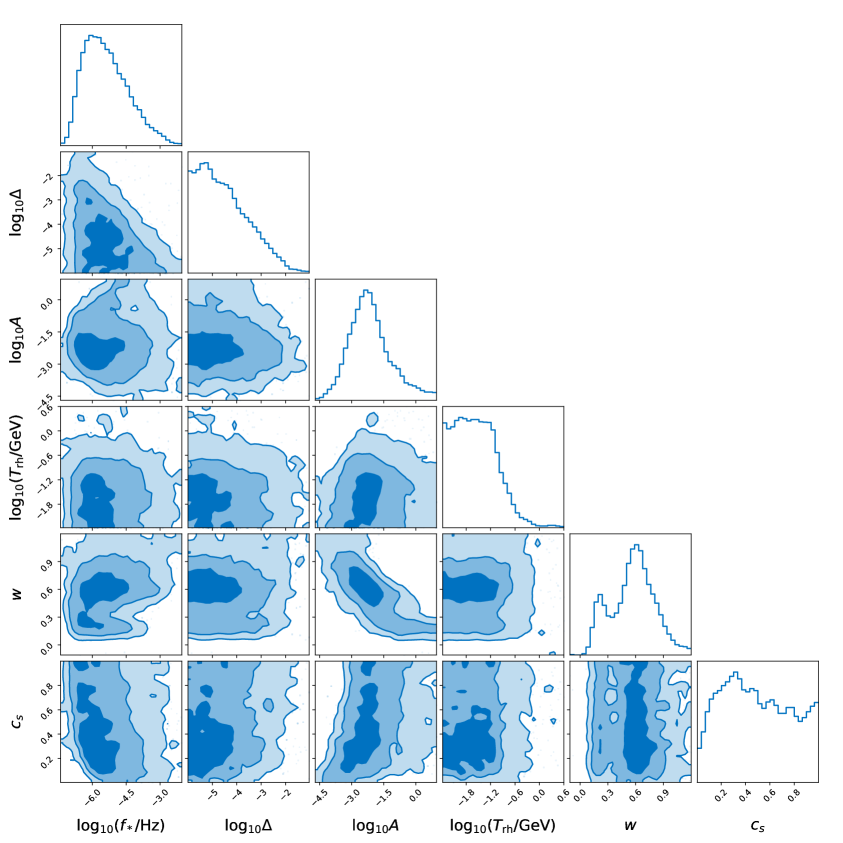
This paper uses pulsar timing array (PTA) data from NANOGrav, PPTA, and EPTA to simultaneously constrain the equation of state (w) and sound speed (cₛ) of the early Universe, assuming the detected nanohertz gravitational wave background arises from scalar-induced gravitational waves. It finds w = 0.60⁺⁰.³²₋₀.³⁹, cₛ ≳ 0.09, and T_rh ≲ 0.2 GeV, favoring a non-radiation-dominated early universe and excluding a pressureless fluid model.
Recently, several major pulsar timing array (PTA) collaborations have assembled strong evidence for the existence of a gravitational-wave background at frequencies around the nanohertz regime. Assuming that the PTA signal is attributed to scalar-induced gravitational waves, we jointly employ the PTA data from the NANOGrav 15-year data set, PPTA DR3, and EPTA DR2 to probe the conditions of the early Universe. Specifically, we explore the equation of state parameter ($w$), the reheating temperature ($T_\mathrm{rh}$), and the sound speed ($c_s$), finding $w = 0.59^{+0.36}_{-0.40}$ (median + $90\%$ credible interval), and $T_\mathrm{rh}\lesssim 0.2\,\mathrm{GeV}$ at the $95\%$ credible interval for a lognormal power spectrum of the curvature perturbation. Furthermore, we compute Bayes factors to compare different models against the power-law spectrum model, effectively excluding the pressure-less fluid domination model. Our study underscores the significance of scalar-induced gravitational waves as a powerful tool to explore the nature of the early Universe.
Motivation & Objective
- To simultaneously constrain the equation of state (w) and sound speed (cₛ) of the early Universe using gravitational wave data.
- To test whether the observed pulsar timing array (PTA) signal originates from scalar-induced gravitational waves (SIGWs) rather than astrophysical sources.
- To evaluate competing cosmological models against the standard radiation-dominated scenario (w = 1/3, cₛ² = 1/3) using Bayesian model comparison.
- To explore the implications of SIGWs for primordial black hole (PBH) formation and reheating temperature (T_rh).
- To assess the viability of non-standard early Universe models with arbitrary w and cₛ using multi-instrument PTA datasets.
Proposed method
- Employs a lognormal power spectrum for curvature perturbations to model primordial density fluctuations.
- Calculates the energy density of scalar-induced gravitational waves (SIGWs) in a universe with general w and cₛ using second-order perturbation theory.
- Applies Bayesian inference with the nested sampling tool dynesty to analyze PTA data from NANOGrav 15-year, PPTA DR3, and EPTA DR2.
- Computes Bayes factors to compare models with different w and cₛ against the radiation-dominated reference model (w = 1/3, cₛ² = 1/3).
- Incorporates constraints on primordial black hole (PBH) production from large curvature perturbations to further refine the parameter space.
- Uses the BILBY Bayesian inference library to perform full posterior sampling and model comparison on the joint PTA dataset.
Experimental results
Research questions
- RQ1What are the joint constraints on the equation of state (w) and sound speed (cₛ) of the early Universe from PTA observations?
- RQ2Does the observed PTA signal favor a scalar-induced gravitational wave (SIGW) origin over astrophysical sources like supermassive black hole binaries?
- RQ3How do the inferred values of w and cₛ compare to the standard radiation-dominated model (w = 1/3, cₛ² = 1/3)?
- RQ4Can the data exclude a pressureless fluid model (w = 0) or a model with cₛ² = 1?
- RQ5What are the implications for the reheating temperature (T_rh) and primordial black hole (PBH) formation under the best-fit SIGW scenario?
Key findings
- The analysis finds w = 0.60⁺⁰.³²₋₀.³⁹ at 68% credible interval, indicating a departure from radiation-dominated conditions.
- The sound speed is constrained to cₛ ≳ 0.09, suggesting a non-ideal fluid behavior in the early Universe.
- The reheating temperature is estimated to be T_rh ≲ 0.2 GeV, consistent with low-scale reheating scenarios.
- The model with w = 1/3 and cₛ² = 1/3 (radiation domination) is excluded by Bayes factors, favoring alternative early Universe dynamics.
- The pressureless fluid model (w = 0) is effectively ruled out by the data, as it yields significantly lower evidence.
- The results support the scalar-induced gravitational wave scenario as a viable explanation for the PTA signal, with strong Bayesian evidence favoring it over competing models.
Better researchstarts right now
From reading papers to final review, dramatically reduce your research time.
No credit card · Free plan available
This review was created by AI and reviewed by human editors.